
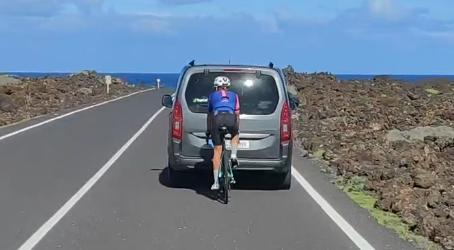
A video showing a cyclist drafting closely behind a hire car in the Canary Islands has sparked anger on social media, but not in the way you might expect.
Local blogger Jose Miguel Arraez Guadalupe uploaded a 40-second video to Facebook and Instagram showing a driver and cyclist travelling along the LZ-1, a major road on the island connecting several tourist attractions.
Arraez Guadalupe introduced his video with the words “suicides around the world”, and many social media users expressed their concern for the cyclist’s safety if the car in front had to brake. Other commenters chose to explain and justify the process of drafting behind a car and why a cyclist would do it.
The cyclist’s extremely close proximity to the back of the Citroen Berlingo van is not explicitly illegal. Spanish traffic regulations dictate, like in the UK, that cyclist must comply with the same rules as vehicle users. In addition, English-language outlet Canarian Weekly reports that “cyclists must normally ride on the hard shoulder to their right and may only leave it during descents if conditions are considered safe. Failure to comply can result in fines of up to €200.” Cyclists are also permitted to ride two abreast, “as close as possible to the right-hand side of the road”.
Yesterday, we reported on the British club cyclists training on Tenerife who were close-passed when riding single-file by accelerating motorcyclists despite maintaining a position on the right-hand side of the lane.
What also came from the upload was a flurry of comments complaining about the overtourism that is disturbing the livelihoods of locals. The comments appeared to be motivated by a hire car sticker that could be spotted in the van’s rear windscreen, coupled with the relatively slower speed of the cyclist compared to the other road traffic.
“I am sorry to say I’m almost certain this is some foreigner who is training, the problem is that they think they have the right to do this in our country, do you think in their country they would? Of course not,” wrote one resident.
Another added “The thing about cyclists on this island is worth studying, hopefully soon they will be charged a traffic tax since they own the island’s roads.”
And finally, “I feel sorry for cyclists but they are a real pain and the island is not adapted to them. They do what they want and then comes the whining and ruin the lives of others for not having a little respect on the roads.”
Cyclists and respect on the road is a well-worn ‘debate’ that no one wants to constantly relitigate. But overtourism is a growing political topic in Spain, and particularly acute in the Canary Islands. Between 20,000 and 50,000 people joined protests in 2024 calling for visitor numbers to be frozen, sparking similar protests in several major cities including Barcelona, Madrid and San Sebastian.
The Islands have become a popular year-round destination for cyclo-tourists due to their year-round warmer temperatures and the diversity of terrain. The Teide volcano on Tenerife is also a popular site for professional cyclists to base themselves for altitude training for weeks at a time, particularly during the spring and early summer in preparation for Grand Tours. Winter training camps are meanwhile often held on the mainland around Calpe, Alicante on the Spanish east coast, taking advantage of cheaper hotel prices out of peak season.
And the Canary Islands aren’t the only Spanish islands to be ‘struggling’ with cyclotourists. Locals in Mallorca were up in arms last March after complaining that the closed roads for the Mallorca 312 sportive made the island into a “theme park”. It turns out cycling holidays are not a holiday from some of the dangers of road cycling we might find at home.