
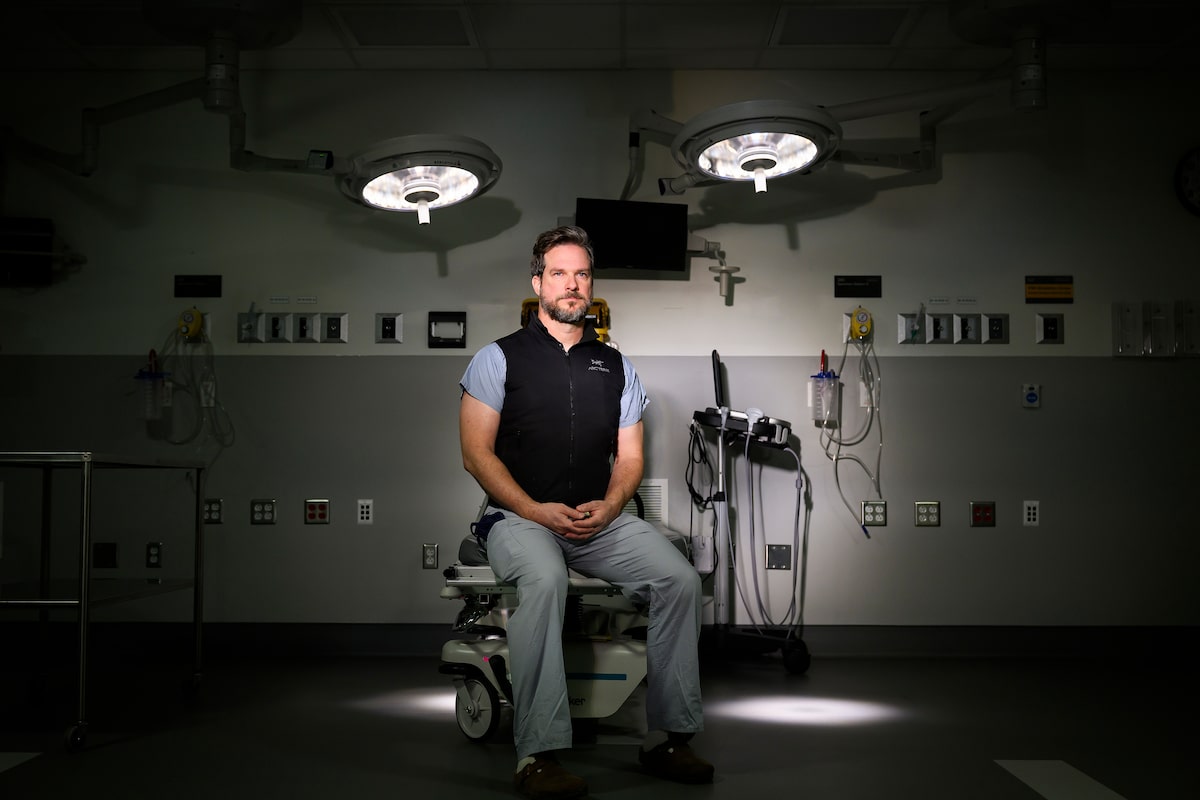
Trauma surgeon Harvey Hawes was particularly stressed during the exercise because the health care system in B.C., which he represented, couldn’t take in patients owing to a lack of available planes and pilots to get them there.Jennifer Gauthier/The Globe and Mail
The team of experts seated around a massive square table at Toronto’s St. Michael’s Hospital have critical decisions to make, and they don’t have much time.
There are hundreds of casualties arriving by boat and plane from somewhere in Eastern Europe, each of them suffering from various injuries, including burns and shrapnel wounds. The patients include injured soldiers from Canada and its allies, civilians and prisoners of war.
Questions are swirling around the table. Will all of the patients land at Pearson International Airport? Which health authority will oversee their care? How many hospital beds are available, and where are they?
As they scramble to deal with those issues, a new problem emerges: A cyberattack has knocked out operations at Pearson for a week, forcing them to find other ways to connect patients with critical health care infrastructure in Toronto.
The scenario was part of a war game in which 79 participants, including health care workers, Armed Forces members and government officials, recently gathered to plot out how Canada’s health care system might respond to a conflict abroad that could see an influx of patients sent to this country for treatment. The goal was to identify the weaknesses in Canada’s civilian health care system if it were forced to respond to a major military conflict overseas, as it did during the First and Second World Wars.

From point of injury to recovery in Canada
This graphic depicts the strategic evacuation journey casualties could follow. For the purposes of Exercise Canada Paratus, participants focused solely on the movement of patients from European care facilities and evacuation hubs away from the site of the conflict, to Canada, and then onward within the Canadian health care system.
Within the scope of Canada Exercise Paratus
Overseas
large-scale
combat zone
Role 3 care, limited Role 4 care
ROLE 1: Medical support at unit level or below. First aid and immediate life-saving measures
ROLE 2: Medical support at formation level.Triage, resuscitation and emergency surgery
ROLE 3: Medical support at brigade level and above. Specialist diagnosis and surgeries
ROLE 4: Medical support in country of origin. Special surgeries, procedures and reconstruction
john sopinski/the globe and mail, Source: university of toronto
dalla lana school of health

From point of injury to recovery in Canada
This graphic depicts the strategic evacuation journey casualties could follow. For the purposes of Exercise Canada Paratus, participants focused solely on the movement of patients from European care facilities and evacuation hubs away from the site of the conflict, to Canada, and then onward within the Canadian health care system.
Within the scope of Canada Exercise Paratus
Overseas
large-scale
combat zone
Role 3 care, limited Role 4 care
ROLE 1: Medical support at unit level or below. First aid and immediate life-saving measures
ROLE 2: Medical support at formation level.Triage, resuscitation and emergency surgery
ROLE 3: Medical support at brigade level and above. Specialist diagnosis and surgeries
ROLE 4: Medical support in country of origin. Special surgeries, procedures and reconstruction
john sopinski/the globe and mail, Source: university of toronto
dalla lana school of health

From point of injury to recovery in Canada
This graphic depicts the strategic evacuation journey casualties could follow. For the purposes of Exercise Canada Paratus, participants focused solely on the movement of patients from European care facilities and evacuation hubs away from the site of the conflict, to Canada, and then onward within the Canadian health care system.
Within the scope of Canada Exercise Paratus
Overseas
large-scale
combat zone
Role 3 care, limited
Role 4 care
ROLE 1: Medical support at unit level or below. First aid and immediate life-saving measures
ROLE 2: Medical support at formation level.
Triage, resuscitation and emergency surgery
ROLE 3: Medical support at brigade level and above. Specialist diagnosis and surgeries
ROLE 4: Medical support in country of origin.
Special surgeries, procedures and reconstruction
john sopinski/the globe and mail, Source: university of toronto dalla lana school of health
During the exercise, one of the participants, Harvey Hawes, was particularly stressed because the health care system in British Columbia, which he represented, couldn’t take in patients owing to a lack of available planes and pilots to get them there.
“We were basically watching Toronto, Halifax and sometimes even Manitoba just get pummelled with patients, and we had nothing we could do,” Dr. Hawes, an entrepreneur and trauma surgeon based in Vancouver, recalled in an interview.
“It was this feeling of helplessness.”
Exercise Canada Paratus was held in September with participants in Toronto and dialling in virtually from across the country. It was the second health care-related war game staged at St. Michael’s, after a smaller-scale exercise about a year earlier that focused more narrowly on Ontario’s health care system.
It also happened amid growing concerns about the risk of global conflict and warnings about an increasingly destabilized world. In the months since the exercise, for example, the United States attacked Venezuela and captured its President, while U.S. President Donald Trump has demanded control of Greenland.
The Globe and Mail reported on Tuesday that the Canadian military has modelled how the country might respond to an American invasion from the south. While such an invasion is considered unlikely, it’s believed to be the first time in a century that the military considered the possibility of an attack from Canada’s closest ally.
Andrew Beckett, trauma medical director for Unity Health, lieutenant-colonel with the Canadian Forces Health Services and a co-director of Paratus, said the war games at St. Michael’s were prompted partly by Russia’s invasion of Ukraine in 2022, and the large number of casualties there.
Exclusive: Military models Canadian response to hypothetical American invasion
The exercise imaged a large-scale conflict breaking out around the Russia-Belarus border and considered what might happen here. Dr. Beckett said Paratus did not examine the prospect of a conflict in Canada.
He said the issues examined during the exercise are problems Canada hasn’t had to think about for roughly 80 years, but they cannot be ignored.
“We thought we would never have to do this again, so on the military side, we closed a lot of the health care infrastructure that we did have. There’s not a single military hospital bed in the country now,” he said.
The directors of Paratus, which included officials from the University of Toronto, Unity Health, the Canadian Institute for Military and Veteran Health Research, the Canadian Armed Forces, Canada Company and Health Canada, produced a report detailing the challenges identified during the exercise. The report identified an array of gaps, from not having enough skin to treat burn victims to no protocol for treating captured persons, as well as a lack of cohesion between Canada’s civilian and military health care systems.
The report included dozens of recommendations to better equip Canada’s health care system for the possibility of war, including having an agency composed of government at the federal, provincial and territorial levels dedicated to dealing with such crises, and having clear contingency plans in place for operations such as airlifting patients to Canada.

Below is an example of a casualty card for an evacuee
Combatant or
Non-combatant
Qualitative casualty information
Weeks needed
in psych ward
Weeks needed
in rehabilitation
Weeks needed
in a burn unit
Battle injury, non-
battle injury, death
JOHN SOPINSKI/the globe and mail, Source: canada company

Below is an example of a casualty card for an evacuee
Combatant or
Non-combatant
Qualitative casualty information
Weeks needed
in psych ward
Weeks needed
in rehabilitation
Weeks needed
in a burn unit
Battle injury, non-
battle injury, death
JOHN SOPINSKI/the globe and mail, Source: canada company

Below is an example of a casualty card for an evacuee
Combatant or
Non-combatant
Qualitative
casualty
information
Weeks needed
in psych ward
Weeks needed
in rehabilitation
Weeks needed
in a burn unit
Battle injury, non-
battle injury, death
JOHN SOPINSKI/the globe and mail, Source: canada company
Major-General Scott Malcolm, a participant and the surgeon-general of the Canadian Armed Forces, said health care in Canada is complex. Including the provinces, territories and military health care system, there’s a total of 14 organizational bodies that need to be in sync to deal with a situation of this scale.
“Even as a member in uniform, I hope that this planning isn’t required. But not to plan would be folly,” he said.
To the country’s European allies, planning for war is merely a fact of life, Maj.-Gen. Malcolm said. Thus, Canada must be able to reinforce that perspective and should not be seen as unknowing or unprepared, he added.
“Canadians need to have this introduced to them in a way that is tangible and understandable,” he said. “Not one that’s meant to frighten, but one that’s meant to have them ask the important questions.”
Exercise Canada Paratus was held over two days and considered a scenario in which Canada is intaking and treating about 100 casualties a week from overseas, where the country is engaged in large-scale combat, and where 10 per cent of its civilian health care work force is deployed. In the scenario, patients were triaged at the site of the conflict and then transported to Canada to be treated and recover in a more secure location.
Editorial: In the age of Trump, it’s time to think about the unthinkable
As the exercise unfolded, participants had to factor new complications into their plans, such as a cyberattack, a local wildfire that increased civilian patients or the spread of a multidrug-resistant infection.
Tabletop exercises are commonly used by the military, Maj.-Gen. Malcolm said, and are typically carried out using tools such as maps and spreadsheets.
Adalsteinn Brown, co-director of the exercise and dean of the Dalla Lana School of Public Health, said Paratus included five rounds, each of which were meant to simulate a week’s worth of work.
“It’s a false simplification of the problem,” he said. ”Large-scale combat operations, generally, are not five weeks long. But it gives us at least a stress test of how we get into the conflict.”
Anthony Robb, director of operations at Canada Company, a charity that supports Armed Forces members and their families, helped facilitate and design the war game. He said decisions such as how many casualties Canada could expect to receive a week were based on NATO estimates.
Opinion: We need to prepare for the possibility that the U.S. uses military coercion against Canada
Canada might seem like a far destination for casualties injured abroad, but he said the changing nature of warfare means it could make sense for the country to intake large numbers of patients.
Traditionally, Mr. Robb said, casualties would be treated at the scene and then transferred to facilities nearby. However, he explained, health care facilities have been targeted in recent conflicts, and the increasing use of autonomous or unmanned weapons, such as drones, spreads the threat over a larger area. That’s why Canada could be considered a safer place for casualties to rest and recover, he said.
The postexercise report listed close to 50 recommendations, including increasing civilian-military health care collaboration, exploring the use of Forces reserves to support the health care sector, developing a casualty-tracking system, reinstating a national trauma registry and scouting airlift or sealift options to evacuate casualties.
The recommendations also call for building up a domestic supply chain for blood, skin and prosthetics, including setting up more skin banks. Canada sources most of its skin, which would be needed to treat burn victims, from the U.S., but those supplies could be strained if Canada and the U.S. are involved in the same conflict.
Maj.-Gen. Malcolm said in a written statement that the Department of National Defence and the Forces will consider Paratus’s recommendations as part of a longer-term effort to improve how Canada’s civilian and military health care systems interact.
Ukraine willing to share drone and military technology with Canada, envoy says
He added that the Canadian Forces Health Services often faces challenges securing necessary personnel or financial resources, but that reform to its programs is under way to better meet the needs of members serving at home and abroad.
Health Canada did not respond to requests for comments about the report’s recommendations in time for publication.
Dr. Brown said many of the recommendations will only be possible if Canada can co-ordinate a national response that isn’t hampered by its siloed provincial and territorial systems.
“There’s a lot of co-ordination on this that just isn’t required outside of a crisis,” he said.
Should Canada find itself at war, Dr. Hawes, the B.C. doctor, said he would anticipate being part of the civilian work force expected to step up to the plate.
“I’m still on the fence about whether I’d be best served here trying to keep the civilian system afloat and integrate with the military, or whether I’m best served there trying to defend ourselves against an enemy,” he said.
Dr. Hawes also said he left the exercise surprised at just how vulnerable the country’s health care system could be, in particular to threats such as cyberattacks. He was unnerved to see how quickly critical infrastructure such as hospitals and airports, and their access to power and water, could be shut down.
“We can talk all we want about accepting all these patients and stressing the health care system,” he said, “but they suggested, in reality, all the infrastructure would just be wiped out.”