
The third time was the harm.
In Houston last Friday, one of the greatest shooters in NBA history, Kevin Durant, erupted for a season-high 39 points, and with Anthony Edwards still nursing an infected toe in street clothes on the bench, the Minnesota Timberwolves lacked a superstar counter in their hard-fought, five-point loss to the Rockets.
In San Antonio less than 24 hours later, Ant was back in action but the Wolves defensive bulwark Rudy Gobert was sidelined with a bum hip — not ideal with the Spurs’ seven-and-a-half-foot praying mantis Victor Wembanyama itching to avenge his team’s two previous losses to Minnesota this season. The game was a spectacular heartbreak, as the Wolves erased a 25-point halftime deficit, and even led briefly due to Ant’s career-high 55-point flamethrowing, 26 of them in the fourth quarter alone. But with Wembanyama matching Durant’s 39-point barrage from the previous evening and preying on would-be shooters from above on defense, the Spurs gutted out a thrilling three-point victory.
Related: Is 2026 the Year of the Wolves?
Two competitive losses on the road to opponents vying with the Wolves for homecourt advantage in the playoffs served to bruise but not break the skin on the notion that the team had locked into its better nature after the calendar has flipped over to 2026.
But that nature was not nurtured in Salt Lake City on Tuesday. Instead, the Wolves resurrected their inner truant in a stubbornly embarrassing loss to the Utah Jazz.
Unlike the Rockets and the Spurs, the Jazz have no intention of competing for a postseason berth. Veteran Wolves fans will find Utah’s current dysfunction familiar: After missing the playoffs the past three seasons, there remain enough holes on their roster to cherish upcoming draft picks. Unless they lose often enough to be eligible for one of the top eight slots in the draft lottery, they will lose the pick to the defending champion Oklahoma City Thunder.
Not coincidentally, their best player, Lauri Markkanen, has already missed eleven of the team’s first 44 games this season, including the last five with an “illness.” It’s a solid strategy if you’re tanking to save your lottery pick: Utah was 0-10 without Markkanen headed into Tuesday night.
They also had played Wembanyama and the Spurs in San Antonio the night before, on Monday, hurrying back to Salt Lake City for the tail end of their back-to-back on the schedule. Ironically, the Wolves last game was also in San Antonio — on Saturday — and had plenty of rest awaiting Utah’s return home to play them.
Having besmirched their mojo at least a little with two straight losses in Texas, Minnesota had every incentive to get back on track by thrashing an inferior team that had a rest disadvantage and a strategic need to sabotage their present to bolster their future.
Timberwolves flex their dominance
Nah, too easy. Better to play cat-and-mouse with this cupcake-caliber foe, flex your dominance and then let it get close again to renew your interest in the outcome.
The Wolves flexed at the beginning of each half. They were up 21-10 in the first five minutes of the opening quarter, pouncing on the careless passing and porous defense of the Jazz, who are dead-last in the NBA in points allowed per possession, at a rate (122.2 points yielded per 100 possessions) that makes their collective opponents more potent on offense this season than any individual team has been overall (Denver leads at 121.5 points scored per 100 possessions).
Utah came back to tie it with five minutes remaining in the half, and led by a point at halftime, 59-58. In the television interview with a Wolves assistant coach just before play resumes in the third quarter, Kevin Hanson described what everyone had just seen about his team: “Looks like they thought it was going to be an easy night.”
And so they flexed again: For a seven-minute stretch that lasted until there was just 18 seconds left in the third quarter, the Wolves went on a 28-11 run that established their lead at 96-82.
Then their defense began to sleepwalk, awakening only after Utah had regained the lead. The first shot the Jazz missed from the field in the fourth quarter occurred very close to the halfway mark, with 6:34 left in the game. Until then, Utah nailed ten straight shots to go up 107-106.
The Wolves played notably harder after that, but just dessert was now already on the menu and the Jazz cooked them enough to emerge with a highly improbable 127-122 triumph.
Utah outscored the Wolves 43-26 in that final quarter, making 14-of-17 shots from two-point range and another 3-of-8 from behind the three-point arc. Minnesota finished the period shooting 6-of-15 from two-point territory and 3-of-15 from distance.
An NBA season is an arduous trek — 82 games from October through April — and there are inevitably stints in every team’s journey that feel like plummets from nirvana to a nadir and onward like the bouncing ball that defines the game. It was just last week that my column bore the headline: “Is 2026 the Year of the Wolves?” The team had won six of seven with a stylistic flair that upped the pace, thrived in the clutch and featured more connectivity and focus.
That’s why the thud back to underachievement carried a special reverberation on Tuesday night. Every team has its doldrums but the Wolves have an annoying knack for procrastinating on quality teamwork by randomly opting out of the kind of sweat equity and alert decision-making required to be a serious basketball team.
It would surprise most people to know that their record against opponents with a losing record is a robust 17-4 because there have been another handful (or more) times when they have done just enough to get by. And that bad habit may be why, in games that pit the top eight teams in the Western Conference against each other, they have the worst record of the bunch at 4-10. (Hat tip to John Schuhmann of nba.com for that stat.)
Of course it is reductive to say that the Wolves weakness is one of attitude more than talent. For one thing, the majority of this roster has been tenacious and resourceful enough to reach the conference finals two years running. For another, they continue to play at a top-ten level on both sides of the ball — although the defensive rating has fallen to 10th as the offensive rating is steady at sixth.
But most of all, you can’t cleave attitude and talent in two. Chemistry is mixture, not silos.
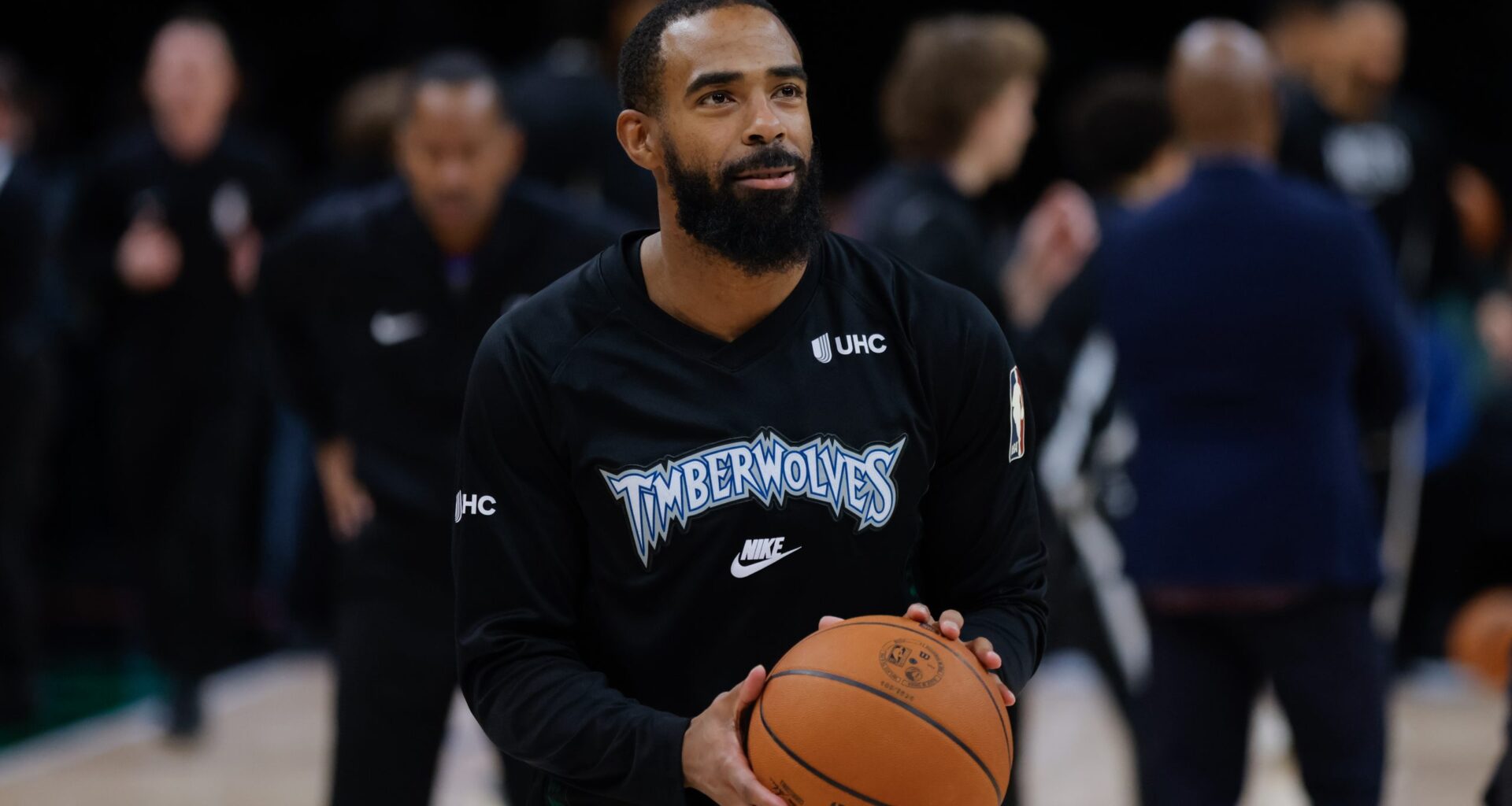
The venerable Mike Conley
The prime example of this right now is the uncertain presence of Mike Conley on behalf of another title run that he fervently hopes will crown what has been a sterling career.
The arrival of Conley at the trading deadline in February 2023 had an enormous impact in transforming the Wolves into a serious contender, the likes of which the Wolves hadn’t seen since the prime of Kevin Garnett. First off, the addition-by-subtraction of losing D’Angelo Russell lessened the locker room strife that was often generated by the discordant relationship between D’lo and Rudy Gobert. But Conley was more than just the anti-D’lo. He was a sage in the locker room and on the court, infusing poise into his team’s identity to a degree that had never been felt within the franchise. I’ve written plenty of paeans about him and there isn’t enough room to repeat them now.
No, the point right now is that the inevitable liabilities of Conley’s aging have become sizable enough to erode a lot of the inimitable value he brings to the ballclub. On offense, opponents can close out on his three-pointer with impunity, knowing that his once-reliable floater is now a relic rather than a weapon. On defense, his court IQ compensates for some of the quickness he’s lost and he remains at least average, and perhaps better, as a chase defender. But he’s more easily screened, or, more often, simply bulldozed by larger, younger, more athletic matchups, which are not hard for a foe to find.
Conley’s words are impressive, inspiring, and contain elite advice and analysis about the game — ask anyone who has ever played with him. But for a long time, his actions on the court were even more influential. The sad truth now is that he cannot lead by example as effectively as he once did because he is not capable of executing everything he knows.
This has become increasingly obvious as the season has progressed. I don’t believe it is a coincidence that the closest Conley has come to vintage form this season is in late December when Finch impulsively brought him in off the bench in Milwaukee after he’d been out nearly two weeks, and four games, with a nagging injury.
There he was: The orchestrator who hastened tempo even as he meticulously arranged and organized spacing and quick decision-making. The offense was mired in static ineptitude when he first entered and for most of that rotation he was on move before he even made the catch, the handle pure, the vision expansive, the intent loudly propulsive. On defense he chased down Gary Trent Jr. in transition from half-court and stripped him of the ball just before the layup. He slipped screens and timed traps for maximum effect.
Second half, same thing. He finished with six points, six assists, five rebounds, two blocks and a steal in 23:54 (six seconds short of exactly half the game). During his time on the court, the Wolves were +16 in a 3-point victory. He was able to dramatize his innate instructions on how to play hoops with your body on the go and your head calmly on straight, able to teach using nearly all of his physical vocabulary.
Those games are too few and far between this season. To be fair to Conley, the acquisition of Julius Randle and the evolution of Anthony Edwards has deprived him of his decades-long role as the primary floor general. Too frequently, he has been reduced to a catch-and-shoot combo guard, his hands off the levers of the half-court sets and improvisations.
But it is also true that Conley’s stamina has declined as well as his athleticism. His three-pointer has begun to clank more often, much as the floater steadily diminished last season. In terms of hard numbers, the Wolves score 114.2 points per 100 possessions when Conley is on the court compared to 117.5 points overall, and allow 113.8 points per 100 possessions when he plays versus 112.9 points allowed overall. Add it up and his net rating — points the team scores minus points the team allows — is +0.4, the lowest of any of the top eight players in the rotation.
Many of the virtues are still notable. Conley is among the league leaders with an assist-to-turnover ratio of 4.87. He makes 88 percent of his free throws. But after consistently making more than 40% of his treys with the Wolves, he now makes approximately one-third of his shots from inside or outside the arc (33.9% from distance, 34.2% overall). Even with exception accuracy at the line, he has the lowest true shooting percentage on the roster aside from Rob Dillingham.
On Tuesday in Utah, Conley was strikingly ineffective. He missed all three shots taken (two of them treys) and had one rebound, two assists and a steal in 15:36 of play. But it was the way Utah’s larger guards bullied him off the dribble, getting to the basket at will, that stood out and accounted for the team being -5 when he was on the court.
Nevertheless, Chris Finch opted to play him over Bones Hyland, who was limited to a measly 4:24 of action. Bones currently has the best net rating of anyone in the regular eight-player rotation — and pushes his teammates to the Wolves’ quickest pace.
But Bones Hyland cannot organize and “smarten up” his teammates better than Conley — nobody on the roster can. And on Tuesday in Utah, the Wolves needed an instructor who compelled them to focus as well as someone who could provide an educated jolt. Conley excels at the former — but the example he sets in the rough-and-tumble is a shadow of what it used to be.
As for the trade deadline, what Conley continues to do really well is an extremely precious commodity that is unlikely to be upgraded through a deal. It is poignant that his peers are folks like Chris Paul, unceremoniously dropped by the Clippers this season.
Before Dillingham’s rookie year, I asked Finch about his expectations. The coach replied he figured Dillingham would play really well one game, really poorly one game and sort of meh one game. I think the best way to use Conley moving forward is through a similar lens: When he is on, milk it all you can. When he is way off, deploy a quick hook. On the meh games, utilize according to prevailing situations and matchups.
That may seem disrespectful to Conley, a class act if there ever was one, but it also feels like the best way to try and provide him with a ring, the absent piece in a nonpareil career. However it pans out, I will continue to cherish the glimpses and gumption of vintage Mike Conley, teaching from the twilight and digging down to practice what he preaches.
Related