
‘When elements of the system are misaligned, even compliant producers and recyclers can’t prevent problems like we’re seeing now,’ says official
What is happening with used tires in Brechin and, more importantly, across the province?
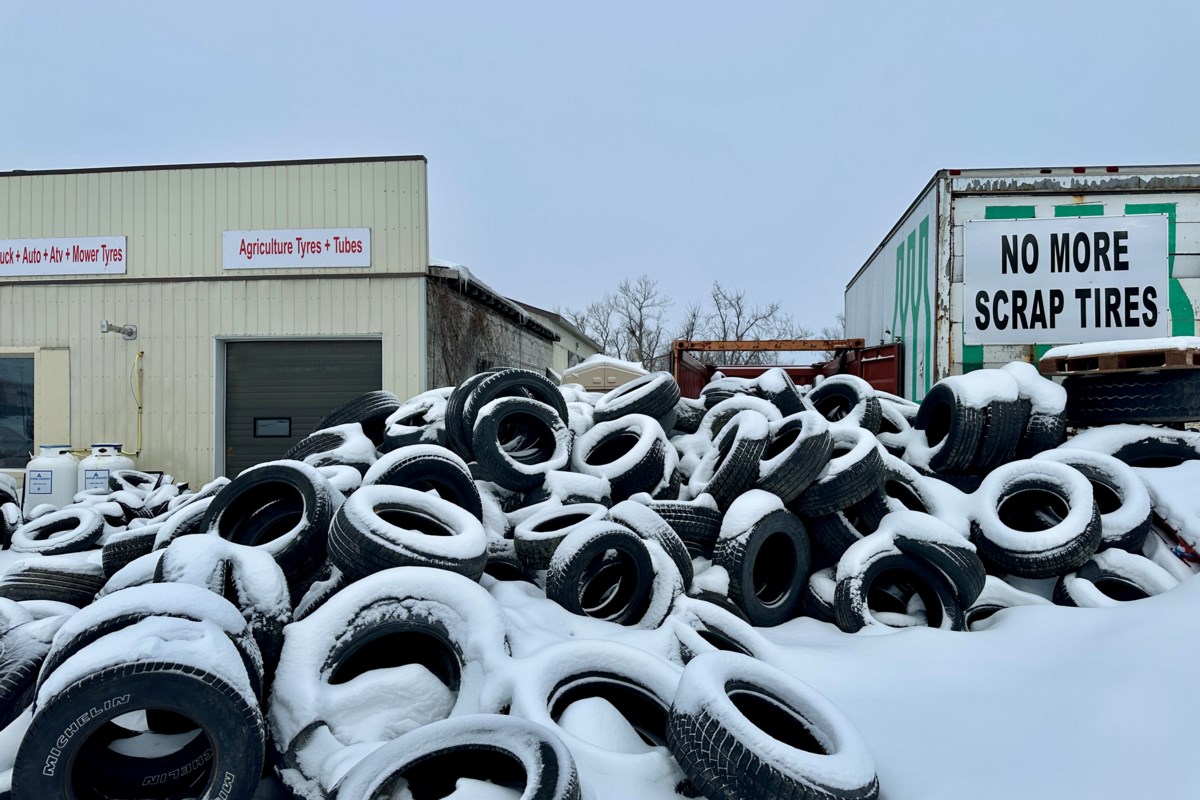
Mike’s Autobody and Tyre on Highway 12 in Ramara has begun to overflow with used tires to the point it cannot accept any more until they are picked up.
Business owner Michael O’Donnell says it was once customary for the tires to be picked up every 10 weeks. He hasn’t received a pickup since November.
Additionally, haulers don’t take the whole pile. Small trucks are manually loaded and only a partial amount of the used tires taken for recycling, he explained.
Last year, his business — a tire collection site registered with eTracks — was informed more than once of delayed tire collections.
“The sad part is that people are paying (a fee) when they buy tires and not getting the value,” O’Donnell said about the environmental handling fee charged with new tires to cover recycling costs.
Businesses across Ontario are experiencing the backlog.
In December 2024, the provincial government reduced tire recycling targets by 20 per cent. It dropped from 85 to 65 per cent.
The Ministry of the Environment, Conservation and Parks (MECP) sets the targets. Overseeing what the provincial government sets in place, the Resource Productivity and Recovery Authority (RPRA) enforces the tire regulation.
It appears the government is allowing only 65 per cent of the service customers pay for with the environmental handling fee to be delivered, but the RPRA is not involved.
“Information about how much tire producers are charging and how they’re using those fees can be obtained directly from tire producers. Any concerns about the fairness of those fees should be directed to Consumer Protection Ontario,” said Wilson Lee, chief of programs and public affairs for the RPRA.
Convoluted as it sounds, the question starts with collection sites like Mike’s Autobody and ends with the provincial government. Who is taking responsibility for the backlog?
Adam Moffat, executive director of the Ontario Tire Dealers Association, and representatives of numerous other organizations wrote a joint letter to the MECP calling attention to the crisis.
Since the province implemented the extended producer responsibility framework — starting with tires in 2019 — it falls on producers to manage the whole life of the tire, from production to recycling.
Producers hire producer responsibility organizations (PROs) to manage the recycling of materials they produce and meet collection targets.
As the only not-for-profit tire PRO in the province, eTracks represents 70 per cent of tire recycling in Ontario, said Melissa Carlaw, vice-president of communications and sustainability with eTracks.
The problem, suggested Carlaw, is with Ontario’s regulations.
PROs have no incentive to continue collecting used tires once their quotas are met, even though consumers pay for tires to be recycled.
Average pickup schedules vary depending on the location and size of the site.
Further complicating the matter, collection sites experiencing excess may call other haulers or PROs, making it difficult to know how often they require services.
Carlaw said this happened often in 2025.
Through a data system, eTracks views the interactions between haulers and collection sites, but it is not the main point of contact, she explained.
Understanding the difficulties with the backlog, last year, eTracks continued to pick up used tires across the province beyond its targets.
“We exceeded our required collection target by roughly 20 per cent. That’s around two million additional tires that were not left in the environment,” said Carlaw.
Although eTracks has notified the appropriate authorities of limitations, Carlaw expects similar issues in 2026. As a not-for-profit organization in the competitive market, eTracks cannot handle the backlog for the entire province.
“Effective tire recycling isn’t just about individual producer companies doing the right thing. When elements of the system are misaligned, even compliant producers and recyclers can’t prevent problems like we’re seeing now,” she said.
For eTracks, tires are “valuable resources that can and should be repurposed beyond their first life.”
Left in the environment, they present various health and safety risks, most notably the well-known fire hazard.
Carlaw said the rates at which used tires need to be collected are fairly predictable.
Lacking planning and direction from the government, eTracks cannot continue to fund the excess tire collections, she stressed.
“There needs to be a co-ordinated mechanism in place to ensure the system is working going forward,” she said.
Gary Wheeler, spokesperson for the MECP, said the “ministry is working with the RPRA, who oversees the Ontario producer responsibility framework, to address these disruptions to the collection and processing of end-of-life tires.”