
Ancient giant kangaroos from the Pleistocene era may have been capable of hopping, just like their modern relatives—according to a new study published in Scientific Reports. The research, conducted by teams from the University of Manchester, University of Bristol, and University of Melbourne, challenges decades-old assumptions about how these colossal marsupials moved across prehistoric Australia.
Reimagining The Movement Of The Giant Kangaroo
For years, scientists believed that Procoptodon goliah, the largest known kangaroo species—standing over 2 meters tall and weighing up to 250 kilograms, was too massive to hop. The prevailing theory suggested that such immense weight would have snapped their Achilles tendons, forcing them to walk upright, in a gait that might have resembled a slow, human-like stride.
The new study overturns that view by analyzing limb bones from 63 species of kangaroos and wallabies, both living and extinct. By comparing fossilized skeletons to modern examples, researchers reconstructed the anatomy of these giant animals in fine detail. They measured tendon attachment points, heel bones, and metatarsals, finding strong indications that the prehistoric kangaroos had the anatomical capacity for hopping.
The team’s calculations show that the ancient kangaroos had tendon structures capable of absorbing the stress caused by hopping motion. This means their legs were not only powerful but also resilient enough to withstand the enormous forces generated by such movement. The results suggest that hopping was physically possible—even if it was not their preferred method of travel.
What The Study Reveals About Prehistoric Mobility
The study, published in Scientific Reports, paints a more dynamic picture of Pleistocene megafauna than previously imagined. Instead of lumbering across open plains, these kangaroos likely used a combination of walking and short bursts of hopping to navigate their environment.
“While hopping may not have been their primary mode of locomotion, our findings suggest that it may have formed part of a broader locomotor repertoire, for example, for short bursts of speed,” the researchers write.
This insight reshapes how paleontologists interpret fossil trackways and body mechanics of other extinct species. It implies that large-bodied marsupials were more versatile and adaptive than once believed, capable of switching between different gaits depending on terrain or threat level. The idea that these creatures could “walk like a furry T. rex” while still being able to hop when needed adds a surprising layer to our understanding of their biology.
Moreover, the findings challenge a long-standing assumption in biomechanics—that body mass strictly limits hopping ability. The research suggests that evolution may have optimized certain tendon and bone structures to distribute stress more efficiently, allowing larger species to perform movements previously thought impossible.
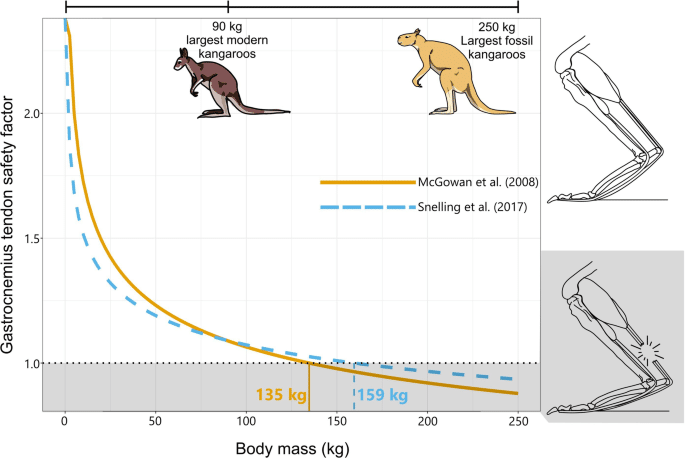 Illustration of previous studies’ results suggesting a size limit of 135–160 kg for hopping in giant kangaroos, based on the scaling patterns of the gastrocnemius tendon safety factor among modern kangaroos. Both curves (Solid10; Dashed11) are based only on data from modern kangaroos. Safety factors below one indicate tendon rupture. Labelled vertical lines indicate the mass at which each allometric curve predicts safety factor to drop below one. Illustrations by MJ. Hindlimb image based on10,25,59.
The Kangaroo’s Evolutionary Edge
The Pleistocene epoch, which ended roughly 11,700 years ago, hosted a range of outsized Australian animals, from massive wombats to giant flightless birds. Within this ecosystem, Procoptodon goliah stood out as a dominant herbivore. Its ability to hop, even in short bursts, could have provided a crucial advantage.
Being able to rapidly accelerate or leap over rough terrain would have helped these creatures evade predators or cross obstacles in the arid landscapes of prehistoric Australia. This locomotor versatility may have also influenced their feeding strategies, allowing them to exploit distant or scattered vegetation.
While their ultimate extinction remains linked to environmental changes and human hunting pressures, this new research reframes the evolutionary capabilities that once allowed them to thrive. The study’s insights emphasize how biomechanics, anatomy, and ecology intertwine to shape the survival potential of large terrestrial animals.