
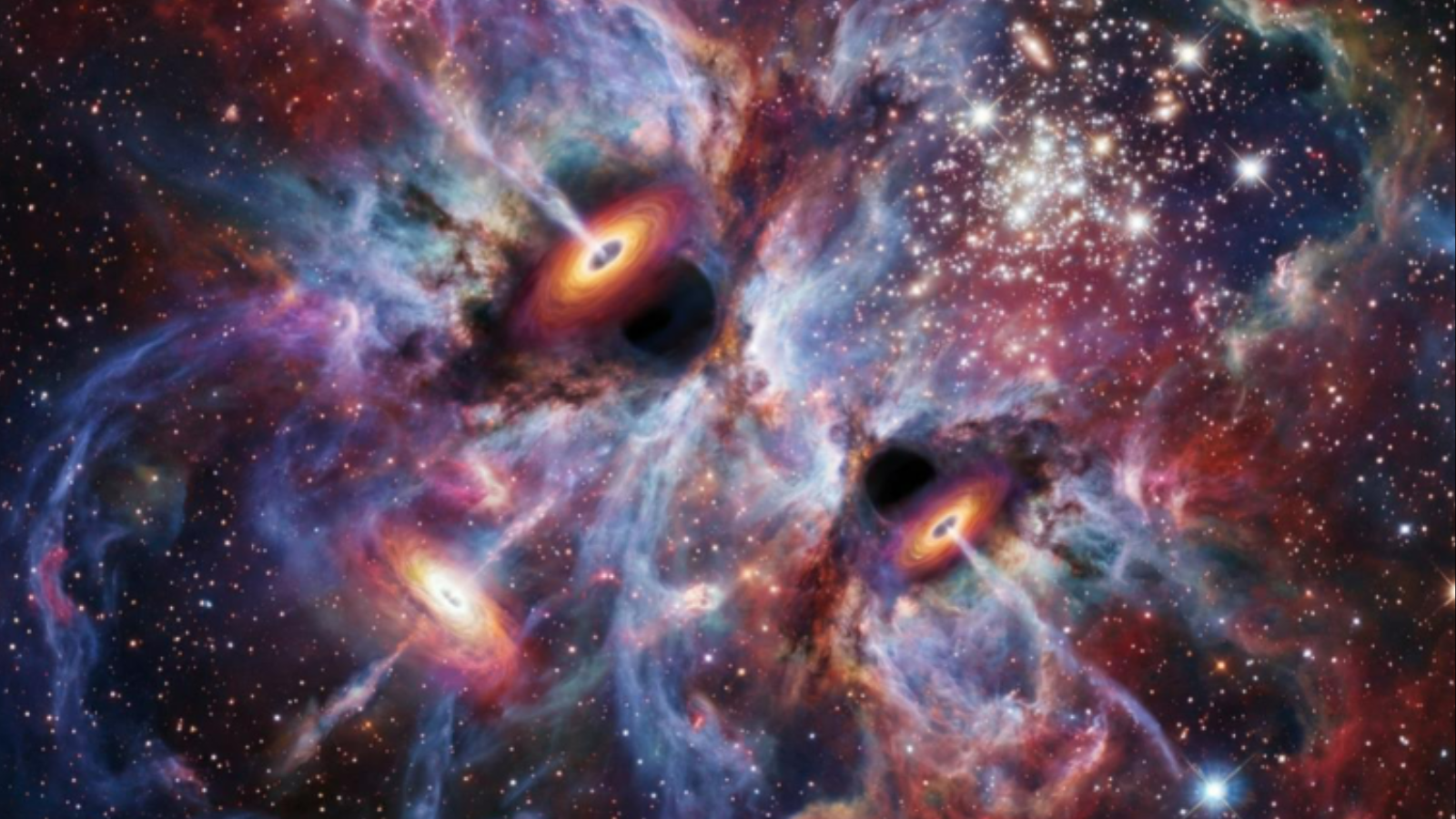
Scientists may have solved a cosmic mystery that has been troubling them since the James Webb Space Telescope (JWST) began observations back in 2022.
When astronomers started looking back into the early days of the universe with the cutting-edge observatory, they discovered supermassive black holes that appear to have formed prior to the universe being 1 billion years old, something our current models of the cosmos can’t explain But a new study has found that a black hole “feeding frenzy” may explain how these cosmic monsters were born so early in the universe’s history.
“We found that the chaotic conditions that existed in the early universe triggered early, smaller black holes to grow into the super-massive black holes we see later, following a feeding frenzy which devoured material all around them,” research leader Daxal Mehta of Maynooth University said in a statement. “We revealed, using state-of-the-art computer simulations, that the first generation of black holes – those born just a few hundred million years after the Big Bang grew incredibly fast, into tens of thousands of times the size of our sun.”
You may like
Performing complex computer simulations, this team of researchers found that the turbulent and dense-gas-rich conditions in the first galaxies may have allowed black holes to enter into brief phases of mega-gluttony, exceeding a barrier known as the “Eddington limit.” This limit determines how much material can fall to a body like a star or black hole before the radiation generated by that accretion pushes further matter away, emptying the central object’s larder of gas and dust, thus cutting off its food supply.
Periods of super-consumption that defy this limit are known as “super-Eddington accretion” and serve as the missing link between black holes that form when massive stars die in supernova explosions and monstrous supermassive black holes.
Supermassive black holes with masses millions or even billions of times that of the sun sit at the heart of all large galaxies in the modern 13.8 billion-year-old universe, which isn’t troubling to explain at all, as they have had plenty of time to grow.
The issue is the discovery of supermassive black holes as early as 500 million years after the Big Bang, a population that the JWST has routinely been uncovering for the last three and a half years. That is because the merger and feeding processes that are thought to allow black holes to achieve supermassive status are thought to take at least 1 billion years.
“It’s like seeing a family walking down the street, and they have two six-foot teenagers, but they also have with them a six-foot-tall toddler,” research team member and Maynooth University scientist John Regan previously told Space.com. “That’s a bit of a problem. How did the toddler get so tall? And it’s the same for supermassive black holes in the universe. How did they get so massive so quickly?”
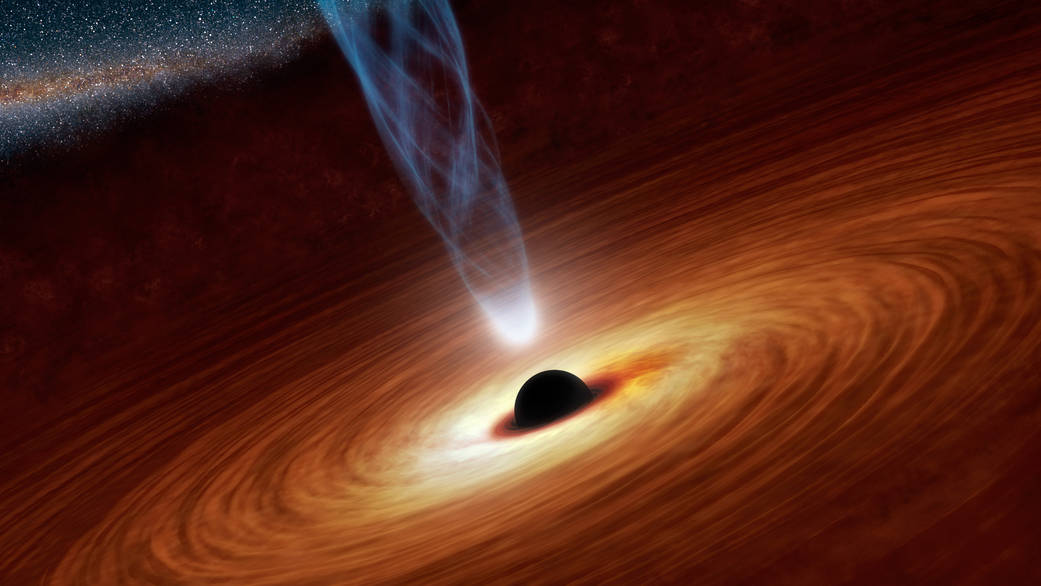
Artist’s illustration of a supermassive black hole emitting a jet of energetic particles. (Image credit: NASA/JPL-Caltech)
The team’s simulations suggest that a super-Eddington feeding frenzy could have allowed the first generation of black holes to gorge on the dense gas of the early cosmos to reach masses of tens of thousands of times that of the sun. While that doesn’t get us to supermassive black holes, it provides a significant head start on the merger process that would see black holes of increasing size collide and fuse together to birth an even more massive black hole.
“These tiny black holes were previously thought to be too small to grow into the behemoth black holes observed at the center of early galaxies,” Mehta said. “What we have shown here is that these early black holes, while small, are capable of growing spectacularly fast, given the right conditions.”
You may like
The team’s research could help scientists determine whether early supermassive black holes started out as “light seeds,” with ten to a few hundred times the mass of our sun, or as “heavy seeds,” with as much as 100,000 times the mass of the sun. Previously, it had been theorized that only heavy seeds would be massive enough to facilitate the rapid growth of supermassive black holes.
“Now we’re not so sure,” Regan said. “Heavy seeds are somewhat more exotic and may need rare conditions to form. Our simulations show that your ‘garden variety’ stellar mass black holes can grow at extreme rates in the early universe.”
The team’s research doesn’t just suggest a new avenue for supermassive black hole growth, but it also shows how important high-resolution simulations are in our investigation of the early cosmos.
“The early universe is much more chaotic and turbulent than we expected, with a much larger population of massive black holes than we anticipated, too,” Regan said.
As for collecting evidence of this theory, that may be a job not for the JWST or any other traditional astronomical device, but for instruments designed to detect the tiny ripples in space known as gravitational waves that mergers such as this radiate. Of particular importance could be the first space-based gravitational wave detector, the Laser Interferometer Space Antenna (LISA), a joint European Space Agency/ NASA mission set to launch in 2035.
“Future gravitational wave observations from that mission may be able to detect the mergers of these tiny, early, rapidly growing baby black holes,” Regan concluded.
The team’s research was published on Wednesday (Jan. 21) in the journal Nature Astronomy.