
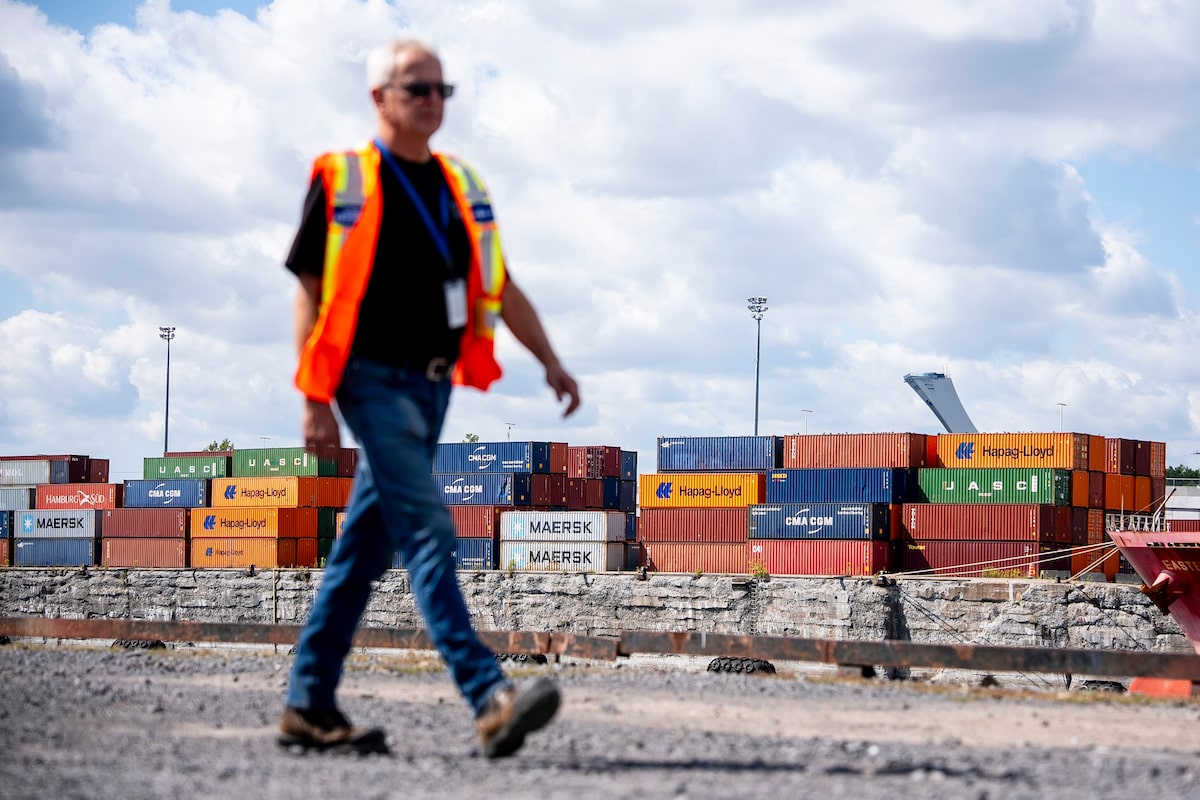
Shipping containers in the Port of Montreal, September, 2025. Container traffic rose 3.6 per cent as the port moved 1.51 million 20-foot equivalent units – an industry measure representing a standard shipping box – while shipments of bulk cargo fell, hurt by droughts in Western Canada.Christopher Katsarov/The Canadian Press
The Port of Montreal saw an increase in container shipping volumes last year, a signal that Canada’s efforts to cement overseas trade relationships and find export markets beyond the United States are yielding early results.
Container traffic rose 3.6 per cent as the port moved 1.51 million 20-foot equivalent units – an industry measure representing a standard shipping box – while shipments of bulk cargo fell, hurt by droughts in Western Canada. Over all, the port handled 34.3 million tonnes of merchandise in 2025, a 3-per-cent decline from the year before.
“We had prepared for a more significant downturn” as U.S. protectionism and uncertainty over tariffs bit into business activity, Montreal Port Authority chief executive Julie Gascon said in an interview this week. “Diversification has mitigated the effect on the country’s economy, which is reflected in container volumes. … All of those strategies to diversify our markets are working.”
Trump’s Greenland threats give boost to Churchill port expansion
Europe is the main trading hub for users of the port, and it is home to four of Montreal’s five biggest two-way trade partners in 2025, according to preliminary annual data that port officials shared with The Globe and Mail. Germany topped the group, supplanting India.
The Port of Montreal also logged a 44-per-cent jump in trade with Morocco, a major fruit producer, and high-double-digit growth in trade with other African countries such as Ivory Coast, which is the world’s biggest supplier of cocoa beans. Trade with South America climbed 12 per cent, suggesting a wider pivot away from U.S. products, according to port officials.
President Donald Trump has upended decades of trade ties between Canada and the United States by imposing import tariffs on aluminum, steel and other products and calling on this country to become the 51st state. Prime Minister Mark Carney is trying to forge new ties in response, telling a gathering of business and political leaders in Davos this week that his government has signed roughly a dozen trade and security deals on four continents in the past six months.
Mr. Carney has pledged to double Canada’s non-U.S. exports in the next decade and expand its ports system. Much of his government’s early focus has been on strengthening bonds with the European Union, including joining European defence procurement plans.
More tariffs, more problems: 12 charts to watch in Year 2 of the trade war
For her part, Ms. Gascon is working to position the Port of Montreal and the St. Lawrence River corridor to become, as she calls it, “an instrument” of that mass diversification. She faces several challenges, however, including scaling up operations and minimizing labour disruption that could see clients turn to rival harbours.
“The world is completely reshaping itself,” Ms. Gascon said, adding there’s a new spotlight on ocean shipping that will put pressure on existing marine-port infrastructure. “We need to be prepared for the long run.”
While the port beat expectations for 2025, demand could be shaky this year as tariffs force businesses to rethink their strategies and hunt for new customers. Montreal generally maintains a balance of import and export volumes.
“As 2026 begins, we see a world increasingly focused on protecting domestic industries and addressing perceived trade imbalances,” Ben Hackett, founder of maritime consultancy Hackett Associates, said in a statement earlier this month.
Ms. Gascon urged the federal government to develop a coherent port and maritime strategy, which she said would be essential to guide investment, leverage trade between provinces and access international markets. Meanwhile, her own immediate focus is expanding the port’s cargo operations with plans for a new terminal in Contrecoeur, located about 40 kilometres downstream from Montreal.
Ottawa has labelled the $2.3-billion project a national priority and mandated the Major Projects Office to help piece together the remaining financing. The port authority has tapped global logistics giant DP World Ltd. to build Contrecoeur’s land-based operations and run the cargo facility for the next 40 years.
Earlier this month, Ms. Gascon’s team won authorization from Fisheries and Oceans Canada to proceed with the project, which calls for a 675-metre-wide docking platform with berths for two ships, eight loading cranes and a container storage yard linked to a rail line. Nature protection group SNAP Québec has vowed to challenge the project in Federal Court, saying proponents are circumventing environmental laws.
A study commissioned by SNAP and made public in recent days concludes the project could become a white elephant that’s likely to be underutilized and unprofitable, “representing a costly strategic mistake for taxpayers and an irreversible blow to biodiversity,” according to Henri Chevalier, one of the study’s co-authors. Assumptions used to demonstrate the need for the terminal decades ago no longer hold, they say.
Ms. Gascon rejects that view, saying an expansion of capacity at Canadian ports is what the country needs. “It’s the best response” to the U.S. threat, she said. “We need to strengthen our supply chains.”
Whether the Port of Montreal shines as a key pillar of Canada’s cargo logistics network or becomes increasingly marginalized as the global shipping industry moves toward larger vessels that are too big for the port’s guaranteed 11.3-metre depth, however, remains to be seen.
Ms. Gascon remains convinced it can hold its own. As a river port, it carves much further inland than coastal ports, bringing cargo closer to the manufacturers in Central Canada and consumers in the U.S. Midwest. That also makes it a destination port, where ships are unloaded and then fully loaded back up to carry new outbound cargo.
Eighty trains a week and 2,800 trucks connect with the port to pick up and drop off goods, Ms. Gascon said, adding that that logistics machine is perfectly suited to the mid-sized container ships that dock there – and which continue to make up about 75 per cent of the global shipping fleet.
The trend lines don’t favour Montreal though, says Jean-Paul Rodrigue, professor in the department of maritime business administration at Texas A&M University. The city has the most limited draft of all major North American ports, he says.
“Ships above 10,000-12,000 TEUs are the real workhorses of global shipping, which are completely outside the range of the Port of Montreal,” Mr. Rodrigue said.