
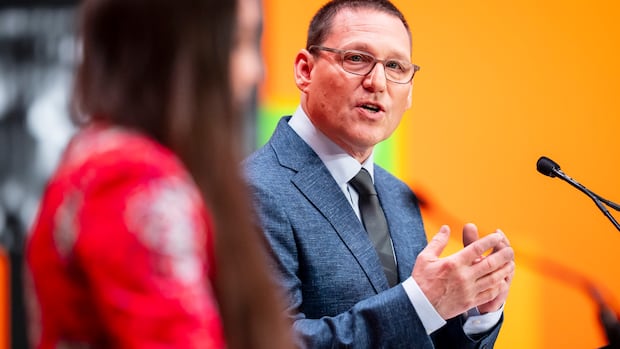
NDP leadership candidate Avi Lewis is calling for a moratorium on data centres along with other measures in a bid to rein in emerging generative artificial intelligence (AI) companies that he says are stealing private data, threatening jobs and harming the environment.
Lewis, one of the front-runners in the leadership race, dropped another platform plank on Thursday that called for a “Humans-First AI Policy.”
It distinguishes between automated machine learning used for medical research, and the campaign’s opposition to “multi-billion-dollar corporate products built on generative AI like large language models (LLMs).”
Generative AI is a type of artificial intelligence that produces content such as text, audio, code, videos and images, with minimal human intervention.
Lewis warns the success of corporate generative AI giants like ChatGPT and Google’s Gemini depend on “causing mass unemployment.”
“AI as a successful technology relies on it delivering massive productivity gains,” he said in an interview. “And what that means is firing millions and millions of workers and replacing millions of jobs with technology.”
Lewis’s policy platform goes after the Liberal government, which sees AI as an opportunity to create millions of jobs and grow the Canadian economy. It opposes the use of AI chatbots to provide public services to Canadians or replace public service jobs.
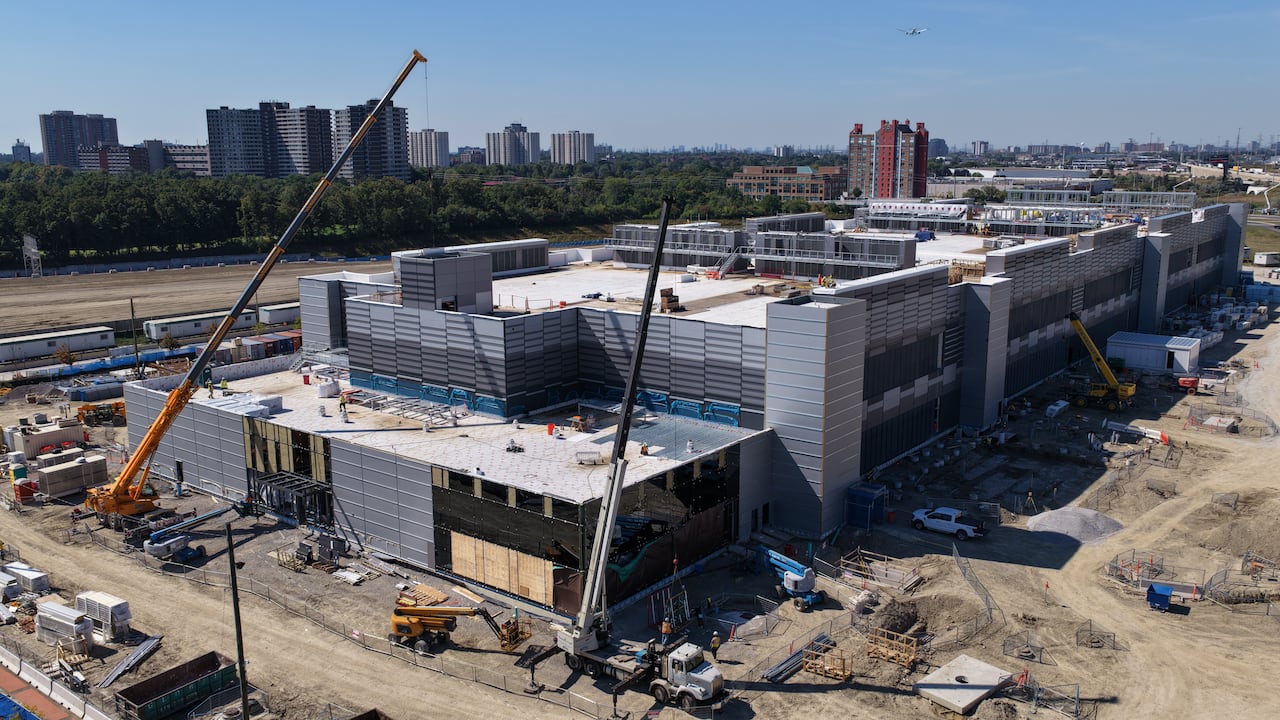 When completed, the Microsoft data centre in the Toronto suburb of Etobicoke will have a gross floor area of 280,000 square feet. (Patrick Morrell/CBC)
The leadership candidate alleges Prime Minister Mark Carney is in a “massive conflict of interest” since he holds shares in a blind trust in a company, Brookfield, that is heavily invested in AI.
CBC News reached out to the Prime Minister’s Office for comment on Lewis’s accusation.
In a speech Thursday from Quebec City, Carney did address the tightrope his government is walking when it comes to the threats and opportunities related to this emerging technology.
“The advent of artificial intelligence will simultaneously challenge fairness, inclusion and solidarity while it creates enormous opportunities for how we live, work and play,” Carney said in a speech. “These tensions can only be reconciled if AI works for all”
Carney said AI can provide “powerful solutions” in education, health care and in the federal public service, but noted “realizing that potential” will require fundamental reforms to Canada’s education system, skills training and the nation’s social welfare system.
Carney did not elaborate on what those changes would be.
Moratorium on data centres
One of the more controversial aspects of Lewis’s AI platform is its call to pause the expansion of data centres. AI requires data centres, which house computer servers that require vast amounts of energy and water to cool down the machines that generate a lot of heat.
A study conducted by the International Energy Agency estimated that “global water consumption for data centres is currently around 560 billion litres per year, and this could rise to around 1,200 billion litres per year in 2030.”
In October, CBC News reported a Microsoft data centre complex in Vaughan, Ont., was expected to consume 730 million litres of water annually, according to a city spokesperson.
CBC News pressed the Lewis campaign on what levers the federal government should use to pause data centre construction, since such project approvals generally fall within the purview of provincial and municipal governments.
A campaign spokesperson said the federal government should use “every lever at its disposal — legislative, regulatory or financial,” including the withdrawal of millions of federal dollars funding data centre projects.
The campaign is also proposing to amend the Canadian Environmental Protection Act to regulate data centre water limits, levying a tax or a combination of these measures.
New Democrats have a range of views on the use of generative AI. For some it’s a non-starter, viewed as an existential threat to workers and labour unions. Others see a place for it — with certain guardrails.
LISTEN | The House takes a deep dive into AI:
The House48:46Will AI make or break Canada?
Tony McQuail, a farmer who’s also running for NDP leader, is calling for curbs on the technology.
“AI is merely a further extension of our addiction to machinery, with huge costs to environments and communities through data centres and technological labour displacement,” McQuail said.
He also raised safety concerns about AI. Several AI technologies have been reported to undermine, deceive and manipulate people.
For example, one AI system resorted to blackmailing engineers who said they wanted to remove it. In another incident, parents of a teen who died by suicide are suing ChatGPT after it coached him on methods of self-harm.
“We mustn’t gamble humanity’s future, as we have in the past, on systems we do not fully understand or control,” McQuail said in a social media post.
Fellow candidate Heather McPherson, meanwhile, wants to limit how much power goes to data centres and ban corporate landlords from using AI to set rent prices.
Rob Ashton, a dockworker and union leader who is also running for NDP leader, has spoken about the harms of AI to workers.
He called for strong regulations on AI including a royal commission and modernized laws that protect people and platforms. He also linked AI to the rise of fascism and the increasing concentration of wealth among a few billionaires.
Noel Baldwin, the executive director of the Future Skills Centre, notes that it’s hard to tell what impact AI is having on the Canadian workforce because it’s rare for companies to say a job has become redundant because of AI.
But Baldwin says Canadians should ask how much AI is playing a role in youth unemployment.
“Early impacts of AI could be part of what’s challenging young people as they’re trying to enter the job market,” Baldwin said.