
Most of the time, space does not wait for anyone. Stars move, grow, and die on their own schedule, usually far too slowly — or far too fast — for humans to notice in real time. Scientists normally piece together what happened long after the event is over, like detectives arriving at the scene too late. That is why, when something unusual shows up at just the right moment, it instantly grabs attention.
Why scientists spend so much time staring at the sky
To most people, the night sky is calm and quiet. Distant stars sparkle, planets drift slowly, and everything seems peaceful. But up close, stars are anything but calm. They are massive balls of gas, constantly burning, changing, and aging. Like living things, they are born, they evolve, and eventually they reach the end of their lives.
When a star is young, it burns fuel by fusing hydrogen and helium deep inside its core. This process can last for millions or even billions of years. But when that fuel begins to run out, things start to change — and sometimes, they change very quickly.
A brief and dramatic phase in a star’s life
Near the end of its life, a star can enter a short and dramatic transition. It swells, sheds material, and begins to release gas and dust into space. This phase creates what scientists call a planetary nebula — a glowing cloud that can help form future stars and planets.
These nebulae may last thousands of years, but on a cosmic scale, that is barely a blink. Catching a star during this transformation is rare, which is why astronomers watch the sky so carefully. Every such moment helps explain how the elements that make up planets — including Earth — came to exist.
The moment NASA didn’t want to miss
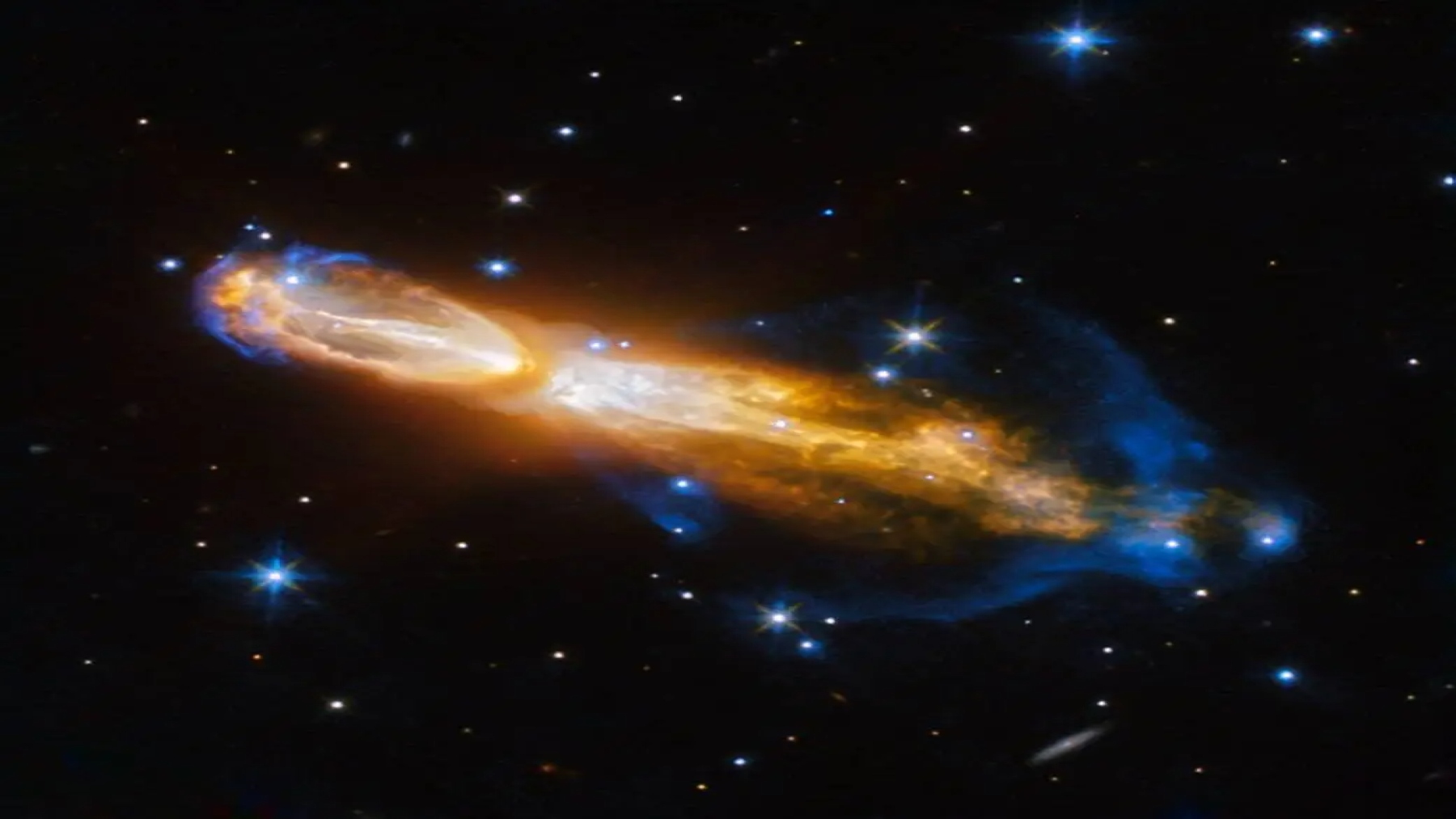
NASA recently shared images of an unusual object known as the Calabash Nebula. What makes it special is not just how it looks, but when it was observed. The central star was caught in the act of leaving its red giant phase, throwing material into space at astonishing speed — nearly one million miles per hour.
Jets of gas and dust were blasted in opposite directions, crashing into surrounding material and forming bright, glowing lobes. Although the full event happened too quickly to record from start to finish, the aftermath told a clear story. The image, captured by the Hubble Space Telescope in 2017, revealed glowing structures visible across multiple wavelengths.
By studying these patterns, NASA scientists determined that the star was relatively small — a low-mass star — making the event even more unusual.
Why this nebula stands out from the rest
Our galaxy contains tens of thousands of planetary nebulae, but very few are seen during this short transition stage. The Calabash Nebula is different because it is asymmetric, energetic, and temporary. It shows forces and motions that are rarely visible in more stable nebulae.
For NASA, this was more than a beautiful image. It provided real data that helps confirm theories about how stars change at the end of their lives. Each discovery like this adds another piece to the puzzle of how the universe recycles matter and creates new worlds.
Space often hides its most interesting moments. This time, scientists were lucky enough to catch one — just before it slipped away.