
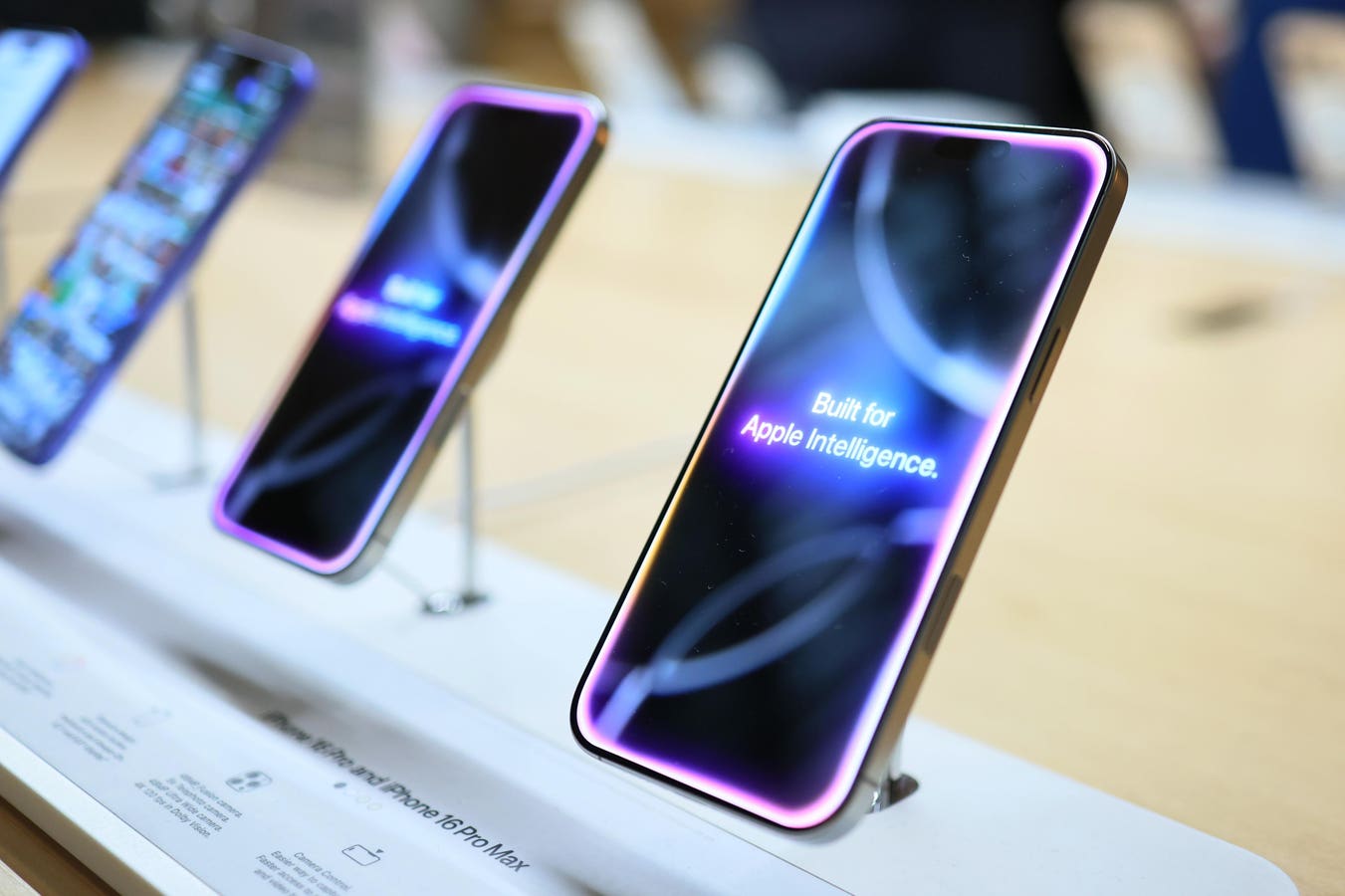
Apple iPhone on display at an Apple store (Photo by Michael M. Santiago/Getty Images)
Getty Images
Taking a look back at this week’s news and headlines from across the Apple world, including iPhone 18 Pro display leaks, Siri’s new AI role, MacBook Pro benchmarks, Apple pushing iOS 26, new products for 2026, Apple AI on your chest, and four Oscar nominations for F1: The Movie.
Apple Loop is here to remind you of a few of the many discussions around Apple in the last seven days. You can also read my weekly digest of Android news here on Forbes.
Still Looking At You From The Center
Apple’s move to a smaller pill-shaped Face ID cutout has been confirmed. While discussions last week suggested a radical redesign to move the hardware to the corner of the iPhone display, voices with a strong track record say FaceID will remain in the centre of the iPhone display. The details come from the reliable supply-chain observations of Ross Young. He notes that discussions on the new size for the Dynamic Island in the iPhone 18 family is accurate:
“Back in June 2025, Young said that while some parts of Apple’s Face ID system would move under the display on iPhone 18 Pro models, the devices would retain visible Face ID elements – meaning the Dynamic Island would persist, albeit in a smaller form than on the iPhone 14 Pro through iPhone 17 Pro.”
Chat To Siri
Apple’s plans for Siri include a major change: offering the on-board service as a chatbot. It’s another change in direction of Apple’s AI plans, reacting once more to the success of AI on Android and pivoting towards that expectation. Siri interactions will be driven through this new interface, which is expected to be built on a customised version of Google’s Gemini. Bloomberg’s Mark Gurman has more:
“The chatbot — code-named Campos — will be embedded deeply into the iPhone, iPad and Mac operating systems and replace the current Siri interface, according to people familiar with the plan. Users will be able to summon the new service the same way they open Siri now, by speaking the “Siri” command or holding down the side button on their iPhone or iPad.”
The M5 Pro Performance Benchmarks
Building on the initial Apple Silicon M5 chipsets in the consumer MacBook Pro, the upcoming M5 Pro and M5 Max variants of the latest ‘desktop grade’ offerings are expected to deliver some of the highest levels of performance in their market spaces. Macworld’s Jason Cross takes a look at the potential performance of the upcoming Apple Silicon beasts:
“Those are pretty stellar estimated scores for the top-end M5 Max. Around 4,500 for single-core CPU performance is a lot, but over 31,000 for the multi-core score is astounding. That’s in the same league as chart-topping 64-core AMD Threadripper CPUs.
“The M5 Max may be the first Apple GPU to break 250,000 on the Geekbench 6 GPU compute test. Even the M3 Ultra, with its 80 GPU cores, landed just a hair under it. If Apple can get there with half as many GPU cores in just two processor generations, that’s an impressive pace of improvement.”
Apple’s Subtle Push To Upgrade To iOS 26
Apple’s annual iOS update includes a short handover period when it maintains both the old and the newer versions to ensure coverage of both, keeping the older version into the New Year. Apple has taken a slightly different approach this year, presumably to push more iOS 26 updates as quickly as possible. David Phelan explains the new approach Apple has taken with the move from iOS 18:
“Instead, iOS 18.7.3 was made available for general release only for those three phones which can’t run iOS 26. It meant that from Dec. 12 onwards — over a month ago now — hundreds of millions of iPhones either had to upgrade to iOS 26, no more delaying, or stay on older software. And since iOS 26.2 had a bunch of security updates, that’s not a great idea.”
What’s New, Cupertino?
Alongside the usual updates and upgrades, Apple has a 2026 that will see it push beyond its comfort zone in several areas. A smarthome hub and FaceID-powered doorbell will connect up your home, a foldable iPhone, and augmented reality glasses. The most exciting will be the A18 Pro-powered MacBook; bringing the iPhone chipset to the laptop should allow Apple to offer a cheaper Mac, but will moving under $999 damage the brand?
“With the A18 Pro chip, the lower-cost MacBook might have only 8GB of RAM, whereas all current MacBook Air and MacBook Pro models start with at least 16GB of RAM. The chip also lacks Thunderbolt support, so the new MacBook would likely be equipped with regular USB-C ports, with slower data transfer speeds and external display limitations.”
Can Apple Strap an AI to Your Lapel?
Looking forward to 2027 and beyond, Apple watchers are suggesting that Tim Cook and his team are going to take a swing at a wearable “AI Pin” that will come with all the usual sensors you get in a smartphone, presumably with a voice interface, to help you with tasks and decisions through the day. Forbes contributor Andrew Williams examines the issues surrounding an iPin, which is provisionally scheduled for 2027.:
“While AI assistants have developed significantly since 2024, Apple has not been at the forefront of those developments. Its own AI is so far behind the frontrunners, Apple earlier this month announced a partnership with Google, which involves the use of the company’s Gemini as the bedrock for future Apple Intelligence models.”
And Finally…
Apple has picked up four Oscar nominations for its “F1: The Movie”. It is up for four awards: Best Picture, Best Visual Effects, Best Sound, and Best Film Editing.
“Pitt stars as former F1 driver Sonny Hayes, who returns to the sport to partner rookie team mate Joshua Pearce, played by Damson Idris, at the fictional APXGP team – slotting alongside the existing 10 squads up and down the pit lane. Following its cinema release, F1 The Movie is now available to watch on Apple TV.
Apple Loop brings you seven days worth of highlights every weekend here on Forbes. Don’t forget to follow me so you don’t miss any coverage in the future. Last week’s Apple Loop can be read here, or this week’s edition of Loop’s sister column, Android Circuit, is also available on Forbes.