
Photo: Courtesy of Sundance Institute/All photos are copyrighted and may be used by press only for the purpose of news or editorial coverage of Sundance Institute programs. Photos must be accompanied by a credit to the photographer and/or ‘Courtesy of Sundance Institute.’ Unauthorized use, alteration, reproduction or sale of logos and/or photos is strictly prohibited.
Sam Green makes what he likes to call “live documentaries,” movies that combine traditional nonfiction filmmaking with elements of live performance of both the musical and spoken-word kind. In the past, he’s collaborated with the Kronos Quartet (2018’s A Thousand Thoughts) and Yo La Tengo (2012’s The Love Song of R. Buckminster Fuller), among others. At first glance, his latest, The Oldest Person in the World, which is premiering at the Sundance Film Festival, would seem more conventional in nature. It’s a documentary following different individuals who have at one point been declared the oldest living person in the world; such a title comes with an unspecified expiration date, of course, and some have held the crown for a few months, some for several years. Green has said that he intends to continue making versions of this movie for the rest of his life, charting the new titleholders for the world’s oldest living person every few years with a new cinematic entry, à la Michael Apted’s famous Seven Up! series — so even this project will have a certain “live” quality to it, with the filmmaker’s own career serving as a kind of performance element across the years.
But there’s something else about The Oldest Person in the World that makes it feel like a living work of art. Green initially becomes interested in these supercentenarians because of his obsession with the Guinness Book of World Records (which he made a film about in 2014, called The Measure of All Things) and his 2015 discovery that the oldest living person at the time, Susannah Mushatt Jones, resided not too far from him in Brooklyn. That’s how the production of this movie began, at any rate, but it appears to have morphed into a document of the filmmaker’s own mortality. Green’s son, Atlas, is born along the way. Then, Green gets diagnosed with cancer. As the world’s oldest people appear on our screen, with the filmmaker visiting them in their homes, we see Sam get weaker while his son gets older. The project thus expands conceptually in unexpected, even disturbing directions — it feels like it may never cohere into a finished work. In addition, we learn more about the 2009 suicide of Green’s brother, a trauma that the director still has difficulty talking about. We realize we’re watching a movie about time — not the time these elderly people have lived, but about our own brief, unpredictable measure of time on this planet. “Every single one of us has been the youngest person in the world for a millisecond,” Green says at one point, and it is at once an obvious and striking observation, the kind of mundane, oft-ignored factoid that reminds us of the all-encompassing wonder of existence. Here’s one thing we all have in common — after that, it’s anybody’s guess what will happen to us.
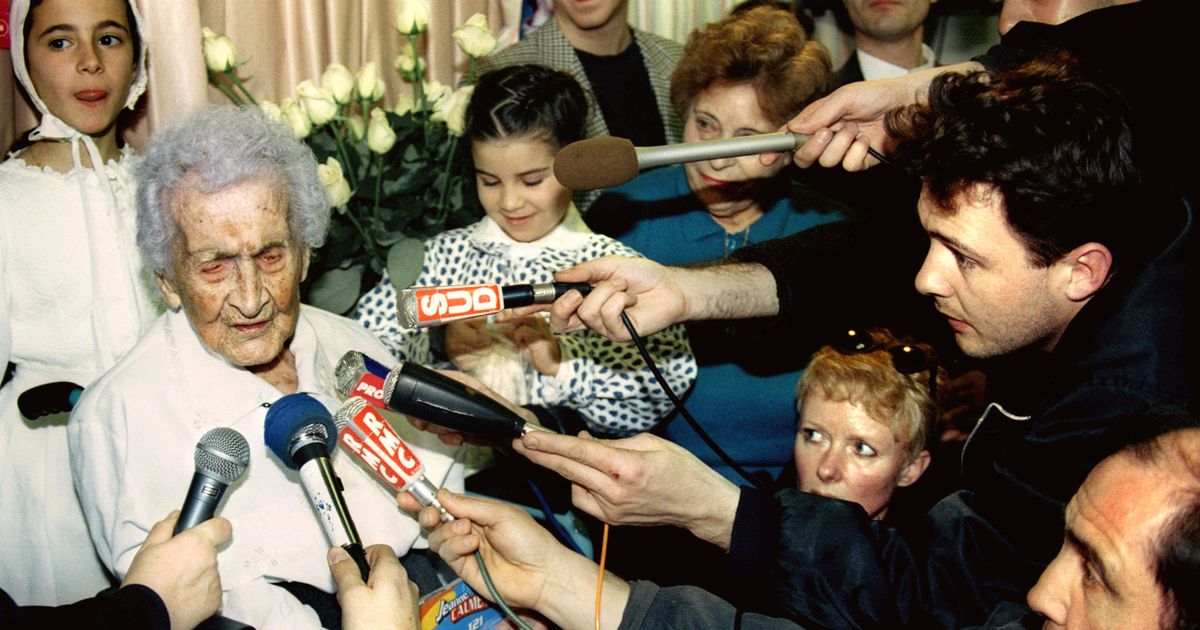
For a movie so filled with death, The Oldest Person in the World is surprisingly, almost confrontationally life-affirming. That sounds cheap, but Green comes by the sentiment honestly. He doesn’t flinch from the realities of age. When he first visits Susannah Jones, he observes that she can barely hold her head up and appears to be asleep, even as various bystanders (politicians, family members) celebrate her longevity and speak for her. His camera gets up close into the faces of his elderly subjects and stays there. We see clearly their milky eyes, their folds of skin, the mouths struggling to form words, but in these things the director finds beauty, not pain or pathos. Some of his subjects are more there than others. Violet Brown, of Saint James Parish, Jamaica, recites Lord Byron’s poem “Vision of Belshazzar” from memory. Emma Morano of Verbania, Italy, sings “Tell Me That You Love Me,” a hit song from Mario Camerini’s 1932 comedy What Scoundrels Men Are!
This closeness, this intimacy, is the real source of the film’s power — especially in a world where it’s become so easy to avoid real-life human contact. Green shoots Morano in her home, sitting in an armchair, and then playfully notes in voice-over, “Right now, we’re doing that thing we do in documentaries where you film someone sitting in their natural environment and they pretend we’re not there.” To cut through the awkwardness, Green then enters the frame himself and sits across from her, and the two share a quiet, warm, extended glance, looking into each other’s eyes. “I don’t think I’ve ever had such an intimate experience with a stranger before,” the director says, and we believe it. The whole film could be an attempt to re-create such an experience on a cinematic level: Watching these people, their features embrittled by time and their eyes speaking to us of the unimaginable fragility of our own lives, we realize just how transformational and healing it can sometimes be simply to look into a stranger’s face.
Sign up for The Critics
A weekly dispatch on the cultural discourse, for subscribers only.
Vox Media, LLC Terms and Privacy Notice