
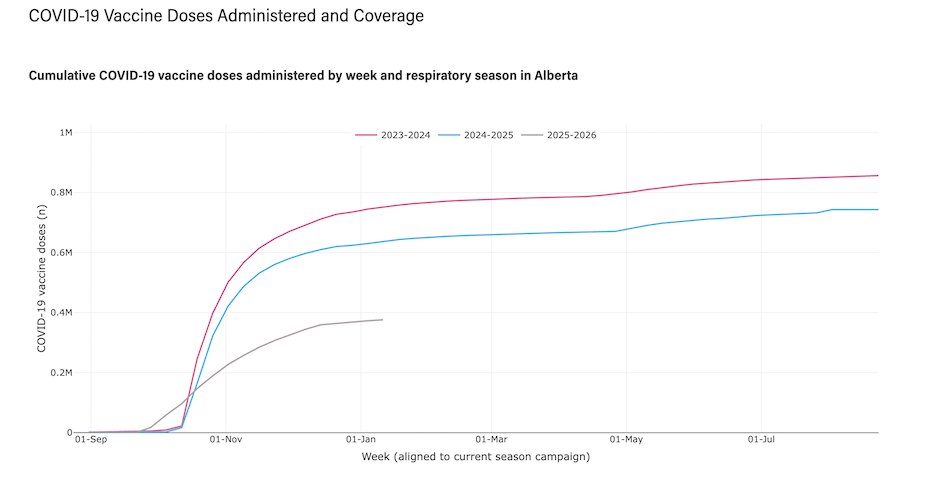
The number of Albertans who got a COVID-19 vaccine during this winter’s immunization campaign is about half the number who got vaccinated in the province during the same time period last season.
“It’s completely unsurprising, given the government’s approach to vaccination, that we would see a drop off,” Chris Gallaway, executive director of Alberta public health advocacy group, Friends of Medicare, told PressProgress.
“Everything they did in terms of their vaccine rollout for this year was designed to lower uptake.”
According to the province’s immunization dashboard, there were nearly 480,000 COVID-19 shots administered between October 2024 and January 2025.
That number dropped by half this season, between October 2025 and January 2026, when about 230,000 COVID-19 vaccines were administered.
This comes after Alberta’s United Conservative Party government made it much harder for its residents to get vaccinated against the pandemic virus this season.
Alberta Vaccine Dashboard/Alberta.ca
Changes include a $100 “administrative cost” up front at a public health clinic for most Albertans. For those who find a pharmacy to get the shot instead of at a designated public health clinic, there may be an extra charge depending on the pharmacy.
Initially, Danielle Smith’s UCP government wanted even healthcare workers to pay for COVID-19 vaccines — only seniors in supportive-living and people who are immunocompromised qualified for an exemption.
They reversed this decision in August for some workers, after nurses and healthcare workers’ unions advocated at the bargaining table for free, voluntary vaccines for their members.
Still, Gallaway says this data shows COVID-19 vaccines are now too expensive and inaccessible for most people in a province that has a documented vaccine hesitancy problem — having been the epicentre of Canada’s measles epidemic that led to the loss of our measles elimination status last year — and a respiratory illness season that is overwhelming hospitals like never before.
“What we’ve heard over the last few months is extreme frustration from Albertans who were trying to use the booking system to get the vaccine, and also frustration from Albertans who were told they would have to pay if they wanted to get it,” Gallaway said.
“The [booking] system online, it was confusing, it didn’t always work, it was clunky, people couldn’t figure out where or when they might be able to get an appointment [and] there would be weeks where there wasn’t one available.”
Anecdotally, Gallaway said his organization has heard from Albertans who left the province to get vaccinated, on trips to BC, US, Mexico or elsewhere. In BC, which had a higher vaccination rate than the national average in 2024, the COVID-19 vaccine was explicitly made free to all Canadians who travelled there.
In October, federal health minister Marjorie Michel said the feds would not step in to help people in Alberta and Quebec — the only other province to implement a fee and other barriers to access — afford the COVID-19 vaccine.
According to Gallaway, neither the provincial nor the federal government will address another major oversight in Alberta’s restrictions to free COVID vaccine access.
“Alberta’s COVID vaccine rollout meant that [Indigenous people] could only get a free vaccine if you were getting it in your home community in reserve, so if you are an Indigenous person living in Edmonton, you do not have access to free vaccination clinics,” Gallaway said.
“We wrote to both the federal and provincial ministers to say, ‘You’re violating people’s treaty rights. You need to solve this.’ They both pointed to each other as the problem.”
The UCP’s justification for instating a fee and other barriers to accessing COVID-19 vaccines was that this would reduce the number of “wasted” vaccine doses, citing a $135 million cost in 2023-24.
The party’s MLAs and Premier Danielle Smith have also been spouting and touting anti-vaccine rhetoric since she won the UCP leadership race in 2022.
There are now countless large-scale, peer-reviewed studies to show that COVID-19 vaccines save lives.
The latest, a global JAMA Network study, found that between 2020 and 2024, conservative estimates indicate that COVID-19 vaccines have averted 2.5 million deaths and lengthened the lifespans of people 60 and above.
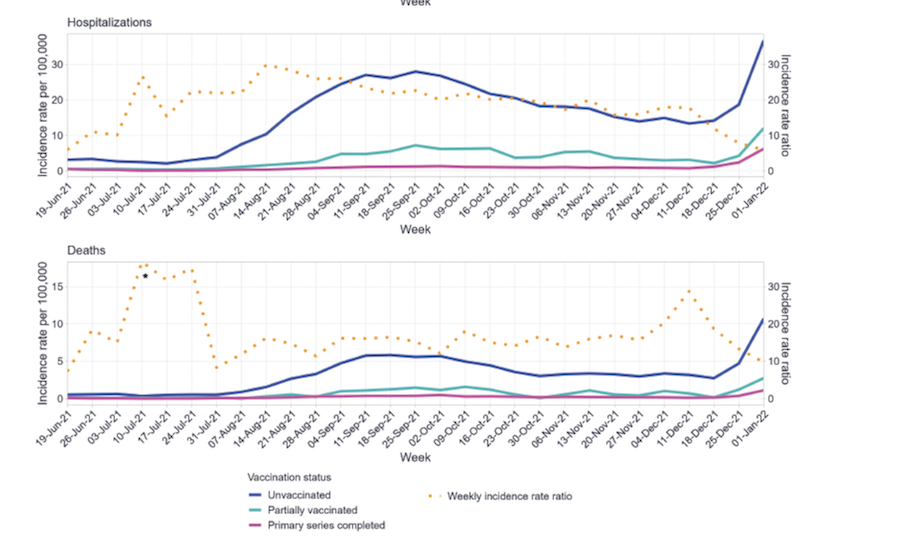
Meanwhile the latest available Canadian data — from June 2021 to January 2022 — shows people who were not vaccinated against COVID-19 had a far greater likelihood of being hospitalized or dying due to the virus.
Source: Public Health Agency of Canada report
In Quebec, where the vaccine costs between $150 and $180 for most people besides healthcare workers, seniors, and other high-risk groups, the government also cited high costs of wasted vaccine doses in prior years as its rationale.
There, like in Alberta, hospitals are overwhelmed by an early respiratory illness season, and a new measles outbreak with nine confirmed cases is currently underway as of Thursday.
According to Santé Québec, the Crown corporation that coordinates the province’s health system, 1.1 million doses of the COVID-19 vaccine have been administered across the province so far, since the start of this season’s immunization campaign on October 6. This number is down from 1.4 million during the same time period last season, and 1.6 million the year before.
“This is the first campaign with stricter eligibility criteria,” a spokesperson for Santé Québec wrote in an emailed statement to PressProgress.
“We cannot distinguish between doses administered through the Quebec Immunization Program and those administered privately; however, we can state that the vast majority of the latter were administered free of charge.” This quote has been translated from French, for clarity.
Neither Alberta’s ministry of primary and preventative health services, nor the Premier’s office has responded to PressProgress’s repeated requests for comment in time for publication.
“We have a government that’s anti-science and that is pandering to a very niche right-wing base that the Premier thinks she needs to keep happy, rather than looking at what’s best for Albertans or our health care system,” Gallaway said.
Our journalism is powered by readers like you.
We’re an award-winning non-profit news organization that covers topics like social and economic inequality, big business and labour, and right-wing extremism.
Help us build so we can bring to light stories that don’t get the attention they deserve from Canada’s big corporate media outlets.