
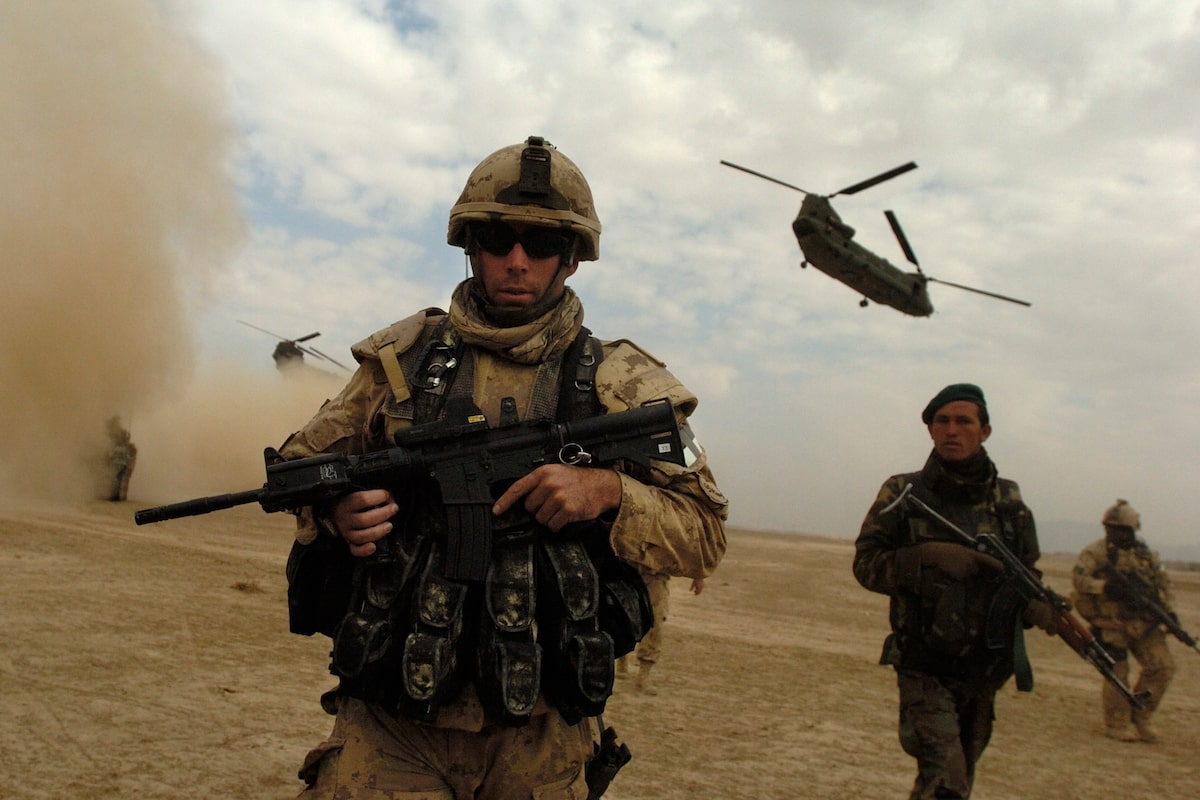
Canadian soldiers accompanied by Afghan National Army soldiers secure the area near Howz-e-Madad ahead of a ‘shura’ in the Panjwaii District of southern Afghanistan, in December, 2006.Kevin Van Paassen/The Globe and Mail
A federal minister pushed back against President Donald Trump’s latest criticism of NATO allies, in which he minimized the role of non-U.S. troops during the war in Afghanistan and said they tended to stay away from the front lines.
Canadian Culture Minister Marc Miller, who once served as an infantry soldier in the Canadian Armed Forces, responded to the remarks at the conclusion of a cabinet retreat in Quebec City.
“I think everybody knows that’s false. I think soldiers probably can speak for themselves. Canadians made great sacrifices in Afghanistan,” he said.
Mr. Miller was reacting to comments that the President made Thursday during an interview with Fox News in Davos, Switzerland.
Mr. Trump said he wasn’t sure NATO would be there to support the United States if and when requested.
“We’ve never needed them, we have never really asked anything of them,” Mr. Trump said of non-U.S. troops. “You know, they’ll say they sent some troops to Afghanistan, or this or that, and they did, they stayed a little back, a little off the front lines.”
Canadian soldiers patrol the Dand district of southern Afghanistan in June, 2009.Colin Perkel/The Canadian Press
Nearly a month after the attacks of Sept. 11, 2001, the U.S. led an international coalition in Afghanistan to destroy al-Qaeda, which had used the country as its base, and the group’s Taliban hosts. Alongside the U.S. were troops from dozens of countries, including from NATO, whose mutual-defence mandate had been triggered for the first time after the attacks on New York and Washington.
The Liberal cabinet retreat was held at La Citadelle, a centuries-old military fortress in Quebec City that is also the headquarters of the Royal 22nd Regiment, a Canadian Army infantry regiment. The VanDoos, as they are colloquially known, rotated multiple times through Afghanistan.
Portraits of six soldiers killed in action in Kandahar lined the same hall where Prime Minister Mark Carney delivered a speech ahead of the meeting on Thursday.
Mr. Carney did not speak with reporters at the close of the two-day meeting on Friday. An anticipated press conference was cancelled for what Finance Minister François-Philippe Champagne later said was a scheduling issue. Mr. Carney’s office did not provide any further details.
Defence Minister David McGuinty and Veterans Affairs Minister Jill McKnight did not answer questions from reporters on Mr. Trump’s remarks.
Opinion: America the predator: Trump wants to show the world he can take what he wants
Laura Scaffidi, a spokesperson for Mr. Carney, released a statement late Friday that referenced the contributions of Armed Forces members, including the Van Doos, who lost 14 of their members in Afghanistan.
“This service and their sacrifice can never be diminished,” she said.
Mr. Champagne said Canadians are proud of the sacrifices of men and women who served in Afghanistan, but did not directly criticize Mr. Trump’s comments.
“We don’t need comments from anyone else to know the strength of our Armed Forces,” he said. “They know what they did. We know what they did. The world knows what they did.”
The Royal Canadian Legion issued a statement Friday noting that more than 40,000 Armed Forces members served during Canada’s mission in Afghanistan. It also said that 158 never came home, and many others returned carrying physical and psychological wounds.
“Today, and everyday, we remember those who made the ultimate sacrifice, we honour the courage of all who served, and we stand with the Veterans and families who live every day with the lasting impacts of that mission,” the statement said, without referencing the President’s comments.
Nujma Bond, a spokesperson for the legion, said the organization does not inject itself directly into political commentary.
“In this case, the attention surrounding Afghanistan presented a need to help educate,” she said.
Starmer says Trump’s remarks on NATO troops in Afghanistan are ‘frankly appalling’
The Royal British Legion responded directly to the President’s comments.
“The service and sacrifice of British personnel in Afghanistan cannot be called into question, and we condemn any comments that undermine their extraordinary contribution,” the legion said, pointing out that 457 British personnel lost their lives in Afghanistan.
British Prime Minister Keir Starmer suggested the President should apologize.
“I consider President Trump’s remarks to be insulting and frankly appalling and I am not surprised they have caused such hurt to the loved ones of those who were killed or injured and, in fact, across the country,” he said.
Without naming Mr. Trump, Prince Harry, who served in Afghanistan, weighed in, saying the “sacrifices” of British soldiers during the war “deserve to be spoken about truthfully and with respect.”
Mr. Trump’s comments about NATO and Afghanistan add to recent tension between the President and his traditional allies, which was fuelled by his repeated comments that Greenland should be part of the United States.
Trump drops tariff threats against allies opposed to U.S. control of Greenland
The President has backed away from threats to impose tariffs on European allies over Greenland, saying a deal has been reached. However, scant details of such a deal have been released, and Greenland’s Prime Minister has said its sovereignty is not negotiable.
Retired major-general David Fraser, who led Canadian troops in Afghanistan alongside the United States, told CTV News Friday that Canadian Forces were there to protect the United States in response to the Sept. 11 terrorist attacks.
“It’s pretty disgusting that the President doesn’t know his own history,” he said.
Mr. Trump has long been critical of NATO countries for failing to live up to past targets to spend two per cent of GDP on defence.
Canada agreed in June to join 31 other NATO countries in raising defence spending to five per cent of GDP by 2035, of which 3.5 per cent would be on direct defence spending, while the rest can be for related infrastructure such as bridges and ports.
With reports from the Associated Press