
Back to Article List
Our waxing satellite passes the planets Saturn and Neptune in the morning; by evening, the trio is visible for a few hours after sunset.
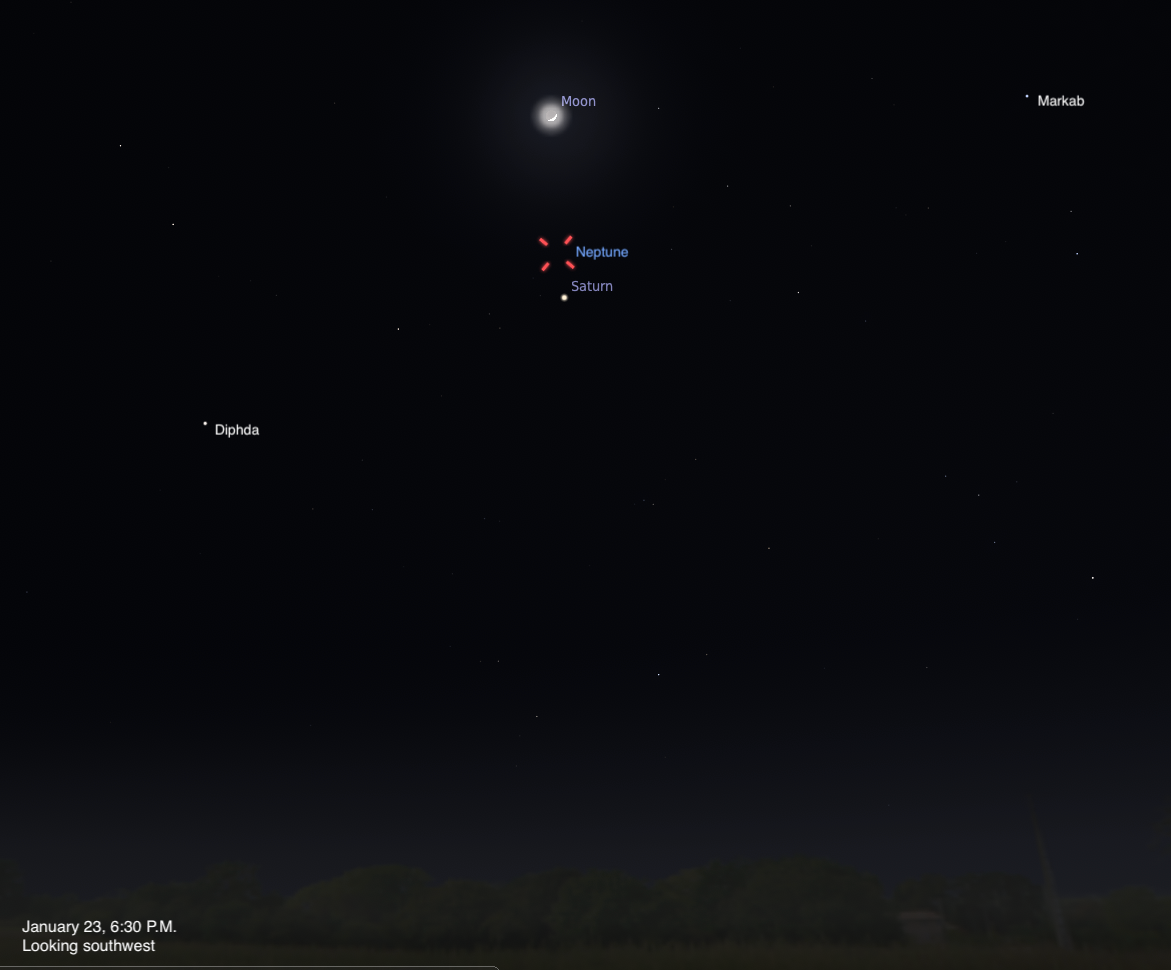
Use the crescent Moon to find Saturn and Neptune in the evening sky on the 23rd. The red crosshairs marks the position of Neptune, which is not visible to the naked eye. Credit: Stellarium/USGS/Celestia/Clementine
Looking for a sky event this week? Check out our full Sky This Week column.
January 22: Explore the Rosette Nebula
The Moon passes 4° north of Saturn at 8 A.M. EST, then passes 4° north of Neptune at 11 A.M. EST. The trio stands in the southwestern sky this evening and remains visible for several hours after sunset. Around 6:30 P.M. local time, they are roughly 40° high — still far enough above the horizon that you have a good chance to catch Neptune before it sinks into the turbulent air near the ground.
First-magnitude Saturn is easy to spot below the crescent Moon — it’s brighter than any star in this part of the sky. The pair is lovely to observe by eye, but a telescope will show Saturn’s full beauty: its stunning ring system, stretching 37” from end to end and tilted just under 2° to our line of sight. Look also for Titan — the planet’s largest and brightest moon — shining around magnitude 8.5 some 1.7’ east of Saturn’s center and having moved from its position nearer the ringed world earlier this week.
Neptune — only visible in binoculars or a telescope — lies 2.2° northeast of Saturn, roughly ⅓ of the distance along a line drawn from the ringed planet toward the Moon. The faraway ice giant spans only 2” on the sky and shines at magnitude 7.8. It will appear as a “flat” bluish-gray star in the eyepiece.
Sunrise: 7:16 A.M.
Sunset: 5:09 P.M.
Moonrise: 9:43 A.M.
Moonset: 10:31 P.M.
Moon Phase: Waxing crescent (28%)
*Times for sunrise, sunset, moonrise, and moonset are given in local time from 40° N 90° W. The Moon’s illumination is given at 10 P.M. local time from the same location.