
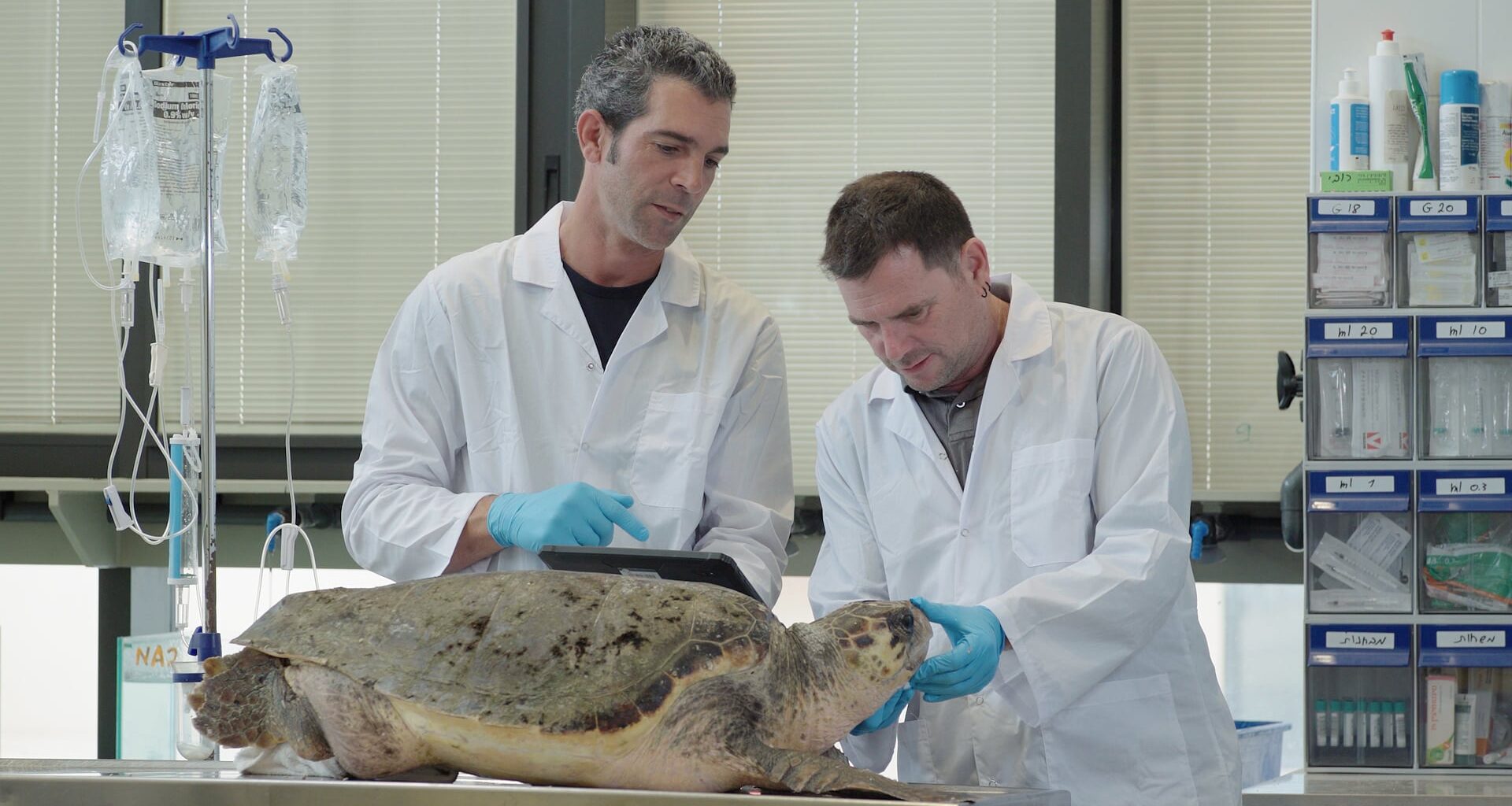
The year was 1999, and a university student named Yaniv Levy, majoring in marine biology, was taking a walk on the sands of Mikhmoret beach north of Netanya when he happened upon a large sea turtle, called a loggerhead, whose limb was injured and who had been hurt by a fishhook.
Levy named the loggerhead Mazal, Hebrew for luck, and her successful rehabilitation was the seed of a dream. Later that year, Levy set up a “temporary” turtle treatment center nearby in collaboration with the Israel Nature and Parks Authority.
Some 27 years and NIS 30 million ($9.5 million) later, Israel’s new purpose-built National Sea Turtle Rescue Center is set to open its doors to the public, with Levy, now a turtle ecologist, as its director. It’s located in the Alexander Stream National Park, not far from where Levy found Mazal.
The facility, which will open to visitors in February, is funded and run by the Israel Nature and Parks Authority, with a handful of donations. It has a staff of 10, including management, experts in emergency medicine and rehabilitation, and a research assistant who also manages turtle nests on the adjacent beach. The employees are supplemented by around 100 volunteers.
The center also represents a new frontier: In addition to caring for the injured animals, it will house the world’s only breeding program for green sea turtles.
Get The Times of Israel’s Daily Edition
by email and never miss our top stories
By signing up, you agree to the terms
“There are fewer than 20 rehabilitation centers like ours,” Levy said. “But we have the world’s only breeding nucleus. We are constantly learning and taking notes. Nobody in the world has the endocrinological information that we have.”
To date, Levy has had the luxury of treating and studying turtles in private. With the influx of visitors, that will all change. “My life will be quite different,” he said.
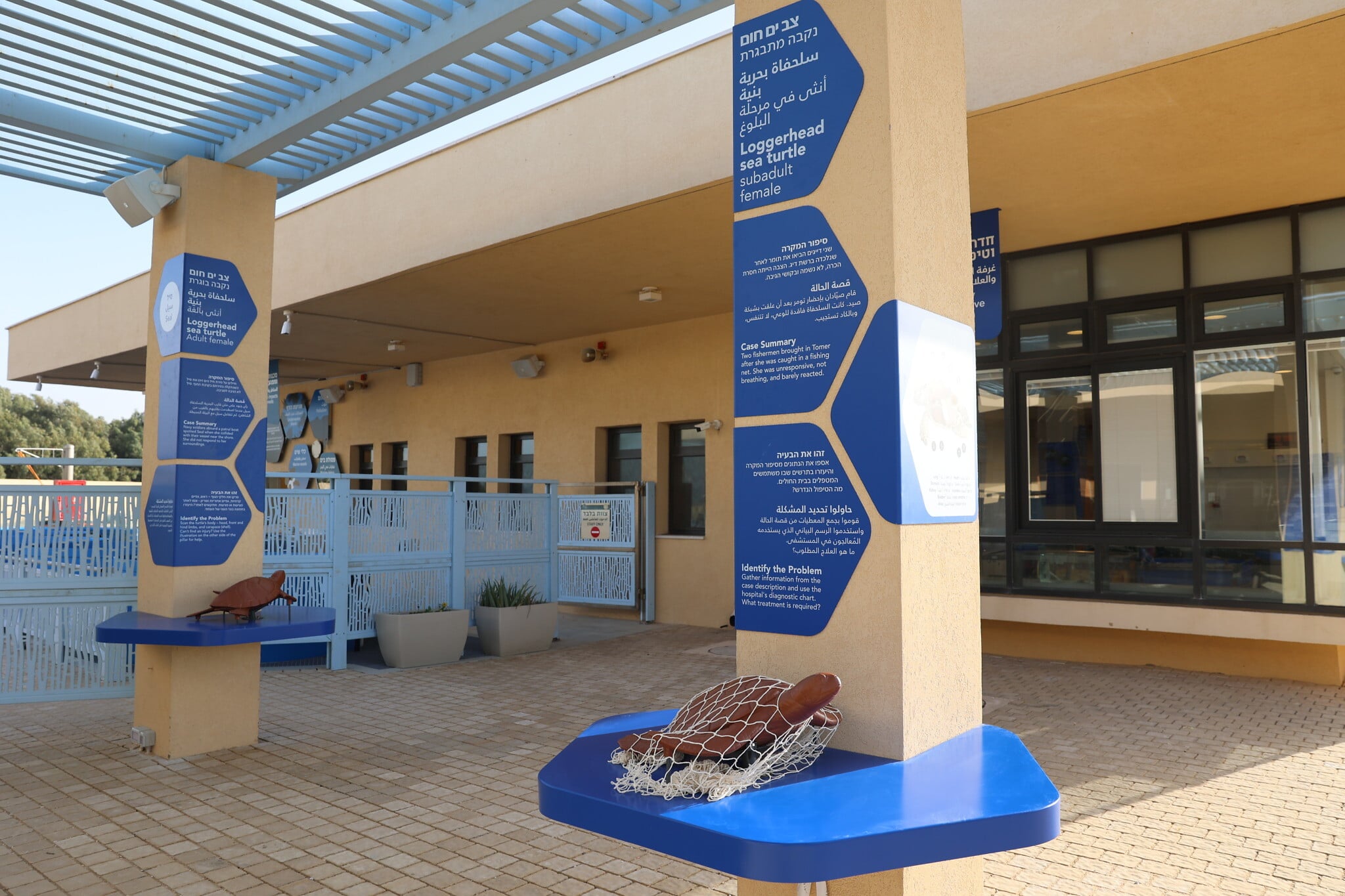
Part of the new National Sea Turtle Rescue Center, in Yannai, central Israel, December 8, 2025. (Shay Isaacs, Israel Nature and Parks Authority)
The population of sea turtles in the Mediterranean Sea is severely endangered, mainly due to intensive hunting in the 1930s, according to the parks authority. During the British Mandate, some 2,000 green sea turtles were hunted annually for their meat and shells on the coasts of what would become Israel.
Thanks to decades of conservation efforts, the global population of green sea turtles has increased to an estimated 85,000 to 90,000 sexually mature females, leading the International Union for Conservation of Nature to move the species from “endangered” to “least concern” on its Red List of Threatened Species.
In the Mediterranean Sea, however, which is rife with dangers ranging from plastic and abandoned fishing gear to boat propellers, there are only around 450 breeding females of this species.
A long wait
When he first became involved with the species more than 20 years ago, Levy recalled, it was almost extinct. First, he realized the importance of protecting the nests on the beach.
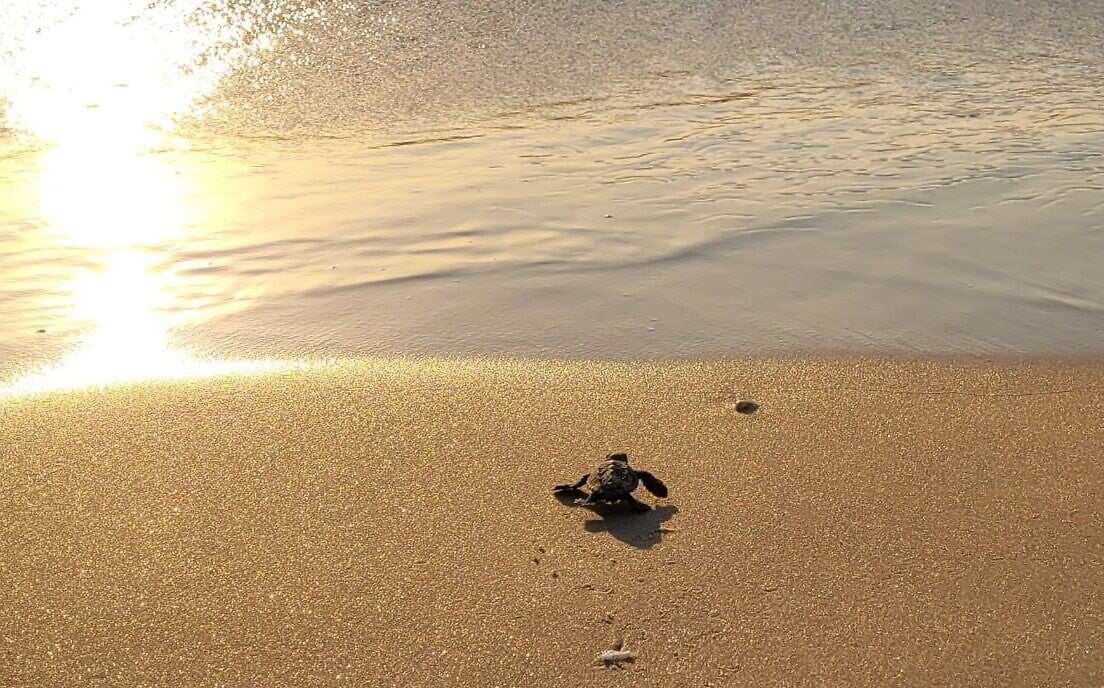
A turtle hatchling moves toward the sea from a nest protected within the Palmachim National Park on August 1, 2021. (Yaniv Cohen, Israel Nature and Parks Authority)
His efforts led to what today is an organized effort during the turtles’ breeding period, from May to August. Volunteers fan out along Israel’s coast to locate new sea turtle nests. Afterwards, center staff carefully extract the eggs and rebury them in areas inaccessible to the public and predators. When the eggs hatch, volunteers ensure that the hatchlings safely reach the sea.
In addition, he began a core breeding group of 22 hatchlings on Israel’s Mediterranean shore in 2002. Levy explained during a recent media tour that he could have taken a shortcut and plucked grown turtles out of the sea, but needed to be sure that the breeding pairs would come from local stock and be suited to Israel’s conditions.
Additionally, injured turtles that would not have survived a return to sea have been integrated into the breeding group, bringing the total population to around 30.
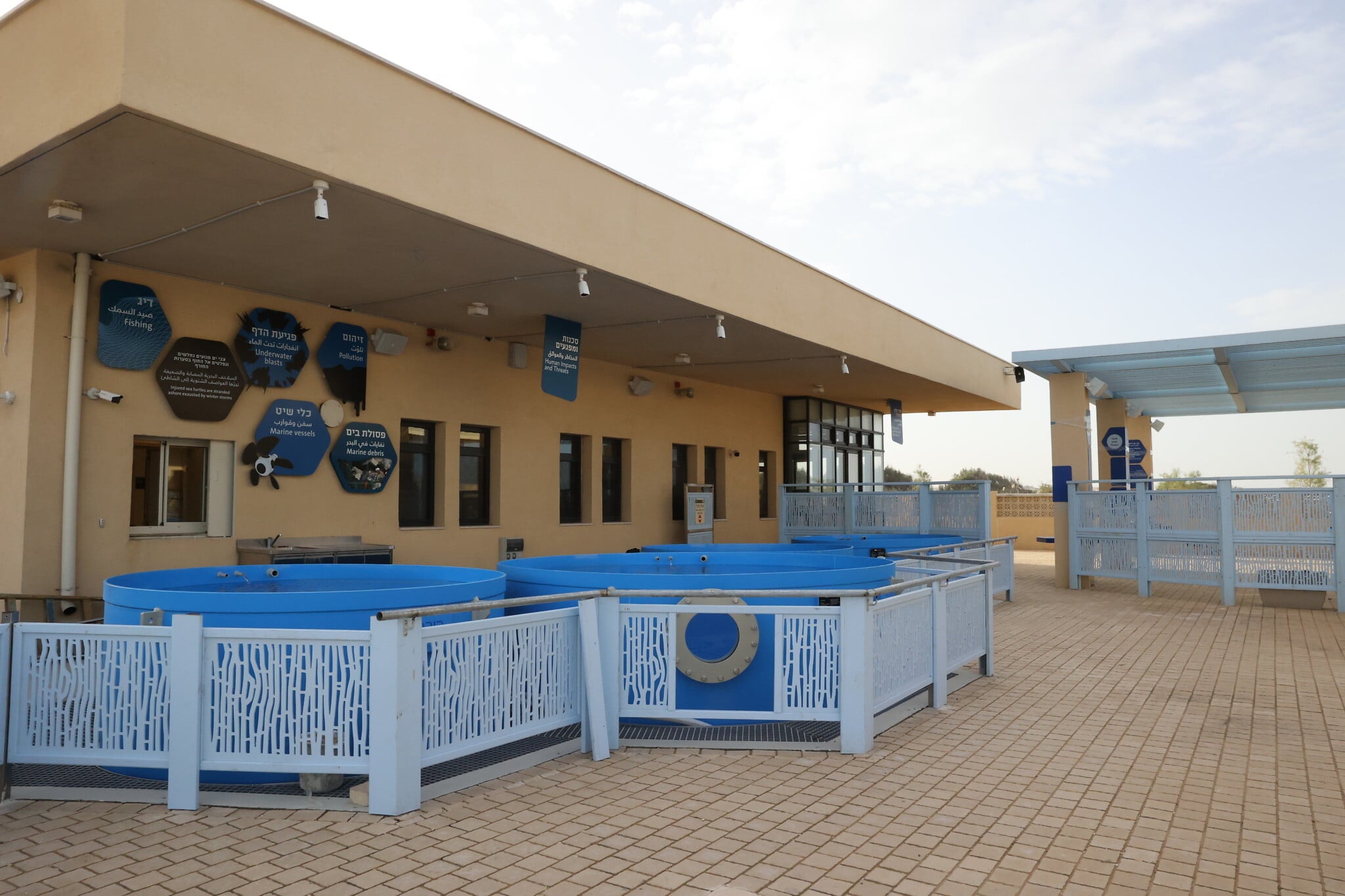
Injured turtles recover in large seawater pools at the National Sea Turtle Rescue Center in Yannai, central Israel, December 8, 2025. (Shay Isaacs, Israel Nature and Parks Authority)
Recalling “sleepless nights and lots of sand in our eyes,” Levy described one female whose back flippers had never properly recovered from injury.
“She dug a pit for her body, but didn’t have the strength in her hind flippers to dig the egg chamber,” he said. “We discovered that we could creep in behind her to dig the chamber, and then she laid her eggs.”
In another instance, a section in the breeding pool was fenced off to enable a male turtle who lost his tail after entanglement with fishing gear to mate quietly without being chased away by his peers.
And Levy’s waited a long time for the hatchlings to grow, given that turtles only reach sexual maturity at 20 to 30 years.
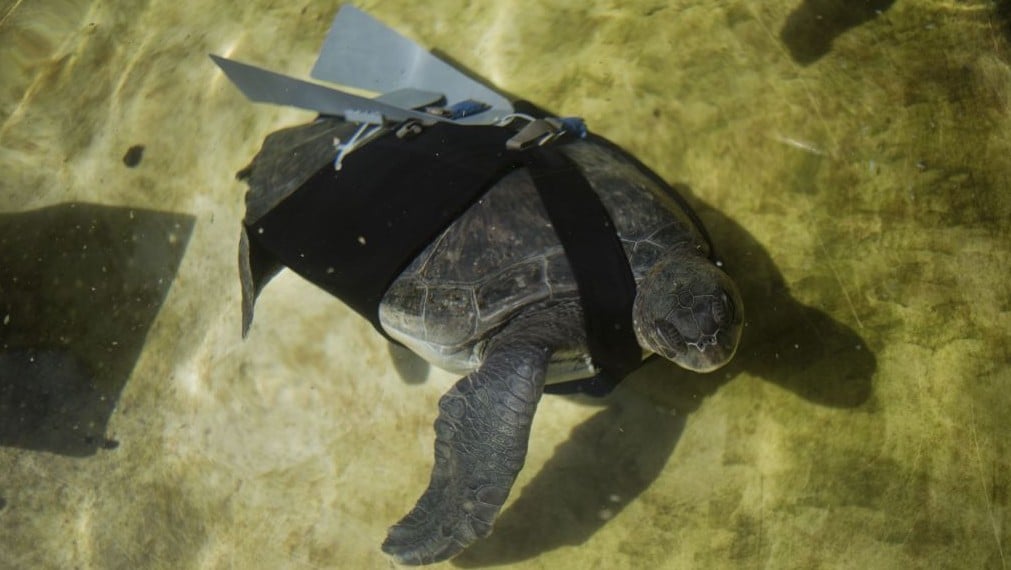
In this photo taken May 15, 2014, the green sea turtle, named “Hofesh,” the Hebrew word for “freedom,” is fitted with a prosthetic fin at the Sea Turtle Rescue Center in Michmoret, Israel. (Photo credit: AP/Ariel Schalit)
“Like humans, the females develop faster, ” Levy said. “The males don’t yet understand what the females want from them.”
Data of global importance
Over the past four years, the breeding nucleus has produced 1,300 eggs, the first of which were not viable. This discovery, like many others, is enabling Levy to add new insights and information to the global sea turtle knowledge base.
Some 20 research projects are underway at the center, in partnership with Israeli universities and turtle researchers overseas.
They include endocrinology (the study of hormones) and genetics. Sadly, not all of the research is positive. Levy discovered that heavy metal residues in turtle tissue and egg shells were three times higher in Israel’s Eastern Mediterranean region than in the Pacific Ocean.
“We test for five hormones,” he said. “We already know which female is about to lay eggs. We know who has mated with whom, and how long they took to do it.”
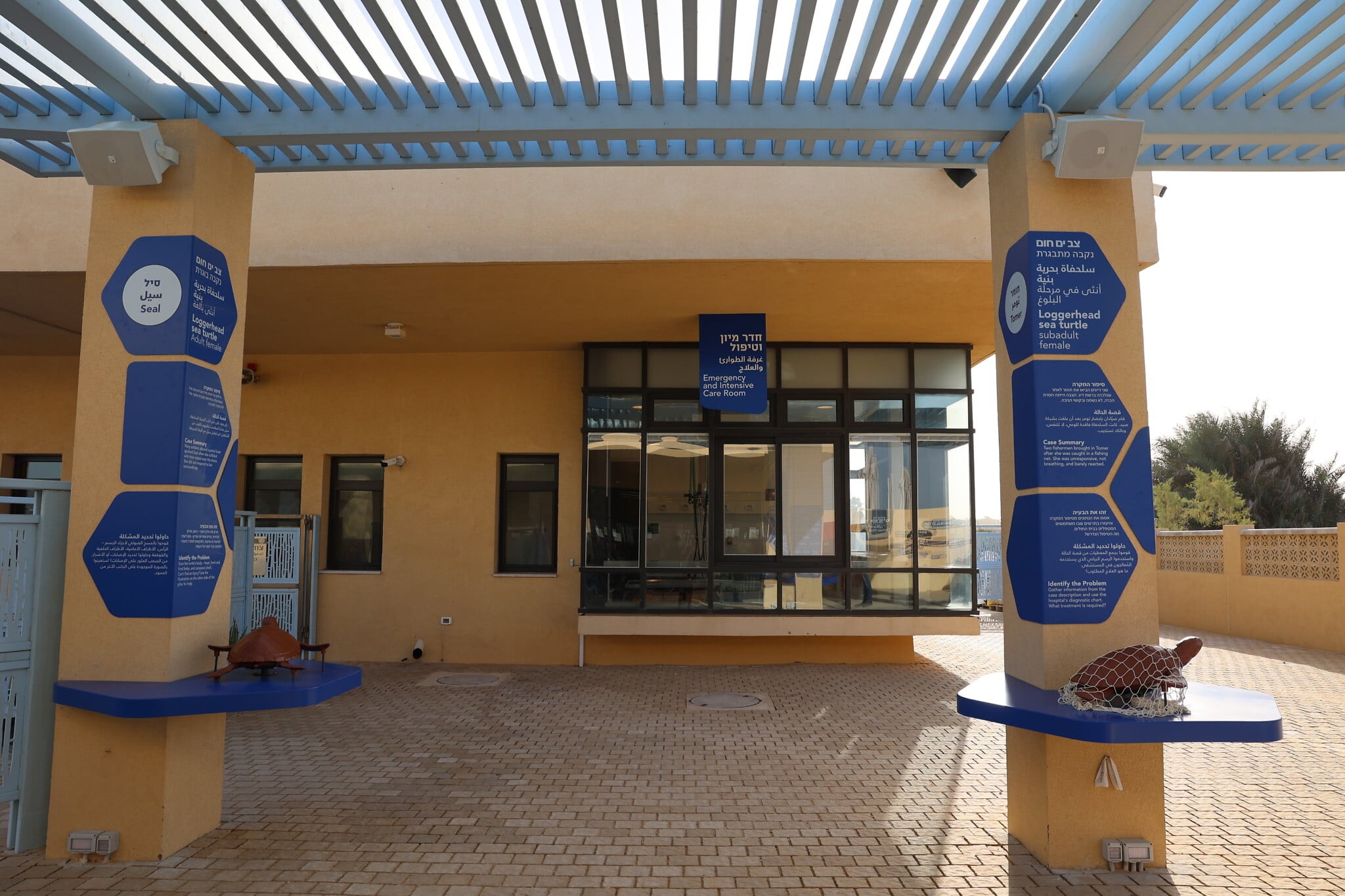
The Emergency and Intensive Care Room at the new National Sea Turtle Rescue Center, in Yannai, central Israel, December 8, 2025. (Shay Isaacs, Israel Nature and Parks Authority)
Sensors alert staff when a female exits the water and clambers onto the sand to lay eggs. Cameras then record and broadcast the process.
Educating the public
The new center hopes to build on those efforts. Its predecessor, cobbled together from shipping containers and ramshackle buildings on the same site, was smaller. Turtles requiring X-rays had to be rushed to a radiologist in Rehovot, roughly 55 kilometers (34 miles) inland to the south.
And outside of events held during holidays or to release rehabilitated turtles or hatchlings to the sea, it was open only to staff, volunteers, and researchers.
The new complex, by contrast, consists of an emergency and intensive care suite, with a reception area, X-Ray room, and operating room, and multiple large outdoor tubs containing seawater where green and loggerhead turtle “patients” recover. The breeding area comprises two large pools and ribbons of sand where females can lay their eggs.
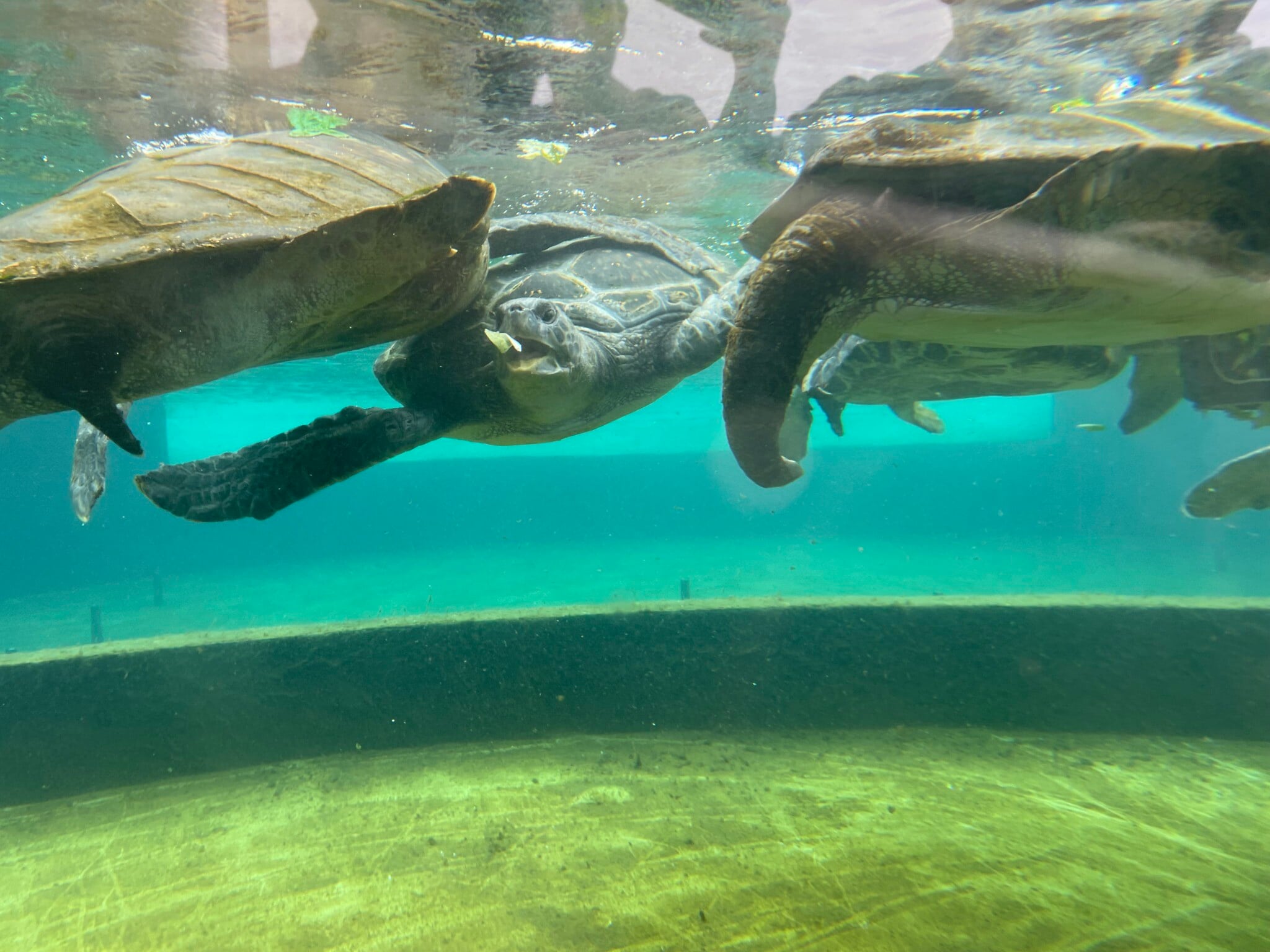
A green sea turtle, seen through an observation window, grabs a piece of lettuce at the National Sea Turtle Rescue Center, Yannai, central Israel, December 8, 2025. (Sue Surkes/Times of Israel)
During a 75-minute tour, visitors to the new center will collect their pre-booked tickets from the gift shop before watching a 12-minute movie in an auditorium.
They will then watch what is happening in the emergency care reception room through a window, moving on to the turtle recovery tubs, where volunteers distribute precise amounts of food and medicine to the marine occupants.
The visit will culminate at one of the breeding pools, where the turtles can be seen from a viewing bridge or underwater through a reinforced window.
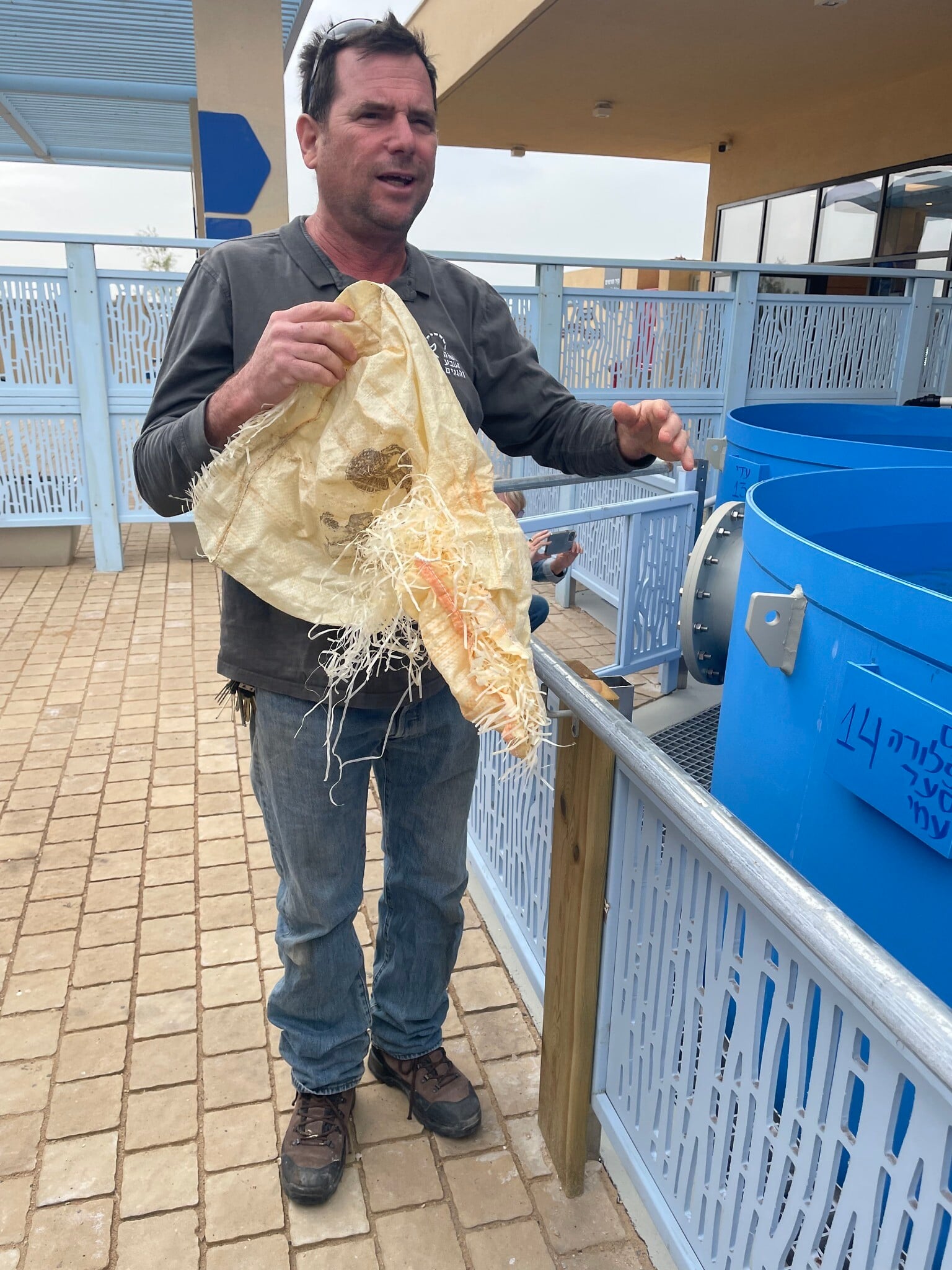
Yaniv Levy, Director of the National Sea Turtle Rescue Center, in Yannai, central Israel, shows an example of garbage that can entangle sea turtles, which mistake it for a carpet of algae, December 8, 2025. (Sue Surkes/Times of Israel)
During the media visit, journalists were treated to the spectacle of dozens of turtles flapping around a large lettuce feeder that had been lowered into the water.
Guides will explain the many dangers facing sea turtles today, among them pollution, underwater explosions, collisions with boat and ship propellers, and entanglement in abandoned fishing gear and garbage, particularly plastic bags.
This year, 176 injured green and loggerhead sea turtles were brought to the center, 67% of which had become entangled with plastic, and 85 were released back into the sea. Around 28,000 hatchlings were born along Israel’s Mediterranean coast, including those from the breeding group, and were escorted back to the water.
Only around one in every thousand will survive into adulthood.
“People won’t be coming on safari,” said Na’ama Dror, who directs audience and community at the parks authority. “They will learn how Israel is saving turtles from extinction.”