
I arrived at the Emergency Room doors in an Uber in the middle of the night, feeling woozy and anxious about what seemed like a mutiny taking place south of my ribs. A security guard helped me navigate a digital sign-in screen that seemed absurdly complicated and found me a wheelchair, which he parked in the entrance foyer alongside about two dozen worried-looking people, all waiting their turn. I clutched a knapsack containing the two objects that had seemed important to bring: a book and my smartphone backup battery. As I watched for my number to come up, I rehearsed the medical history I’d tell the triage nurse.
Over the next 30 hours or so, I felt like I was being absorbed by the Sunnybrook Health Sciences Centre — from that waiting area to a chair in the orange zone, then a gurney in a curtained cubicle and, several shapeless hours later, one with a door. From there, a night in a basement storage area dubbed the Transitional Care Unit and finally up onto a patient ward, where a double room with its own bathroom awaited.
For several days, I told my story to a succession of doctors, gave blood samples and was wheeled around on a gurney to undergo imaging tests in the far-flung corners of the warren of buildings that make up the GTA’s largest regional trauma centre.
The experience of being pushed on a stretcher is discomfiting: the upright people you pass — outpatients, visitors — never make eye contact. But as I began to pay attention to Sunnybrook’s geography and all the bodies flowing through the corridors, I was struck by its unmistakable urbanism. I write about how cities work; once I’d noticed the hospital’s social rhythms and its topography, I couldn’t unsee the curious reflection of the metropolis outside.
Scarcely a news cycle passes without some urgent conversation about Canada’s health care system, with its escalating costs, over-burdened labour force and apparent lack of efficiency. We listen in on tense policy debates about qualifying internationally trained doctors, the dearth of family physicians and the role of private clinics in delivering procedures such as hip replacements.
Our perceptions are also rooted in personal experiences and our attitudes about the way health care is delivered, or not, in the U.S (that is, having to pay for it). Almost all of these disparate pressures hit the ground in Canada’s public hospitals, the places in our communities where we least want to be and yet need most in times of crisis, as in a pandemic or a midnight trip to the ER.
Beyond some designer lobby architecture, hospitals are deeply functional buildings, filled with outpatient clinics, Operating Rooms and patient wards. We don’t think about their sense of place.
In this regard, Sunnybrook is an oddity. It opened in 1948 as a veteran’s hospital on a former estate, and has grown for decades, adding large extensions while re-modeling entire departments — a process that continues to this day with the recent completion of a new wing.
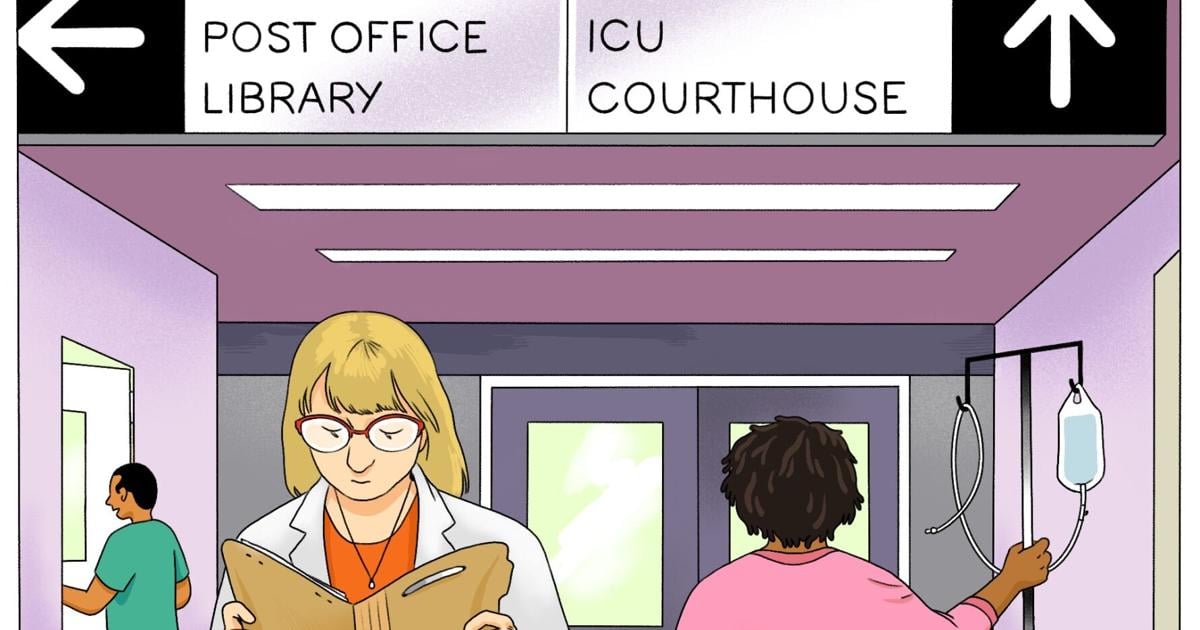
The result is a sprawling walled city with a hierarchical internal street network that includes shortcuts (both horizontal and vertical), bridges, a retail high street, public spaces, tunnels, breezeways and cul-de-sacs. There are office districts, technology parks, education and industrial zones, waste management depots, a flea market and residential areas — the wards, which are gated communities, accessible only via intercoms. Much of Sunnybrook, moreover, shows its age, and bears a bit of the ambience of older downtown neighbourhoods — aging, scuffed, messy.

Ivy Johnson illustration
There’s a lot of traffic here on wheels — not just gurneys, but all manner of portable diagnostic gear, IV posts, waste bins, floor Zambonis, and computer stations. The corridors have way-finding signage that’s not always helpful, as well as taped-off parking zones and unspoken rules of the road: no speeding, no road rage and anyone pushing a patient gets the right of way.
To pull this thread a bit further, it struck me that the ER, with its aura of barely-managed chaos and crowding, is nothing if not a kind of border zone, set up to process the waves of asylum seekers who arrive from that other city of health, literally seeking refuge from what ails them.
Besides the physical echoes, the most conspicuously urban trait of a place like Sunnybrook is the incredible diversity that marks its workforce of some 11,000 people as quintessentially Torontonian.
The people I encountered — both staff and patients — came from everywhere, and represented, on any given day, a microcosm of the city-region beyond Sunnybrook’s walls. Like all big cities, their ranks include local characters, like Lillian, a nurse with 37 years of experience whom I met twice. Her exclusive task is to roam the corridors and insert IVs, which is her superpower and the reason Sunnybrook didn’t want her to retire. As another nurse told me with an approving grin, Lillian can find the shyest of veins. “I am the best,” she agreed, her eyes twinkling behind her mask.
Unlike our wider metropolis, which sometimes seems like a tower of Babel, the hospital city communicates with itself in a widely understood lingua franca: the language of medical science — data, observation, questions, technical explanations, more data. We exist in a cynical era defined by hostility towards the medical professionals and the health sciences. So it felt refreshing that no one I encountered was trafficking in dubious DIY research or the results of a cursory search, much less what too often passes as knowledge in our distracted online world.
Indeed, the prevailing discourse within the hospital-city — kindness instead of anger, candour instead of BS — revealed for me the ways in which the urban culture at an institution like Sunnybrook — and, frankly, any big-city hospital — diverges from the urban culture outside.
Case in point: fashion is unhelpful for most hospital staff, while patients’ clothing is seen as an obstacle to diagnosis and treatment. Any sense of personal space vanishes in an instant. However, the strange thing is that once surrendered, it doesn’t feel like an absence or a source of shame, but rather the price of admission. I found myself thinking about how invested we are in privacy, status and artifice, and then how superfluous these features of modern urban society become when we’re thrust into a specialized world that doesn’t care about any of that stuff.
When I finally arrived to my room after being admitted, the patient in the bed next to the window was an extremely elderly man whose breathing was so laboured that he sounded as if he was underwater. For several days, the members of his large, extended family came and went — adult children, grandchildren, daughters-in-law, etc.; he was, to their credit, rarely alone.
With nothing but a flimsy curtain dividing the suite, I could plainly hear the strain etched in their voices as they sought to comfort him. But those bedside conversations also drifted in all sorts of directions — a wedding in New York, a reno job, travel logistics.
One afternoon, the man’s doctors wandered in and began laying out palliative care options and summarizing the family’s directions. “I’m a doctor,” one of the attending physicians said softly, “but I’m also a daughter. I know how hard this is.” Moments after they left, someone on the other side half-whispered, “He’s stopped breathing.” The elderly man just died, ever so quietly — an entirely common occurrence in a hospital, yet one that left me feeling as if I had intruded on a solemn, grieving space that should have been far more private.
A day later, that bed came to be occupied by an older woman with cancer. She had no visitors, so I’d get her a double-double and a muffin on my daily run — escape — down to the Tim’s on the main floor.
One evening, quite late, two doctors came to see her. They explained that the medical team had overlooked an important detail on her imaging, and apologetically recommended that she undergo surgery as soon as possible. She let out a sharp sob, but quickly collected herself and told them she wasn’t sure what she wanted to do.
Later, in the perennial twilight of all hospital rooms at night, I heard her voice drift over the curtain. “Hey roommate,” she called out. “What do you think? Should I get the operation?” I told her I couldn’t and shouldn’t offer an opinion. Another disconcertingly intimate moment.
Most people who end up in a hospital room with more than one bed experience some form of this radical blurring of private and public, sequestered with complete strangers, and their visitors, in circumstances that are very much less than ideal.
No one wants to spend more time than is absolutely necessary in a patient ward. Yet there’s also something suggestively urban about such sojourns, like a highly distilled version of living in a dense neighbourhood. Meaning: those places where you can clearly hear what’s going on in the next flat or the house on the other side of the party wall while the city beyond pulses to its own improvised rhythms, some of them welcome; some, definitely not.
After almost a week at Sunnybrook, I was told I would be moved downtown, to Mount Sinai, which specializes in what seemed to have attacked me. A patient transfer vehicle arrived at 10:30 p.m. — did I mention that a hospital, like New York, is the city that never sleeps? — and the two attendants strapped me to a gurney. I was loaded inside, facing backwards. As they navigated downtown through a light snow, I tried, without much success, to get my bearings.
I spent four more days, including a dull weekend, at Sinai as the doctors there ordered more tests, drew lots more blood, and began orbiting around a consensus diagnosis. The care culture felt virtually identical, but Sinai, a single purpose-built structure, doesn’t have Sunnybrook’s meandering, idiosyncratic terrain.
Ten days after stumbling into the ER, I found myself waiting for an Uber outside Sinai’s Murray Street entrance, eagerly anticipating a decent meal, a long shower and a walk. It was a bitterly cold afternoon. As we picked our way through rush-hour traffic, I watched pedestrians crowd onto the sidewalks, heading home or out after a day’s work, most of them not thinking about these health care cities within the city that open their portals whenever the need arises.
Opinion articles are based on the author’s interpretations and judgments of facts, data and events. More details