
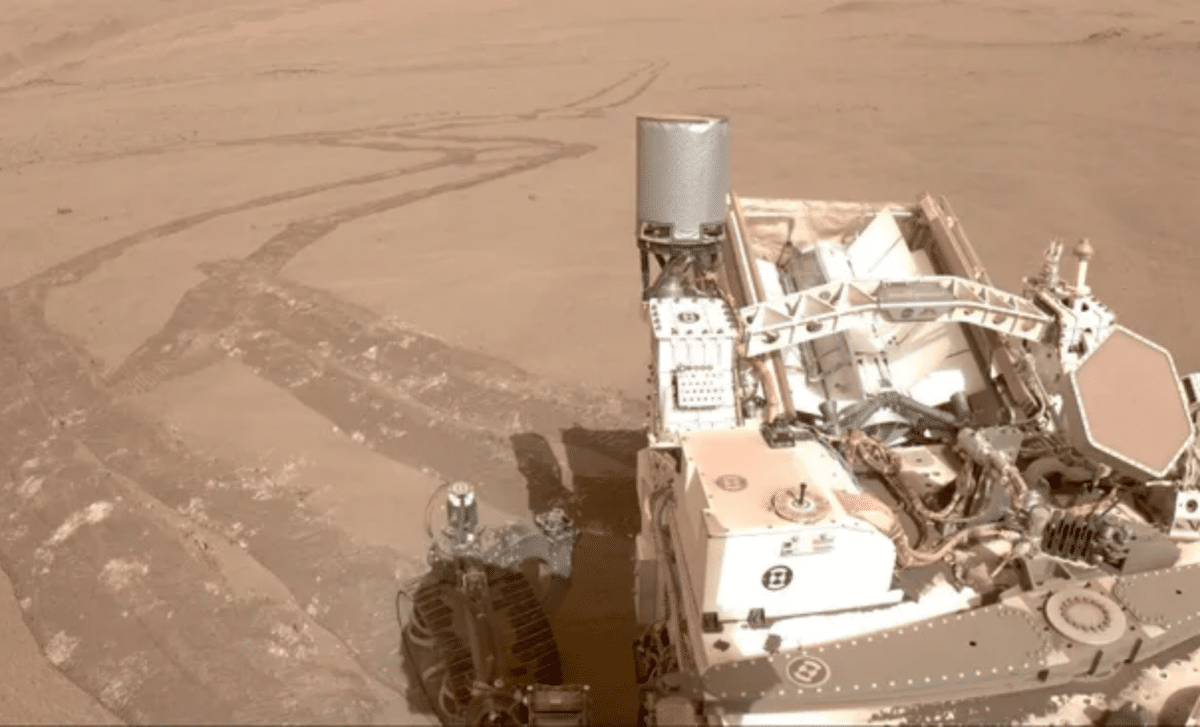
NASA’s Perseverance rover has officially crossed the 42.2-kilometer mark on Mars, surpassing the equivalent of a marathon. This achievement, announced just ahead of the rover’s five-year anniversary, builds on findings presented by NASA’s Jet Propulsion Laboratory (JPL) . The Jezero Crater explorer is not only proving its longevity but also gearing up to break a new record, potentially becoming the longest-distance traveler on another planet.
A Mission Engineered For The Long Haul
As the mission continues, engineers at NASA’s Jet Propulsion Laboratory (JPL) have confirmed that Perseverance is more than ready for extended operations on the Martian surface. According to a detailed update shared during the American Geophysical Union’s annual meeting, the rover’s systems were put through rigorous checks to ensure long-term mobility and scientific functionality.
“These tests show the rover is in excellent shape,” said Perseverance’s deputy project manager, Steve Lee of JPL, who presented the results at the conference. “All the systems are fully capable of supporting a very long-term mission to extensively explore this fascinating region of Mars.”
Backed by enhanced hardware and robust software, the rover has already logged 26.3 miles (42.32 km), and with components like its rotary wheel actuators certified for up to 60 more kilometers, there’s much more terrain in its future. This milestone proves that not only is Perseverance durable, but it’s also increasingly autonomous, making it a model for future interplanetary exploration.
A Self-Driving Pioneer On The Red Planet
One of the most significant breakthroughs of the Perseverance mission has been its ability to drive autonomously across the Martian landscape, a feat unmatched by earlier rovers. Using terrain mapping algorithms and hazard avoidance software, the rover can navigate large distances with minimal human input, a critical advantage given the delay in communication between Earth and Mars.
“More than 90% of Perseverance’s journey has relied on autonomous driving, making it possible to quickly collect a diverse range of samples,” said Hiro Ono, a JPL autonomy researcher and lead author of the recent paper. “As humans go to the Moon and even Mars in the future, long-range autonomous driving will become more critical to exploring these worlds.”
This development has enabled the science team to prioritize sample collection from multiple scientifically relevant locations within shorter timelines, without sacrificing safety or efficiency. The success of this autonomous system, tested on Perseverance, lays critical groundwork for the next generation of planetary rovers, and even crewed missions.
Opportunity’s Record In Sight
The current benchmark for the longest distance driven on another world belongs to Opportunity, which logged 28.06 miles (45.16 km) during its nearly 15-year mission. At its current pace, Perseverance is on track to exceed that record, potentially within the coming months. But speed isn’t the only goal: each kilometer traveled brings Perseverance closer to the ancient river delta formations and geologically rich zones that may hold clues to past microbial life.
During its most efficient travel campaign, the rover covered 5 kilometers in just 24 sols (Martian days), showcasing the powerful synergy between planning teams on Earth and the vehicle’s onboard navigation software. With its ability to perform high-speed, safe traverses and pause for in-situ scientific analysis, Perseverance represents a new standard in mobile Mars science.
Built To Persevere, Designed To Discover
JPL engineers are confident the rover can cover a total of 100 kilometers (61 miles), with the current hardware proving reliable even in harsh conditions. The brakes and motors, especially the rotary actuators, have been tested for long-term reliability, and the rover continues to show minimal wear despite rocky terrain and extreme temperature variations.
Lessons learned from earlier missions like Spirit, Opportunity, and Curiosity have directly influenced how JPL manages rover health. Even when mechanical components fail, NASA has repeatedly demonstrated its ability to adapt operational strategies to extend mission lifespans. Perseverance is expected to follow in that tradition, with mission planners already preparing new science routes based on satellite data and recent terrain scans.