
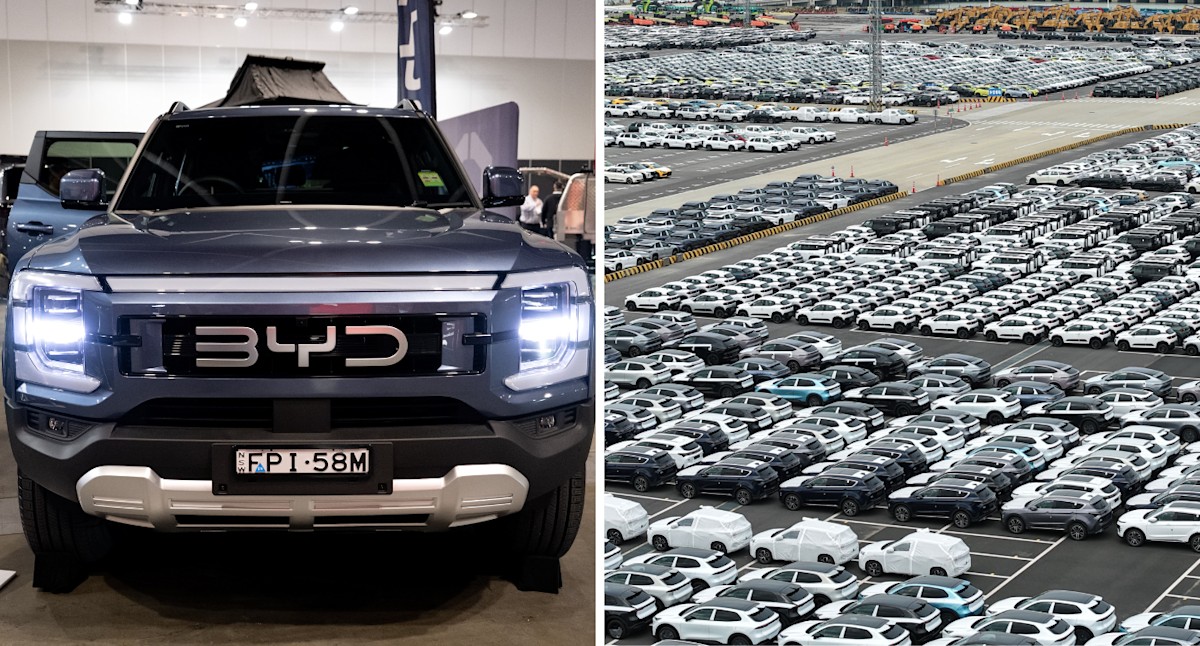
 Chinese car brands like BYD are rapidly expanding their market share in Australia. (Source: AAP/AP)
In the last full calendar year prior to the pandemic, of the 1.06 million cars sold in Australia, a little under 18,000 were manufactured in China. That’s just 1.69 per cent of the national total.
Fast forward to the end of 2025, and over a quarter of a million new Chinese-made cars hit Australia’s roads for the first time, accounting for over one in five new vehicles sold within our shores for the year (1.24 million total).
To put this into perspective, the largest source of new cars for Australia in 2025 was Japan, with 358,900, followed by China with 252,700 and Thailand in third position with 250,000.
RELATED
China is the second biggest source of new cars in Australia in 2025, behind only Japan. (Source: Tarric Brooker)
As more and more Chinese carmakers enter the Australian market and existing dealers add more models to their range, Chinese carmakers are set to become an even greater player in the nation’s domestic market.
This shift toward Chinese-made vehicles has been significantly boosted by the popularity of plug-in hybrid electric vehicles (PHEV).
Of the top selling PHEV’s in 2025, four out of five are manufactured in China, with the BYD Shark 6 and BYD Sealion 6 dominating the sales charts.
Four out of five of the top selling PHEVS were made in China. (Source: Tarric Brooker)
China’s meteoric rise in the Australian automotive world has been reflected in markets around the globe.
When 2020 drew to a close, China’s total automotive exports were not in a drastically different place to where they started the 2010’s, at around 1 million vehicles per year.
At the time, this put China in sixth place for the largest exporter of cars in the world, behind Japan, Mexico, Germany, South Korea and the United States.
According to estimates from the Council on Foreign Relations, by the end of last year, China was on track to export 10 million vehicles, with a little under 9 million of them being cars.
If realised, this would mean that China is not only the largest exporter of cars in the world, but larger than the next two highest performing nations (Japan and Mexico) and then some.
China is on track to export 10 million vehicles, with just under 9 million being cars. (Source: Brad Setser)
While China exports millions of entirely internal combustion engine vehicles each year, its rise as an automotive superpower has been underpinned by the rise of the various forms of electric vehicles.
As of the latest estimates from Council on Foreign Relations Senior Fellow Brad Setser, China’s exports of electric vehicles are running at approximately 4.4 million on a three-month annualised basis.
Story Continues
China’s exports of EVS. (Source: Brad Setser)
To put this into perspective, if realised over a full year, China’s electric vehicle industry alone would be the largest exporter of vehicles by nation in the world.
While much of the world is enjoying the additional competition Chinese-made cars are bringing to the market, nations defined by their automotive industries have quite a different perspective.
Once upon a time, China was seen as a boon for auto manufacturers from Turin to Tokyo, as the number of cars imported by the Middle Kingdom went from strength to strength, hitting a peak of over 1.4 million cars per year in 2014.
At the time, the means of the domestic Chinese car industry to compete with the likes of Audi, BMW and Mercedes was limited, driving strong demand for these vehicles and others made by European car manufacturers.
But in the last decade that demand has plummeted, as domestic Chinese car manufacturers equal and in some cases arguably exceed the standards of those made overseas.
BYD Sealion 7 is among the top selling PHEVS in Australia. (Source: BYD)
As of the latest data from the Chinese government, China is set to import under half a million cars in the 2025 calendar year, down well over 60 per cent from the peak recorded in 2014.
While the loss of vital export market share is concerning for global car makers, they are now seeing another challenging dimension arise, the influx of Chinese-made cars, particularly EV’s into their domestic markets.
Where once the loss of jobs to China in industries such as textiles or durable goods manufacturing was seen as simply the free market playing out, delivering cheaper goods, as it becomes clear that highly sophisticated manufacturing jobs and industries were under threat, policymakers have changed their tune.
For example, in Europe, amidst the rise of Chinese goods into their market and a growing trade deficit with China, French President Emmanuel Macron has warned that the European Union (EU) may be required to take “strong measures” against China.
This would include possible tariffs and the implementation of other trade barriers if Beijing fails to address its growing trade surplus with the EU.
“I’m trying to explain to the Chinese that their trade surplus isn’t sustainable because they’re killing their own clients, notably by importing hardly anything from us any more,” Macron said.
“If they don’t react, in the coming months we Europeans will be obliged to take strong measures and decouple, like the US, like for example tariffs on Chinese products.”
Amidst long waiting lists for some new brands and models, the rise of the Chinese-made car in Australia’s domestic market appears set to continue into 2026 and beyond.
On the global automotive stage, China appears set to expand its domination of the world’s car export market.
The big question going forward is what traditional car manufacturing nations, which don’t already have trade barriers up against Chinese vehicles, are set to do about this.
Where once the rise of China was defined by cheaper televisions and clothing, it is now increasingly treading on toes throughout the developed world.
Ultimately, policymakers have a choice to make: do they protect domestic industry at the price of greater costs to the consumer, or do they allow their industrial base to be hollowed out, leaving them vulnerable to a crisis and reliant on China on an ongoing basis?
Get the latest Yahoo Finance news – follow us on Facebook, LinkedIn and Instagram.