
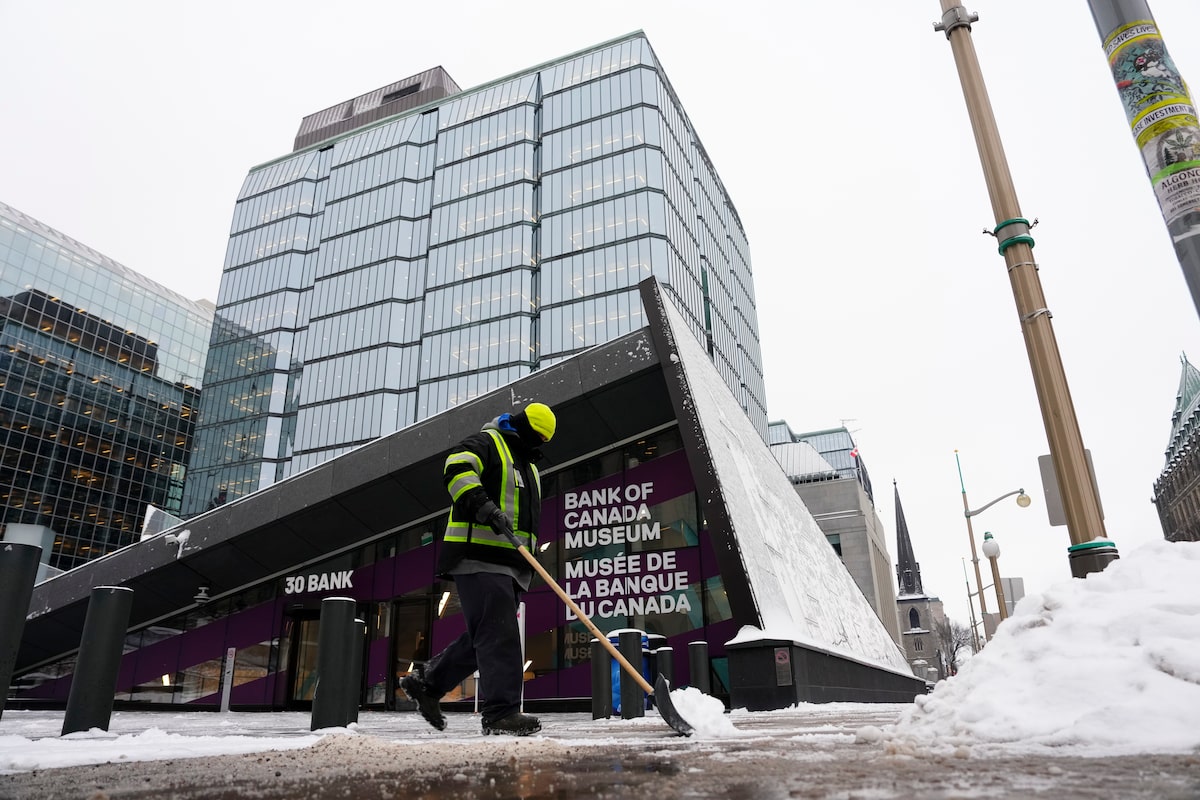
A worker shovels snow in front of the Bank of Canada in Ottawa on Dec. 10, 2025.Sean Kilpatrick/The Canadian Press
The past three weekends have featured a raid on Venezuela, a subpoena of the U.S. Federal Reserve chair, and threats to Greenland. Each sent emergency flares through the market, only to fizzle out by week’s end. Let’s keep that in mind now that it is our turn. Now, for some reason, I have a sudden, unexplainable craving for tacos.
Mercifully, earnings will take centre stage this week with 102 companies on the S&P 500 reporting and 12 on the Toronto Stock Exchange.
Here are five things to know:
Decision day: The Bank of Canada and the Federal Reserve will both make interest-rate decisions on Wednesday and neither are expected to change rates. The BoC’s announcement was slated to be a non-event, but now that U.S. President Donald Trump is threatening 100-per-cent tariffs if we sign a deal with China (which he said was a good idea less than two weeks ago), it just became more eventful. What exactly is the BoC’s threshold for cutting rates on trade fears? If the United States-Mexico-Canada Agreement gets cancelled altogether, does that trigger them? Expect specific questions at the presser, but it’s unclear whether we will get specific answers. As for the U.S. rate decision, the market has priced out the chance of any rate cuts at all this year. A few months ago, the market was pricing in at least one. A few things have happened: The U.S. job market didn’t completely crash out, inflation remains sticky, and U.S. GDP for the third quarter was revised to a stunning 4.4 per cent, with the Atlanta Fed GDPNow indicator suggesting 5.4 per cent for the fourth quarter.
“The battle between the hawks and the doves will be on full display next week,” Bank of Montreal’s U.S. economist Scott Anderson wrote. “Expect [Fed chair Jerome] Powell to emphasize that policy remains in a ‘good place’ right now with little urgency to act in either direction.”
Tech check: Should we even bother talking about all the mega-cap tech firms reporting earnings this week? The Mag 7 are now the Lag 7 in 2026, underperforming the S&P 500 and small caps. They still represent 30 per cent of the market so it’s probably prudent to skim over their results. Magnificent 7 stocks Meta Platforms Inc. META-Q, Microsoft Corp. MSFT-Q, Tesla Inc. TSLA-Q and Apple Inc. AAPL-Q are all reporting this week, as is International Business Machines Corp. IBM-N Meta and Microsoft will be reporting Wednesday afternoon. Both stocks are down more than 10 per cent from their record highs. For Meta, attention will be focused less on how their core business is doing (Are advertisers spending? Are users still ‘gramming?) and more on their artificial-intelligence spending plans. In early January, Mark Zuckerberg announced the company is planning to build tens of gigawatts of AI compute infrastructure this decade. “We believe there is some room for [total expenses and capital expenses] to tick higher,” Stifel analyst Mark Kelley wrote in a preview note to clients. He warned that spending could increase more than consensus expectations, and said he “would be cautious owning this one into the print.”
Memory problems: Apple has the honour of being the worst-performing Magnificent 7 stock in 2026 ahead of results Thursday. Its woes are less about its AI platform (or lack thereof) and more about concerns around the soaring price of memory chips, a key component for Apple devices. Ironically, memory-chip maker Sandisk Corp. SNDK-Q also reports the same day and is expected to show a more than 40-per-cent jump in revenue, highlighting how acute the problem is for end users such as Apple. Remember, no one makes smartphones as profitably as the iPhone maker. Investors are waiting to see how much rising memory prices are going to hurt margins in the back half of the year, UBS analyst David Vogt said. Memory chips make up about US$50 of the cost to make a single device, according to Mr. Vogt’s analysis. The average selling price for an iPhone is just over US$1,000. That might not look like a big deal, but that brings us to Apple’s other problem: valuation. Mr. Vogt noted Apple is trading at a 28-per-cent premium to the S&P 500, and while that is better than the 50-per-cent premium at the beginning of December, it is still elevated, he argued.
Ride the rails: The old saying is “trains, planes and automobiles,” but if we were ranking it in terms of performance, it would be “rocket ships, planes, autos … rails.” Canadian Pacific Kansas City Ltd. CP-T and Canadian National Railway Co. CNR-T report results this week as the stocks have been slowly chugging along for months. CP Rail has been promising for a while to grow earnings 15 per cent, since its merger with Kansas City, but it has yet to hit that target. Meanwhile, CN Rail has cut its forecast three years in a row. Toronto-Dominion Bank analyst Cherilyn Radbourne warned there is a risk that CP Rail’s profit growth outlook will miss expectations and that CN Rail will look to underpromise and overdeliver after a string of misses. Aside from earnings, there are two risks to the rails: the renegotiation of USMCA, and mergers and acquisitions south of the border. On trade, the current status of Prime Minister Mark Carney and Mr. Trump’s relationship would fall under “it’s complicated.” On M&A, Ms. Radbourne warned that the proposed tie-up between Union Pacific and Norfolk Southern makes the Canadian rails “vulnerable to a focus of investor fund-flows in the U.S. rails.”
Game day: Rogers Communications Inc. RCI-B-T is set to report quarterly results Thursday morning. It was the best performing telco last year as it integrated its 2023 acquisition of Shaw and closed its deal to buy BCE Inc.’s BCE-T stake in Maple Leaf Sports & Entertainment Ltd. Unlike its peers, its dividend was never in question, and that also added to performance. While the stock has outperformed, RBC Capital Markets analyst Drew McReynolds believes there is more room to run. “We view the shares as less oversold but still undervalued trading at a discount to large-cap peers,” Mr. McReynolds said in a preview note to clients. Yes, telcos still face slower growth because of reduced immigration. But there are a number of offsetting factors for Rogers, Mr. McReynolds argued, such as paying down debt, balance-sheet repair and optionality from selling a minority stake in MLSE.
In the Money with Amber Kanwar is Canada’s top investing podcast. New episodes out Tuesday and Thursday. Subscribe now at www.inthemoneypod.com