
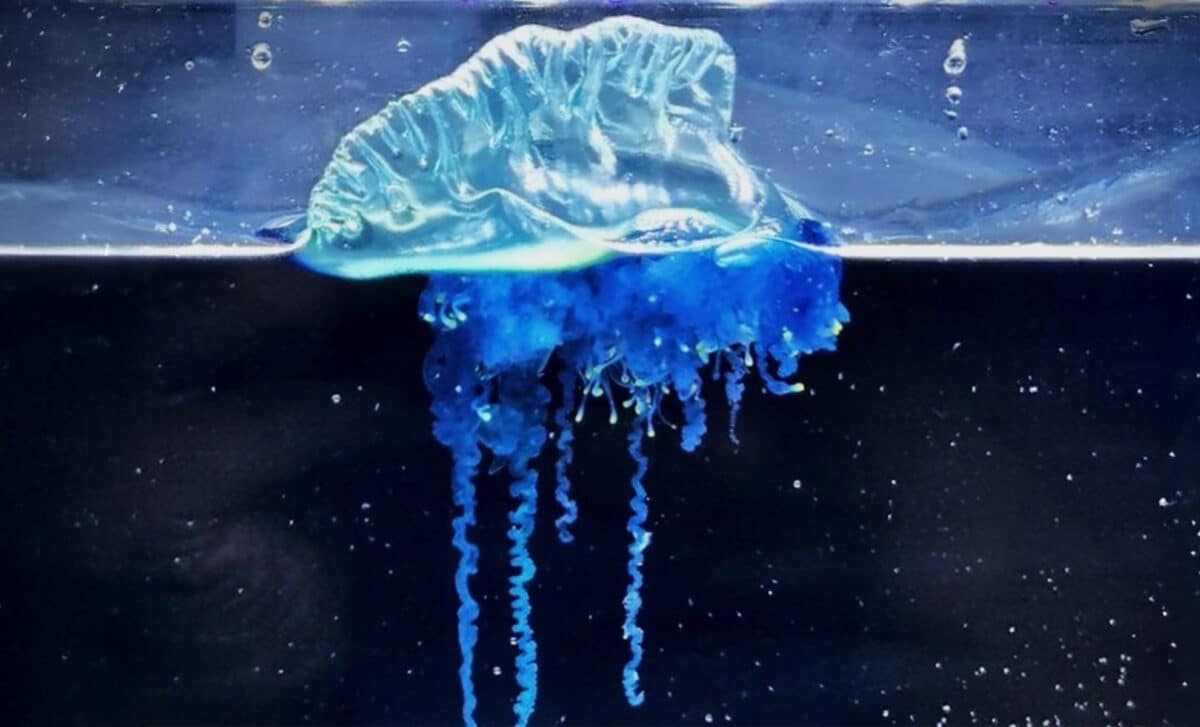
At first glance, it resembled the infamous Portuguese man o’ war. But after detailed analysis, researchers confirmed it was a completely new species, Physalia mikazuki, a venomous tropical invader that found its way to the cooler waters of Sendai Bay.
Named after the crescent-moon-shaped helmet of the 16th-century warlord Date Masamune, this newly discovered siphonophore is raising alarms about shifting marine life patterns, climate-driven ocean currents, and potential risks to human safety.
Rare Find on a Temperate Beach
In July 2024, locals strolling along Gamo Beach in Japan’s Tohoku region noticed something unusual, bright blue balloon-like creatures stranded in the sand. These beaches are historically too cold for tropical species, which made the sighting immediately curious. Among the first to investigate was researcher Yoshiki Ochiai, who happened to be in the area on an unrelated study.
“I scooped it up, put it in a ziplock bag, hopped on my scooter, and brought it back to the lab,” Ochiai explained. What followed was a meticulous examination that revealed clear structural differences between this creature and the known Portuguese man o’ war.
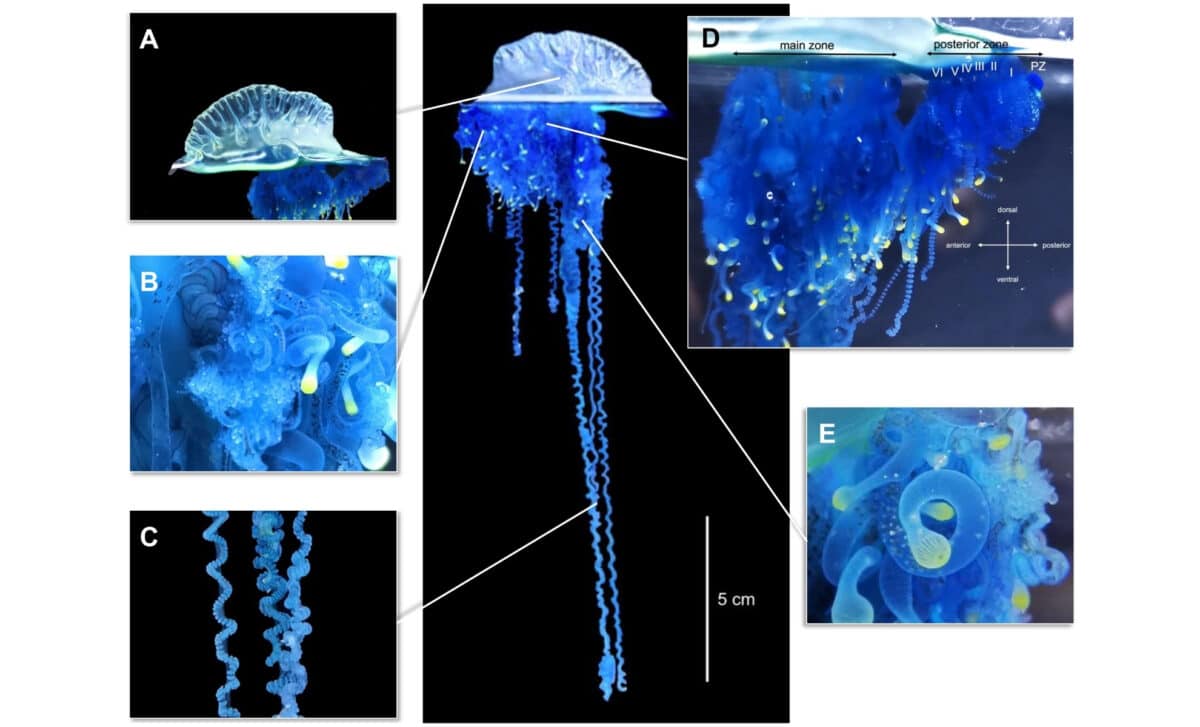 Morphological characteristics of Physalia mikazuki sp. nov. collected from Gamo Beach, Sendai City, Miyagi Prefecture, Japan – © Frontiers in Marine Science
According to ZME Science, the new species’ float only reaches up to 72 mm, far smaller than the familiar Physalia physalis, which can grow to 300 mm. Its colors range from deep blue to purple, and its translucent membrane shows bluish-green tones. Internally, its feeding and fishing tentacles are uniquely shaped and arranged, making it unmistakably distinct from its relatives.
A Name Rooted in Local History
The name mikazuki comes from the Japanese word for “crescent moon” and pays tribute to Date Masamune, the founder of Sendai City. The crescent-shaped float of the creature mirrors the warlord’s iconic helmet, linking this scientific discovery to a symbol of local cultural identity.
This connection between taxonomy and history adds another layer to the find. It’s not just a new species, it’s one that carries the region’s legacy in its name. As described by the research team at Tohoku University, the process of identification was slow and demanding. Lead author Chanikarn Yongstar highlighted the effort it took to match each anatomical detail with illustrations found in historical marine biology texts. “A real challenge when you look at just how many tangled parts it has,” she remarked.
Until now, scientists believed the genus Physalia only included one or two valid species. The emergence of Physalia mikazuki not only adds to that list but shifts our understanding of where and how these creatures can survive.
Climate Shifts Enable Tropical Migration
The sudden appearance of Physalia mikazuki in northern Japan isn’t random. Scientists traced its journey using particle tracking simulations, which showed how abnormal heatwaves and warm ocean currents in 2024 likely carried the species far beyond its usual tropical range.
This movement, driven by climate anomalies, brings not just a new species but new risks. Like its relatives, mikazuki is venomous. Its tentacles can inflict painful stings on humans, raising public health concerns in an area that rarely faced such dangers in the past. This could impact tourism in the Tohoku region, especially along beaches unaccustomed to the presence of stinging marine life.
Ecologically, the impact could be deeper. As a carnivorous predator, Physalia mikazuki feeds on fish larvae and small plankton, two critical components of the local marine food web. Its presence could destabilize predator-prey relationships and interfere with commercial fisheries in the region.