
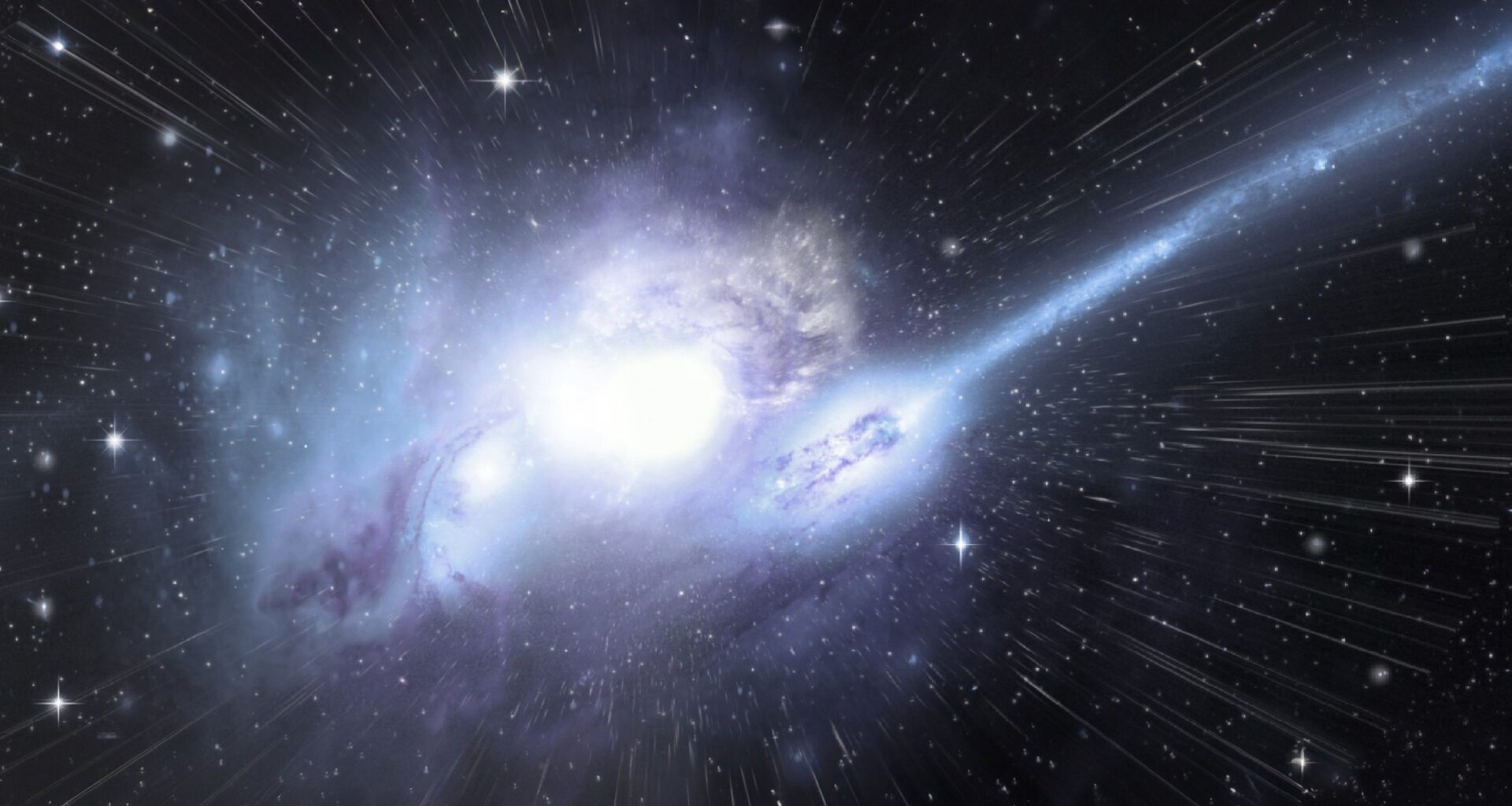
Fast radio bursts are some of the strangest signals we pick up from space. They last just a few thousandths of a second, but they can outshine whole galaxies in radio light while they’re happening.
For years, one big question kept hanging around: what kind of object can make something that loud and fast – and sometimes do it again and again?

Now, a long set of telescope observations has added a major piece to the puzzle. The key idea is simple. Some of these repeating fast radio burst sources are not alone in space – they have company.
A signal that points to two stars
The new work centers on a repeating source called FRB 220529A, located about 2.5 billion light-years away.
Over nearly 20 months, astronomers watched it closely enough to catch a rare change in the radio signal. The kind of change that was detected could only happen if the burst source sits in a messy, active neighborhood.
That neighborhood looks a lot like a binary stellar system, where two stars orbit each other.
Instead of an isolated star sending bursts into empty space, the repeating source appears to share its space with a nearby partner star that can stir up the environment around it.
The observations were led by an international team using the Five-hundred-meter Aperture Spherical Telescope (FAST) in Guizhou.
FAST, also called the “China Sky Eye,” is huge – with a dish about 1,640 feet across. The team also used Australia’s Parkes radio telescope to support the result.
Radio wave with strange activity
Fast radio bursts are known for having radio waves that are almost perfectly lined up in a single direction, a property called linear polarisation.
As those waves move through hot, charged gas threaded with magnetic fields, the angle of that polarisation can rotate. Scientists measure that effect using something called rotation measure, or RM.
In late 2023, the team saw RM swing wildly for FRB 220529A, then settle back down. The team calls this short, sharp event an “RM flare.” It acts like a fingerprint of the material the radio waves passed through right before reaching Earth.
Dr. Ye Li of Purple Mountain Observatory and the University of Science and Technology of China is the study’s first author.
“Near the end of 2023, we detected an abrupt RM increase by more than a factor of a hundred,” said Dr. Li. “The RM then rapidly declined over two weeks, returning to its previous level.”
Why a companion star fits the data
A fast change like that suggests that a dense cloud of magnetised plasma briefly crossed the line of sight between Earth and the burst source.
The team links that plasma to a coronal mass ejection, or CME, from a nearby companion star. CMEs are big eruptions of charged particles that stars can throw into space, including our own Sun.
“One natural explanation is that a nearby companion star ejected this plasma,” explained Professor Bing Zhang, founding director of the Hong Kong Institute for Astronomy and Astrophysics at the University of Hong Kong HKU.
Professor Yuanpei YANG of Yunnan University noted that the team’s model works well to interpret the observations. “The required plasma clump is consistent with CMEs launched by the Sun and other stars in the Milky Way.”
Repeating radio bursts reward patience
Repeating fast radio bursts are rare, but they’re priceless for researchers because they let telescopes watch the same source over time.
Patterns can show up only after months of monitoring, especially if the bursts interact with changing material around the source.
FRB 220529A was part of a dedicated FAST program that has tracked repeating sources since 2020. For a while, it didn’t stand out.
“FRB 220529A was monitored for months and initially appeared unremarkable,” said Professor Zhang. “Then, after a long-term observation for 17 months, something truly exciting happened.”
Linking magnetars to fast radio bursts
The new result lines up with an idea many astronomers already take seriously: magnetars may be behind at least some fast radio bursts.
A magnetar is a type of neutron star, the ultra-dense remnant left after a massive star explodes, with a magnetic field so strong it can reshape the space around it.
When a magnetar sits near another star, that partner can dump plasma into the area, changing what the burst signal looks like when it leaves.
“This finding provides a definitive clue to the origin of at least some repeating FRBs,” said Professor Zhang. “The evidence strongly supports a binary system containing a magnetar – a neutron star with an extremely strong magnetic field, and a star like our Sun.”
The team credits the result to long, careful observing time and persistence across multiple facilities.
According to Professor Xuefeng Wu of Purple Mountain Observatory, the discovery was made possible by the persevering observations using the world’s best telescopes and the tireless work of a dedicated research team.
The full study was published in the journal Science.
Image Credit: NASA/JPL-Caltech
—–
Like what you read? Subscribe to our newsletter for engaging articles, exclusive content, and the latest updates.
Check us out on EarthSnap, a free app brought to you by Eric Ralls and Earth.com.
—–