
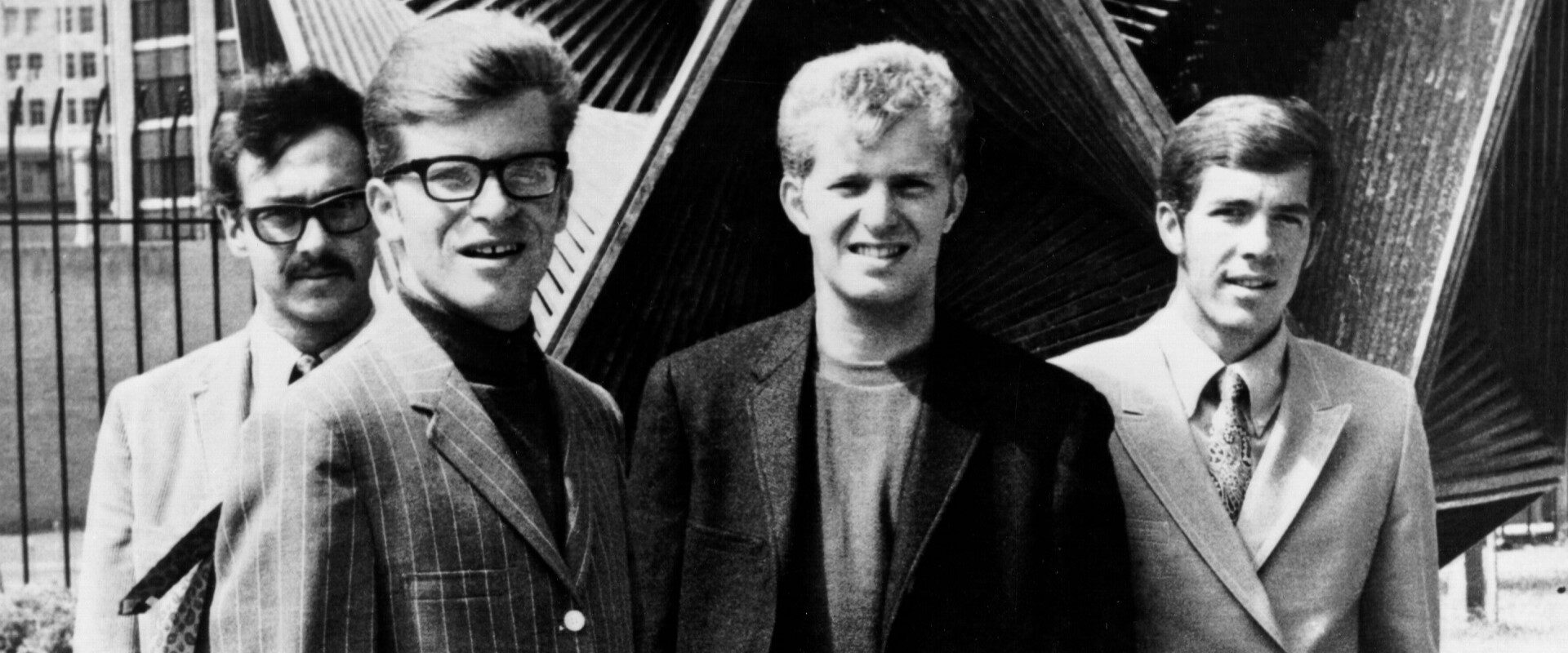
John Fogerty has been on bad terms with the other surviving members of Creedence Clearwater Revival, bassist Stu Cook and drummer Doug Clifford, for decades. That being said, the former bandmates began as friends who first met when they attended the same junior high school.
In a recent interview with the VRP Rocks YouTube channel, Cook shared his recollection of how the band that became Creedence Clearwater Revival got its start.
“We met in the eighth grade, junior high school, in El Cerrito, California,” Cook recalled. “Doug heard … somebody playing the piano in the music room, and he went in and he found John. … Doug said, ‘I’m looking to form a band.’ And John said, ‘I’m looking to form a band, too.’ And Doug said, ‘I know a guy who has a piano [and] plays piano, and he has a place where we can rehearse. His name is Stu.’”
Fogerty, Cook, and Clifford formed an instrumental trio called The Blue Velvets that quickly enjoyed some local popularity.
“We played school dances,” Stu remembered. “Eventually, we played assemblies, where … they brought the whole student body together in the gym to see entertainment, to hear speeches … and watch people receive awards and so on and so forth.”
Cook continued, “And eventually, we became so well known in the East Bay, across the bay from San Francisco, we were sent to other high schools to perform at their assemblies, which is a pretty good deal, because we got the rest of the day off from school.”
Teaming Up with John’s Older Brother, Tom
Not only did Fogerty, Cook, and Clifford play as an instrumental trio, but they also began recording with John’s older brother, Tom Fogerty.
As Cook explained, “Two weeks after I joined [The Blue Velvets], we were in the recording studio, because Tom Fogerty … was a singer in another band, and wanted to have a career in rock and roll. And so, he needed a backup band, and so that became us. Early on, it was Tommy Fogerty & The Blue Velvets.”
The lineup of Tommy Fogerty & The Blue Velvets was exactly the same as Creedence Clearwater Revival’s classic lineup. With Tom fronting The Blue Velvets, the group released a few singles in the early 1960s.
In 1964, the band was signed to Fantasy Records. The label’s co-owner, Max Weiss, who began managing the group, rechristened them Vision and then The G*lliwogs. Cook explained in the interview that the band was not fond of the latter moniker, and for good reason.
“[It wasn’t] a name we’re really proud of at all, because it turns out it’s a racist term from … Great Britain’s colonial past,” Stu noted. “But that’s what our manager named us, and as much as we disliked it, we were reluctant to change it, because he was the only manager we had.”
The G*lliwogs released seven singles between 1964 and late 1967, during which time John began to take over leadership of the group.
The last single The G*lliwogs released was “Porterville.” Around this time, the Fantasy label was sold to Saul Zaentz, who offered the band the chance to sign a new deal. The members accepted, but asked if they could change the group’s name, and Zaentz agreed.
How the Band Came Up with the Name Creedence Clearwater Revival
In the interview with VRP Rocks, Cook explained that the band wanted to come up with a multiple-word name in the vein of some of the contemporary groups, such as the popular Bay Area bands Jefferson Airplane and Quicksilver Messenger Service.
“[W]e were looking for something that meant something to us, but would not [have] a clear [meaning to others],” Stu shared. “And … we wanted a mysterious, ambiguous character to it as well.”
The word Creedence was a modified version of the first name of man Tom Fogerty knew, Credence Newball. Cook pointed out that credence means belief, and the band members decided to add an extra “e.”
Stu continued, “‘Clearwater’ … was an early reference to the ecology. There was an ad on television that showed [a Native American man] by a creek, and a tear in his eye, and it was … a reference to pollution. And so that that kind of imagery appealed to us.”
As for “Revival,” Cook explained that it referred to “a personal revival” for the band members. That is, the group felt newly committed to try to become a successful band after plugging away together for more than nine years.
As Stu recalled, “John put the three names together. He said, ‘I think we should be Creedence Clearwater Revival.’ We said, ‘That is a mouthful. It probably won’t fit on the marquee, John.’ But we said, ‘Well … no one’s gonna confuse us with anybody else.’ And that name wasn’t taken. So, we went with it. … [I]t was unlikely, [an] oddball choice perhaps … but no one could ever say, ‘How can you live up to that name?’”
After becoming Creedence Clearwater Revival, “Porterville” was re-released as the first single under the band’s new name.
(Photo by Michael Ochs Archives/Getty Images)