
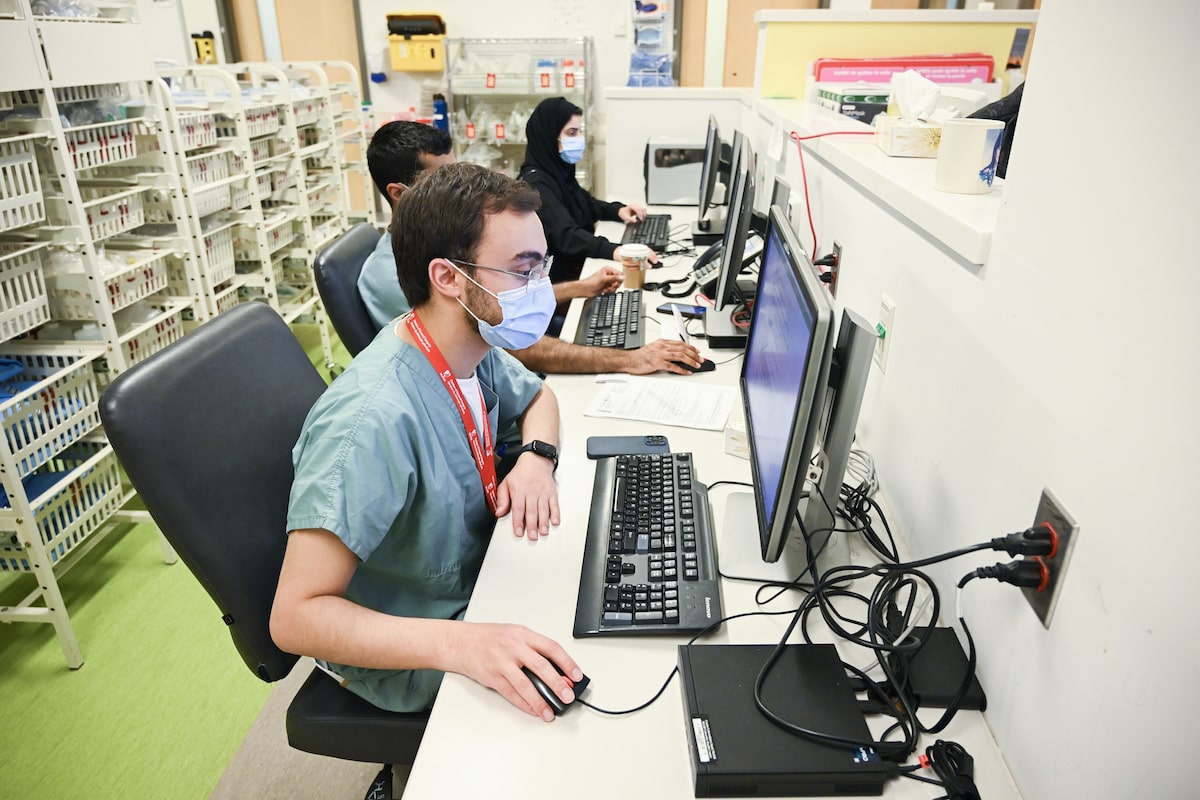
Doctors work at the ER department at the McGill University Health Centre (MUHC) in Montreal in April, 2025.Graham Hughes/The Globe and Mail
Physicians are spending hours a week on unnecessary administrative tasks, but artificial intelligence tools are helping to reduce that workload, according to a new report by the Canadian Medical Association and the Canadian Federation of Independent Business.
The two groups – which represent doctors and small businesses, respectively – surveyed 1,924 physicians last July and August about how much time they feel is wasted on red tape.
On average, the doctors said they spent about nine hours a week on administrative tasks, about half of which they felt was unnecessary. About three-quarters of respondents identified the most burdensome tasks as insurance paperwork, referrals, and test requisitions and electronic documentation.
More than nine in 10 doctors surveyed said the extra paperwork was disrupting their work-life balance, harming their professional fulfilment and contributing to burnout.
“The more time that physicians spend on unnecessary paperwork, the less time they have to see patients,” said Margot Burnell, CMA president and an oncologist in New Brunswick.
AI health gadgets like those at CES come with accuracy, privacy concerns, experts say
But one bright spot in the survey was the use of AI tools to help fill out forms. Nearly half of surveyed physicians (45 per cent) said it was a high-priority solution for cutting down on paperwork, and those who reported using AI tools (28 per cent) said it was reducing their workload by an hour per day.
One of the most popular applications of AI with physicians are AI scribe tools, which can listen in to a doctor’s appointment with a patient, interpret the conversation into clinical notes, and auto-populate forms that the doctor can later review and approve. These applications save doctors the time of writing down notes during or after the appointment.
Still, these tools can come with their own obstacles. About half of respondents (49 per cent) said there were privacy and legal risks if the tools were not used correctly.
For example, Ontario’s privacy watchdog recently issued a cautionary letter to a hospital, where a doctor had used an unauthorized transcription tool that ending up e-mailing confidential patient information to many current and former hospital employees.
“Who is it shared with, who owns the data, is all very critical,” Dr. Burnell said.
Costs and difficulty choosing among the multitude of technology companies coming to market with these tools were also cited as concerns.
“Physicians do not have the capability to test each one of those because the number on the market is just increasing exponentially,” Dr. Burnell said.
About a third of respondents said they hoped for help identifying and vetting vendors and negotiating preferred pricing. A third also said they wanted more training and “tips and tricks” for using AI scribe tools.
Jean-Joseph Condé, a family physician in Val-d’Or, Que., and member of the CMA board, noted that many providers of electronic medical-record (EMR) systems are now adding AI tools directly into their platforms.
“So, this is going to help many doctors starting to use AI scribe because it’s going to be incorporated in their EMR,” he said.