

B.C. physicians are losing three million hours each year to unnecessary paperwork.
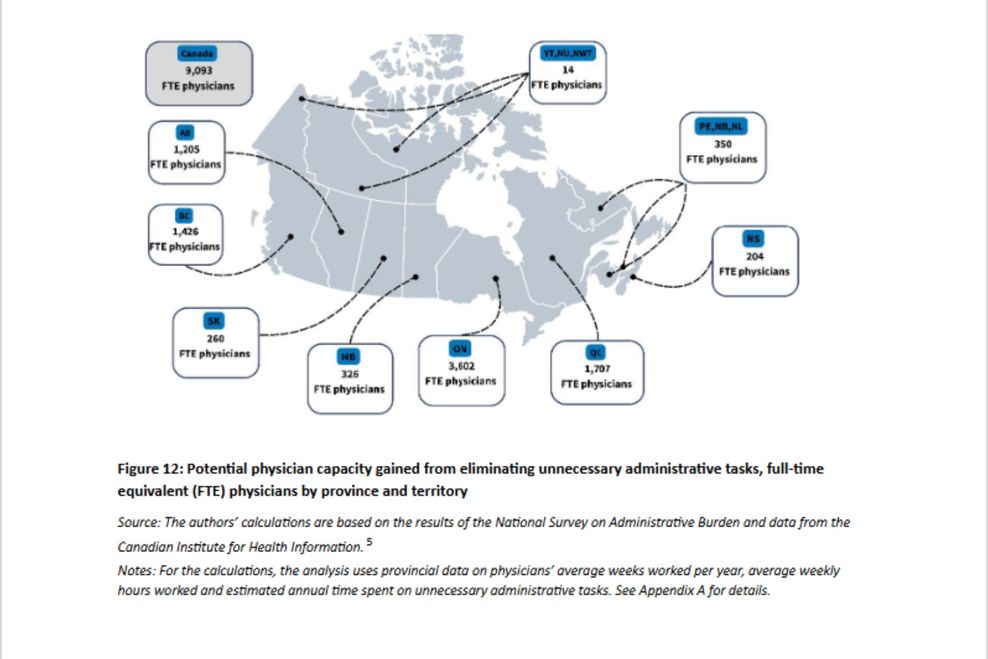
This is according to a recent report from the Canadian Medical Association (CMA) and Canadian Federation of Independent Business (CFIB), which states that this timeline is applicable to about 1,400 full-time doctors.
With B.C. dealing with a strained healthcare system, CFIB notes that administrative tasks are taking up doctors’ precious time to spend with patients. In 2024, over 140,000 patients left B.C. ERs without being seen. One in five of B.C. residents doesn’t have a family doctor.
“B.C. doctors are spending 9.7 hours per week on red tape, with general practitioners reporting the greatest administrative workload. More paperwork means fewer family doctors available for British Columbians,” said Ryan Mitton, CFIB’s director of legislative affairs for B.C.
The report is based on a survey with 1,924 responses from physicians nationwide. Across Canada, they found that doctors spend about nine hours per week on administrative tasks, or about 42.7 million hours a year.
CMA/Submitted
Out of this, 47 per cent of that time was spent on “unnecessary tasks.” In other words, 19.8 million doctors’ hours are spent on unneeded desk work each year. The report estimates that this is the same as about 9,000 full-time physicians.
“Doctors tell us red tape has them feeling exhausted, frustrated, and burned out,” said Kalith Nanayakkara, a senior policy analyst at CFIB.
Physicians reported that the unnecessary tasks are largely driven by the health system (things like referral forms, testing requisitions, and billing) and insurance companies.
The “most burdensome” form is the Disability Tax Credit benefits form, with 53 per cent of respondents rating it as a major burden and 32 per cent calling it a moderate burden. Private insurance forms and forms for federal disability programs also top the list.
The benefits of eliminating administrative work
Across Canada, cutting out these unnecessary administrative tasks could give physicians an additional 199 hours per year — over a month of working time.
“This reclaimed time could restore physicians’ work–life balance and be redirected toward patient care, research, teaching and/or professional development. Reducing physicians’ administrative burden would also help reduce competing demands, interruptions and task-switching, which would in turn improve focus, lower fatigue and burnout risk and facilitate safer, higher-quality care,” reads the report.
What are the solutions?
In the survey, doctors prioritized a list of solutions that would help reduce their administrative burden. The top three were eliminating the requirement for doctors to perform some administrative tasks (72 per cent), working on the compatibility of patient care records (71 per cent), and simplifying insurance processes (70 per cent).
Forty-five per cent ranked adopting AI as a time-saving tool, which the CFIB noted as ” an emerging tool for reducing red tape in health care.”
“By clarifying rules for AI use, providing training materials, and by working to secure preferred pricing for practitioners, governments can leverage AI tools to help ensure doctors spend more time with patients. By working with medical, technology, and business leaders, the B.C. government has a new opportunity to reduce the strain on our health care system,” said Nanayakkara.