
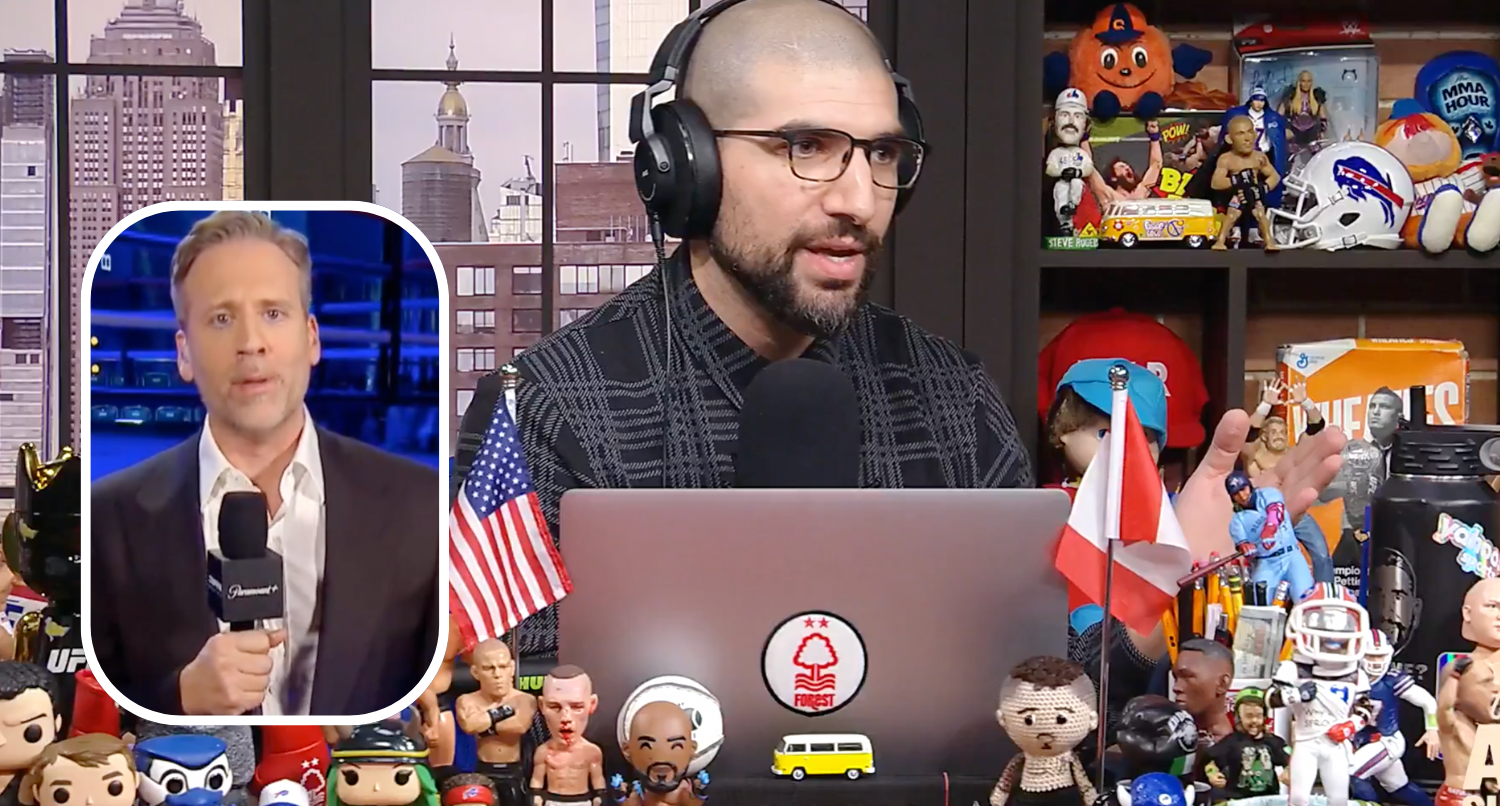
Ariel Helwani watched Max Kellerman call Zuffa Boxing’s first event over the weekend and couldn’t reconcile what he was hearing with the broadcaster he once idolized.
“What the hell happened to Max Kellerman?” Helwani asked on his eponymous show. “There was once a time early in my career when I was telling my parents, ‘I want to be the Max Kellerman of MMA.’ He was a truth-teller.”
There was a time early in my career when I was telling my parents, “I want to be the Max Kellerman of MMA.” He was the biggest truth-teller in all of boxing. I followed this guy’s entire career and read everything about him.
What the hell happened?
For Zuffa Boxing to have a… pic.twitter.com/g5XZ8wsTZH
— Ariel Helwani (@arielhelwani) January 26, 2026
Helwani has followed Kellerman’s entire career, from his days hosting Max on Boxing on New York cable access television, through his time at ESPN, HBO, and Fox Sports. He studied Kellerman’s work, absorbed his approach to boxing commentary, and saw him as the antidote to everything that routinely dragged down combat sports coverage.
That version of Kellerman didn’t show up for Zuffa Boxing’s debut event. What Helwani heard instead was a broadcaster so eager to sell the product that he undermined the very credibility that once made him indispensable.
Kellerman and ESPN parted ways in June 2023 as part of a massive round of layoffs that also included Jalen Rose, Jeff Van Gundy, and Suzy Kolber, though Kellerman continued collecting paychecks through the end of his contract. He resurfaced nearly two years later when TKO announced he would be part of the broadcast team for Zuffa Boxing, the new boxing promotional venture launched by the parent company of UFC and WWE. The booth features Joe Tessitore on play-by-play, Andre Ward providing analysis, and Kellerman as the third voice, which on paper represents one of the strongest broadcasting teams in boxing right now.
“For Zuffa Boxing to have a broadcast team call fights at the apex where it’s Joe Tessitore, Andre Ward, and Max Kellerman — that is an all-star team,” Helwani admitted. “That might be the best booth in boxing right now.”
Talent, however, doesn’t guarantee restraint.
“There’s a way to be appreciative of the opportunity, there’s a way to hype it up without shilling and going over the top,” Helwani continued. “When he starts the broadcast saying that he literally had been waiting for this moment his entire life to have someone like Dana White come in and save boxing, it feels over the top.”
Max Kellerman: I have literally been waiting for this, for right now, my entire life, since I was a little kid.pic.twitter.com/0TlpkDYFQf
— Jed I. Goodman © (@jedigoodman) January 23, 2026
Kellerman repeatedly worked in references to TKO, Dana White, and Nick Khan, often detached from what was actually happening in the ring. Khan’s presence, in particular, was hard to ignore given his previous role as Kellerman’s agent at CAA before becoming WWE president and eventually TKO co-CEO. Helwani didn’t dispute the personal connection or the instinct to show loyalty, but he did argue that loyalty doesn’t require abandoning editorial judgment, either.
“You can do that without going over the top, without sounding like a shill, without hurting your credibility,” Helwan said. “When you compare Callum Walsh to Roy Jones Jr., you are hurting your credibility. You just are.”
Helwani also pointed to Kellerman’s remarks at the post-event press conference as another example of the same issue. Turki Alalshikh, the Saudi royal bankrolling many of boxing’s biggest events, warrants recognition for his financial impact on the sport. But framing the night as something that wouldn’t exist if not for Alalshikh’s very birth, nearly amounted to outright sycophancy, at least in Helwani’s eyes.
“When you’re at the press conference, and you’re saying, ‘We wouldn’t be here unless Turki Alalshikh was born,’ it makes you look like a shill,” Helwani said. “Max Kellerman, I want you to understand, was the biggest truth-teller in boxing. He weeded through all the BS. He never showed any kind of bias toward any promoter. He was the kind of guy who would get up there and give you a soliloquy on HBO boxing and tell it to you like it is.”
That’s the version of Kellerman that Helwani admired, the one who made him want to pursue a similar career in MMA journalism. The broadcaster who appeared on Saturday’s Zuffa Boxing event felt unrecognizable, almost like someone more concerned with pleasing the people who hired him than serving the audience that once trusted him.
Helwani acknowledged the unavoidable conflict that comes with working directly for a promoter, a dynamic Kellerman never faced during his years at HBO. But he flatly rejected the notion that credibility must be the casualty, pointing out that plenty of broadcasters manage to navigate those waters without surrendering their voice.
“I know he works for a promoter now, but you can still kind of be that guy and work for the promoter,” Helwani said. “You could still do that. This is over the top. And dare I say, unlistenable? He is insufferable on these broadcasts. Ward isn’t. Tessitore isn’t. Molly Qerim isn’t. Why does he feel like he has to go over the top like this? Why is this the guy who is known to be the biggest truth-teller of them all, the guy who pulled no punches, the guy who told you like it is, why is he doing this?”
For someone like Helwani, who has spent his career navigating similar tensions between access and independence in his coverage of UFC and Dana White, watching Kellerman cross that line feels particularly disappointing. Helwani has faced his own battles over maintaining journalistic integrity while covering a sport dominated by one powerful promoter, and he’s made career decisions that prioritized independence over easier paths that would have required compromising his approach.
Seeing Kellerman — someone he once aspired to emulate — take the opposite approach had to feel pretty defeating.