
UCLA researchers who first violated Bredt’s rule in 2024—a century-old principle of organic chemistry—are once again challenging our understanding of possible molecular shapes.
Bredt’s rule states that two carbon atoms cannot form a double bond at the bridgehead position. Yet in Neil Garg’s lab at UCLA, the team managed to do so in 2024, now continuing their research to create two unusual cage-shaped, double-bonded molecules named cubene and quadricyclene.
Further stretching the possibilities, the team’s recent organic chemistry paper in Nature describes how the two molecules’ double bonds do not lie in the same plane, with potential applications in drug research.
Organic Chemistry Bonds
“Decades ago, chemists found strong support that we should be able to make alkene molecules like these, but because we’re still very used to thinking about textbook rules of structure, bonding, and reactivity in organic chemistry, molecules like cubene and quadricyclene have been avoided,” said co-author Neil Garg, distinguished Kenneth N. Trueblood professor of Chemistry and Biochemistry at UCLA. “But it turns out almost all of these rules should be treated more like guidelines.”
Organic molecules contain single, double, or triple bonds, which reflect the number of electron pairs shared between bonding atoms. Alkenes have a double bond between carbon atoms, which typically adopt a flat, or planar, structure due to the trigonal planar geometry of the carbon atoms. The unusual three-dimensional shapes of the molecules studied by the UCLA researchers lead to bond orders closer to 1.5 than to 2, making them even more exotic.
“Neil’s lab has figured out how to make these incredibly distorted molecules, and organic chemists are excited by what might be done with these unique structures,” said co-author Ken Houk.
The researchers noted that their discovery closely aligns with drug researchers’ quest to find new three-dimensional molecular shapes for use in drug development.
“Making cubene and quadricyclene was likely considered pretty niche in the 20th century,” said Garg. “But nowadays we are beginning to exhaust the possibilities of the regular, more flat structures, and there’s more of a need to make unusual, rigid 3D molecules.”
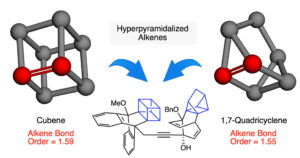 The unique shapes created in Garg’s lab display a bond order closer to 1.5 than to 2. Credit: Professor Neil Garg’s Lab (UCLA)
Breaking the Rules of Organic Chemistry
The process for producing these molecules was complex and involved multiple steps. The team began by creating stable groups of atoms with silicon at the center and adjacent leaving groups that steal the bonding electron pair. Next, one of the two groups was treated with fluoride salts, producing either cubene or quadricyclene, depending on the precursor involved. Finally, when the molecules were directly intercepted by yet another reactant, the resulting compounds acquired unusually complex forms that would typically elude chemists’ efforts to create them.
According to the UCLA team, the molecules’ pyramidalized geometries at the alkene carbons allow much faster reaction rates than those of common flat alkene geometries. They have termed these structures “hyperpyramidalized” to describe their unusual shape and weak bonding. At present, the molecules are so unstable that they have yet to be isolated and directly observed, but experimental studies and simulations suggest they do exist for short periods.
“Having bond orders that are not one, two, or three is pretty different from how we think and teach right now,” said Garg. “Time will tell how important this is, but it’s essential for scientists to question the rules. If we don’t push the limits of our knowledge or imaginations, we can’t develop new things.”
Ongoing Research and Applications
The next step for the UCLA team is to partner with pharmaceutical companies to begin the next generation of medicinal research. These novel forms vastly expand the possibilities for an industry that has recently begun to move beyond the simple, flat molecular geometries it has relied on for decades. These complex new three-dimensional structures could trigger a major industry shift, the team says.

Additionally, Garg notes that the molecules could have further industrial applications in developing new energetic materials. For now, he remains focused on investigating shapes that may be possible but have not yet been considered by researchers.
“In my lab, three things are most important. One is pushing the fundamentals of what we know. Second is doing chemistry that may be useful to others and have practical value for society,” Garg concluded. “And third is training all the really bright people who come to UCLA for a world-class education and then go into academia, where they continue to discover new things and teach others, or into industry, where they’re making medicines or doing other cool things to benefit our world.”
The paper, “Hyperpyramidalized Alkenes with Bond Orders Bear 1.5 as Synthetic Building Blocks,” appeared in Nature Chemistry on January 21, 2026.
Ryan Whalen covers science and technology for The Debrief. He holds an MA in History and a Master of Library and Information Science with a certificate in Data Science. He can be contacted at ryan@thedebrief.org, and follow him on Twitter @mdntwvlf.