
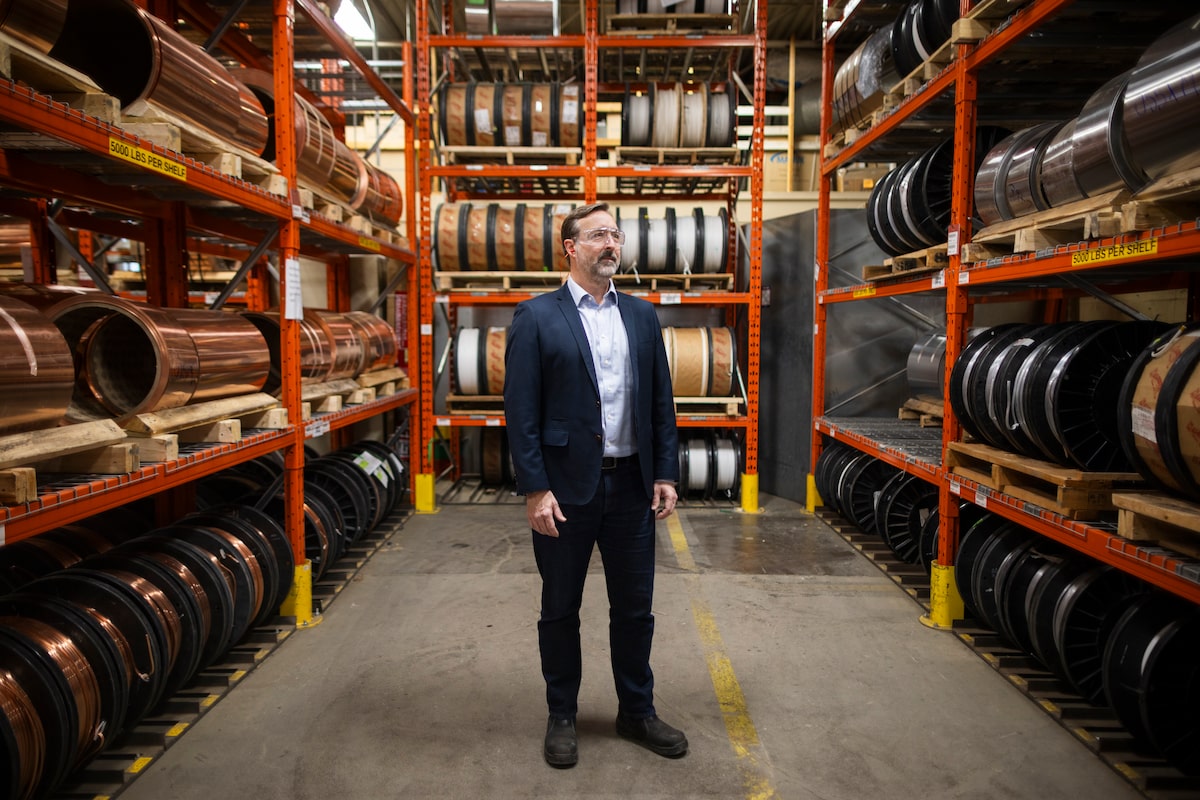
Adrian Thomas, chief executive officer of Hammond Power Solutions, at the company facility in Guelph, Ont., on Jan 16.Nick Iwanyshyn/The Globe and Mail
The question of whether artificial intelligence is caught up in a financial bubble arises a lot for Adrian Thomas, the chief executive of Hammond Power Solutions Inc. HPS-A-T
Like anyone with a stake in the outcome, he’s listened to an inordinate number of podcasts and assessed the occasional personal opinion. A recent conversation with his adult son, who has a fintech startup that leans heavily on AI for its operations, added reassurance to the notion that adoption of the technology is just beginning.
But Mr. Thomas has a clear sight line into the AI boom through his role at Hammond, a manufacturer with deep roots in Guelph, Ont. Though it’s some 4,000 kilometres from Silicon Valley, the company’s products are proving crucial for AI development.
The race to build more powerful AI models and support growing adoption has kicked off a data centre construction spree. Meta Platforms Inc. is a building a facility in Louisiana that’s roughly the size of Manhattan, while OpenAI has plans to invest some US$500-billion in data centres, to take two examples.
These facilities require large amounts of electricity, translating to more demand for the kind of transformers built by Hammond. These are unglamorous but indispensable pieces of equipment that convert the high-voltage electricity flowing through transmission lines into a lower-voltage for the servers housed inside data centres.
Mital Patel cleans up leads on a final assembly hookup at the Hammond Power Solutions facility.Nick Iwanyshyn/The Globe and Mail
Hammond can trace its history in Guelph back more than 100 years, and its share price was fairly sleepy before the release of ChatGPT in late 2022. Since then, it has surged some 600 per cent, catapulting Hammond’s market cap to close to $1.5-billion. The stock hit a high last fall when Mr. Thomas disclosed on an earnings call that Hammond had received “several large orders” tied to data centres after the quarter closed.
The wild gains have cooled in the past couple of months as more skepticism about the sustainability of AI infrastructure construction has set in. Hammond’s stock has fallen about 20 per cent since its peak in November. But Mr. Thomas hasn’t seen any pause in demand yet. “Our business is now just starting to see the real uplift,” he said.
“All the big names that you think of as large hyperscalers would have our products,” he said, using the term for large cloud service providers such as Microsoft Corp., Amazon Web Services and Google.
Hammond has spent $80-million in the past four years to bolster manufacturing capacity, including $20-million for expansion in Mexico that is mostly tied to its data centre business. The company expects capacity at that facility to fill up quickly.
Which brings us back to the AI bubble.
Raw bus bar stock of conductive metals, copper and aluminum, used in transformer units on the shop floor at Hammond.Nick Iwanyshyn/The Globe and Mail
Ted Simpson, the company’s vice-president of global marketing, said during the past few months the company has received some of its biggest orders yet. But even people on the team have had questions about how long the demand will last.
“‘What if it stops next year? What are we going to do with all this capacity?’” some employees have asked, he said.
Mr. Thomas said the company’s growth prospects are not solely tied to AI, and renewable energy development and electric-vehicle adoption are also increasing demand for transformers. “We have a lot of flexibility,” he said.
Indeed, Hammond was growing at a healthy clip even before the AI took off. Revenue totalled $270-million in 2019, and the company is on-track to bring in more than $800-million for 2025, according to Mr. Thomas.
Cormark Securities analyst Nicholas Boychuk said sales tied to AI account for a relatively small part of Hammond’s business. “Even if they were to taper off a bit, it won’t have a debilitating impact on the company,” he said. Hammond’s facilities in Guelph, which build products for the construction, mining and oil and gas industries, would continue operating as usual should AI spending slow down.
Opinion: We can’t let Canada’s AI moment slip away
Moreover, Hammond has no long-term debt and the potential to make acquisitions. “I look at it trading like an average business,” Mr. Boychuk said, even though it has “a very resilient and visible growth profile.”
Hammond employs close to 2,500 people, including more than 650 in Canada. Chairman William Hammond, who owns nearly 27 per cent of the company, is a third-generation executive whose grandfather started a small manufacturer in Guelph in 1917 to build tube radio sets, battery chargers and other equipment.
His sons later incorporated as Hammond Manufacturing and expanded into building transformers. The company spun out the transformer division as Hammond Power Solutions in 2001, with Mr. Hammond as CEO. Mr. Thomas, meanwhile, joined as CEO in 2023 from French multinational Schneider Electric SE.
Building for AI data centres has necessitated a few changes. The energy capacity of an individual transformer has more than tripled, for one thing, while customers are demanding products under tighter timelines.
Since the fall, however, concerns have been rising that the hundreds of billions of dollars tech companies are spending on data centres is unsustainable and bound for a correction, partly because of the debt some companies are amassing and the lack of clear financial returns from AI. Peter Berezin, chief global strategist with BCA Research in Montreal, wrote recently that estimates for AI infrastructure spending in 2027 and 2028 appear to be flattening, suggesting it’s close to the peak.
How AI is both hurting and helping the next generation of workers
Technological changes can throw a wrench in things, too. This month, Santa Clara, Calif.-based Nvidia Corp. said its next chip will be less reliant on specialized cooling equipment. As a result, shares in businesses that make cooling equipment for servers took a hit. Similarly, if building and running AI models becomes more energy efficient, the huge, power-hungry data centres of today may fall out of fashion – and hit Hammond.
But the trends are only working in Hammond’s favour so far. Nvidia’s latest chip actually requires more power than its predecessors, and data centres need to be refreshed every few years or so, translating to a potentially strong outlook for transformers and other equipment.
“We’ve been building one model of data centre for a long time. Now we’re going to start building a different data centre model,” Mr. Thomas said.
Even steel and aluminum tariffs, which hit Hammond’s products, have not slowed sales. It helps that its competitors manufacture abroad, too, and have been similarly affected.
Whether the AI bubble bursts or not, Mr. Thomas sees only more need for transformers. “There’s a huge demand for electricity,” he said.