
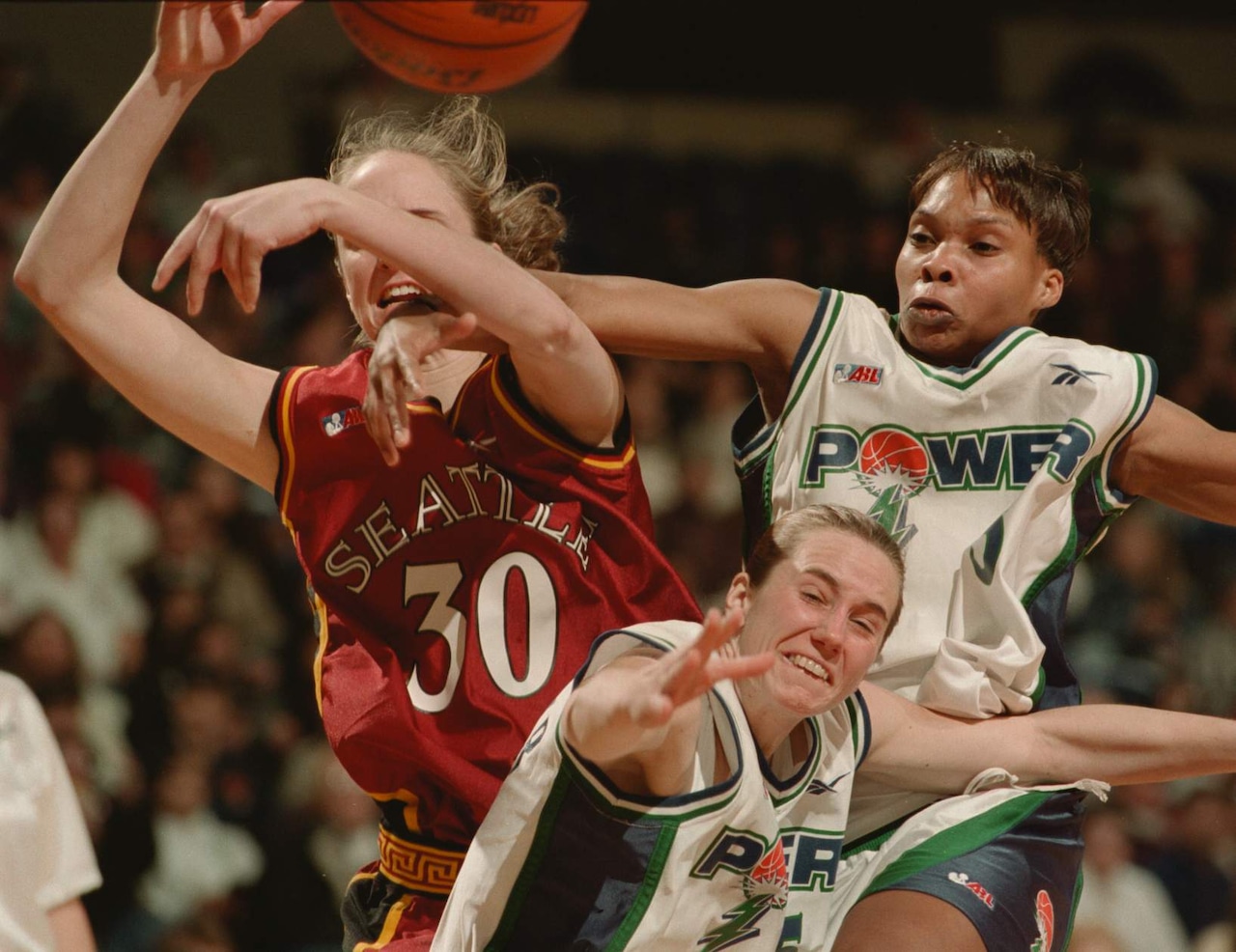
As the Portland Fire prepare for their return to the WNBA in 2026, many longtime women’s basketball fans have been looking back to the previous iteration of the team that ran from 2000 to 2002.
But did you know there was a Portland basketball team before that?
The Portland Power played in the American Basketball League for the duration of the league’s existence and hosted games at Memorial Coliseum.
The ABL ran from 1996 through 1998 and featured a total of 11 teams.
Here is a year-by-year history of the Portland Power:
1996-1997
The Power’s inaugural year was led by coach Greg Bruce, who coached the Portland State women’s basketball team from 1986-1996 and led the Vikings to a 199-89 record. The Power started with a 5-17 record and Bruce was ousted in January 1997.
Lin Dunn took over as head coach and the Power went 9-9 for the rest of the season. They finished last in the Western Conference and missed the playoffs.
Natalie Williams was named to the All-ABL First Team with 17.3 points and 12.5 rebounds per game. Stacey Ford scored 11.3 points per game with 6.2 rebounds. Guard Michelle Marciniak averaged 10.7 points per game with 2.9 assists.
1997-1998
The Power brought in Sylvia Crawley and DeLisha Milton-Jones. The additional firepower on the roster helped elevate Williams to 21.9 points and 11.5 rebounds per game and she was named ABL MVP. Williams led the ABL in scoring, rebounding, field goal percentage (.556) and blocks (1.1 per game).
Elaine Powell put up 12.3 points with 3.7 assists per game and the Power completely flipped the script to go 27-17 and win the Western Conference. The Power fell to the Long Beach Stingrays in the ABL Semifinals.
Dunn was named the ABL Coach of the Year.
1998-1999
The Power opened the 1998-99 season with a 9-4 record and jumped ahead to first place in the Western Conference with a five-game winning streak.
On Dec. 22, 1998, the ABL declared bankruptcy in the middle of the season and the season was ended without any warning. Many of the players for the league’s nine teams migrated to the WNBA.
At the time of the ABL’s closure, Williams was second in scoring (19.9 points), field goal percentage (.580) and rebounding (9.9). Katy Steding led the ABL in three-point percentage (.432). Sonja Henning was second in the ABL in assists (six per game).