
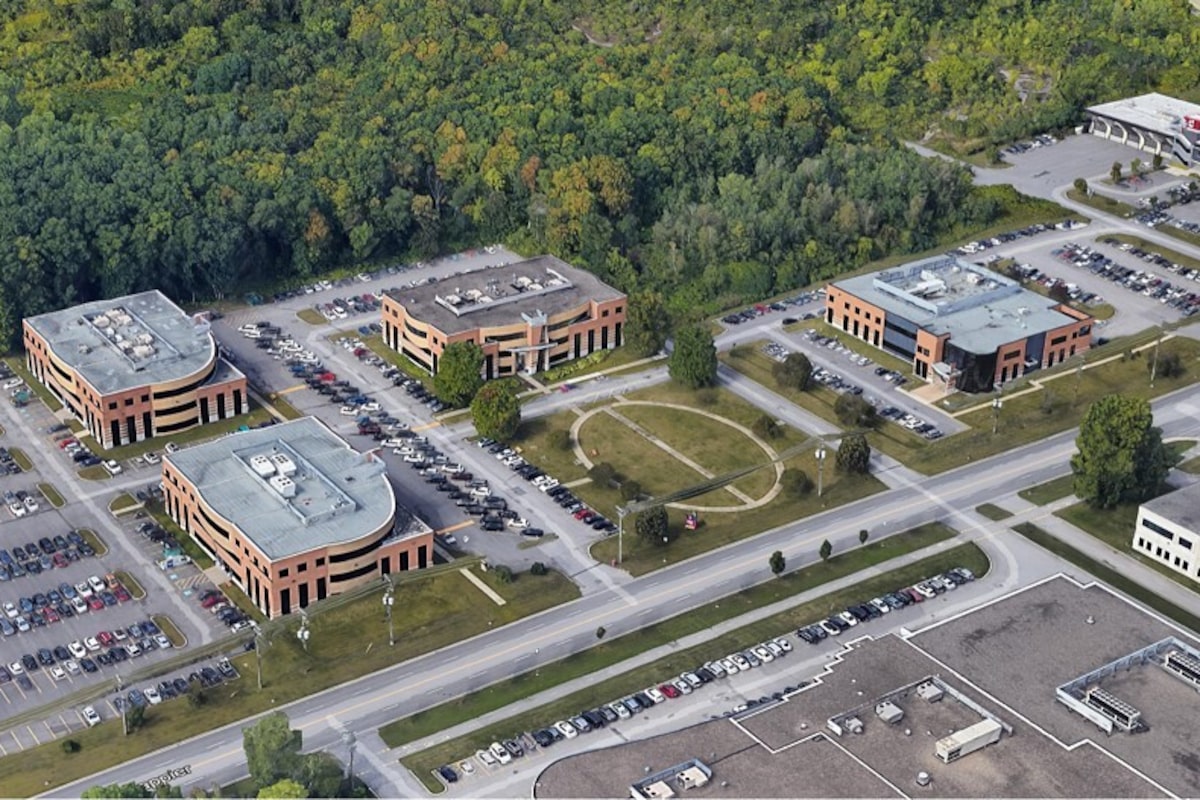
With Canada’s health care system overburdened and its office vacancy rate higher than pre-pandemic levels, developers are transforming empty and underused space into medical research labs, doctor and dental offices, and outpatient surgery centres. One example is the Cité de la Biotech in Québec (pictured), which converted office buildings into life sciences labs.Supplied/HarveyCorp
High office vacancy rates and an overburdened health care system are driving the conversion of Canadian offices into medical infrastructure – primarily physician and dental facilities, but also outpatient surgery centres and life-sciences research labs.
Developers’ efforts to repurpose office space comes amid increasing demand for new health care centres driven by Canada’s aging population and an increased focus on preventative, convenient walk-in care.
“There is more support than there’s ever been to see the private sector deliver environments that would traditionally be found on hospital campuses,” says Matthew Johnson, Colliers Canada’s senior vice-president and Canadian lead of the firm’s North American Life Sciences Practice Group that helps clients find lab and manufacturing facilities.
“You’re seeing the start of a trend and it’s going to continue.”
Policy makers support health care property
To account for rising health care demands, policy makers are responding with regulatory reforms and new funding.
For example, Toronto’s City Council is working toward changing its office-conversion rules to allow makeovers for uses beyond residential, including medical.
The federal government also announced in its 2025 budget a $5-billion, 10-year fund for health care infrastructure, although a fund spokesperson says decisions have yet to be made on what spaces will be eligible for support.
Overall, health care spending in Canada, mostly from governments, has been projected to rise 4.2 per cent to $399-billion in 2025, according to the Canadian Institute for Health Information, with the increase driven by inflation and population growth.
But while governments are committing billions to relieve pressure on hospitals, Mr. Johnson says the funding will be disbursed over a decade even though the need is immediate. He suggests that moving non-essential health care services away from hospitals can free up space for more urgent needs.
Challenges for health care real estate
An office-to-medical conversion is not a panacea for overcrowded hospitals or lowering national office vacancy rates, which are above pre-pandemic levels at more than 16 per cent thanks to the rise of remote work, according to real estate firm Altus Group.
This is largely because medical-conversion projects can face costly and challenging infrastructure, operational and regulatory requirements that are unique to health care, although research shows medical tenants pay higher rents and sign longer-term leases than typical occupants.
The high rents result from building upgrades that range from simple to complex. For instance, a simple change may consist of installing plumbing for sinks in general practitioners’ offices, while more complex renovations for ambulatory surgery centres require widening corridors and elevators for gurneys, as well as heavy load-bearing floors to support medical equipment such as CT scanners.
Sean Bahmani, director at Toronto-based construction company Shamaim Building Group, also notes that conversions require compliance with health care-specific codes and rezoning from local municipalities with permits often taking twice as long as approvals for a standard office.
In Ontario’s York Region, a former office building has been transformed into the Uxbridge Medical Centre, featuring offices on the main floor that can be customized to practitioners’ requirements and a second-floor dental clinic. The repurposed structure also includes several upgrades such as special medical waste and HVAC air filtration systems.Supplied/Shamaim Building Group
Rising appetite for office-to-medical conversions
The potential to boost office occupancy after pandemic restrictions ended with premium medical tenants, while relieving cost pressures on overcrowded hospitals, is driving interest among health authorities, insurers and investors.
And while more than 70 per cent of office conversions are residential, alternative uses, particularly medical, are gaining ground in a Canadian-medical-office-buildings market expected to post a compound annual growth rate of 12.4 per cent through 2030, according to market research.
“Whether it’s dental, medical, cosmetic or everything in between, there’s so much opportunity,” Mr. Bahmani says.
His firm specializes in managing complex commercial projects, including one that saw a new medical facility built over the strengthened foundations of a 1960s office building.
The two-storey, roughly 4,000-square-foot Uxbridge Medical Centre in York Region features offices on the main floor that can be customized to practitioners’ requirements and a second-floor dental clinic.
The repurposed building includes upgraded plumbing, specialized medical waste and HVAC air filtration systems, as well as higher electrical load capacity and backup generators to support imaging and other medical equipment.
The structure meets the Ontario Building Code, Ontario Ministry of Health rules and medical facilities’ municipal zoning standards, which include achieving sustainability targets, adding parking and ensuring accessibility compliance.
While the Uxbridge project had its complexities, they did not compare to the work in 2020-2021 that went into the conversion of a 40,000-square-foot space in a Toronto Bay Street office tower to a biotechnology laboratory now being leased by the University of Toronto near its Temerty Faculty of Medicine.
Jay Deshmukh, principal at Arcadis, the firm that led the specialized design for the conversion, says the devil was in the details.
“Jurisdiction and technical requirements need to align to make such projects feasible,” she says.
The Bay Street project made sense for U of T, which needed off-campus space to build new laboratories, because the conversion was less expensive than purchasing or constructing a new building.
Despite demand, one expert says investors’ ‘risk aversion’ has prevented more projects from moving forward – primarily due to the strict requirements for wet lab research facilities that conduct experiments with liquids, chemicals and biological materials.Supplied/Arcadis
How labs space fits in
Despite high demand, Ms. Deshmukh says investors’ “risk aversion” has prevented more projects from going ahead in Toronto. This is because of the stringent requirements for wet lab research facilities that conduct experiments with liquids, chemicals and biological materials.
“We’re waiting for the starting gun,” she says.
Requirements include floor-to-floor heights that can exceed 16 feet for ductwork above ceilings, vibration isolation for sensitive instruments, strict infection controls and security measures, as well as vacuum systems and hazardous waste drains.
In Québec, where the Coalition Avenir Québec government has committed to help the province become a life science hub, Longueuil-based HarveyCorp specializes in the construction and conversion of office and industrial buildings into biotech laboratories including at the Cité de la Biotech in Laval.
But even with high lease rates for wet lab space, the company’s president, Hugues Harvey, says office-to-medical conversion costs are daunting, reaching $900 a square foot compared to the $225 to $300 a square foot to convert a standard office into a basic medical space.
“A very small percentage of vacant office space is suitable for labs unless you want to put in major investment,” Ms. Deshmukh adds.