
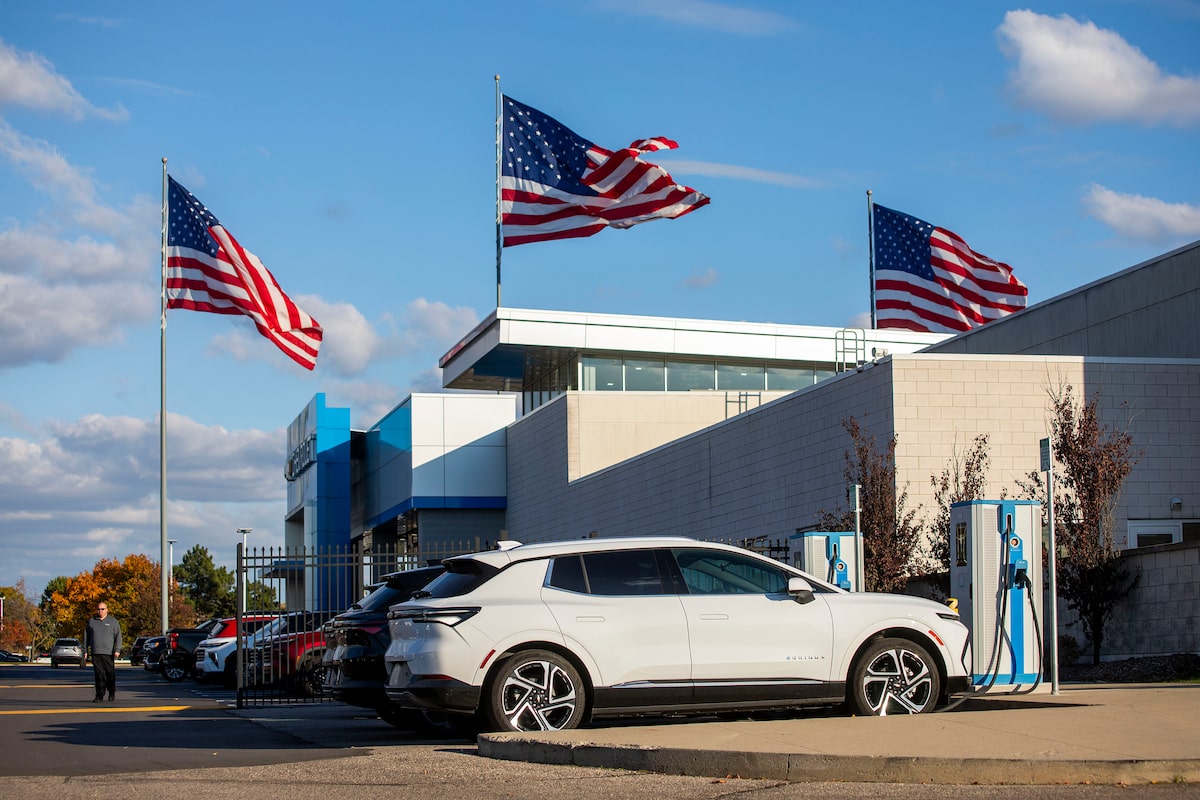
Chevrolet Equinox EVs for sale at a dealership in Michigan last year. General Motors has taken a hit from U.S. tariffs targeting the auto industry.Bill Pugliano/Getty Images
General Motors Corp. GM-N expects tariffs could cost it as much as US$4-billion this year, after paying US$3.1-billion in levies in 2025.
The Detroit-based automaker revealed the toll of U.S. President Donald Trump’s signature trade policy on Tuesday as it released its financial results for the fourth quarter and 2025.
GM’s chief financial officer Paul Jacobson, on a conference call held to discuss the results, said the 2025 tariff total was less than predicted, and 40 per cent of the amount was offset by actions that included cost reductions and moving production to avoid the import taxes.
Opinion: How Canada’s auto sector can survive its terrible, no-good, very bad year
GM is set to eliminate a third shift of workers – 700 jobs – at its Silverado truck plant in Oshawa, Ont., as it boosts production in in Fort Wayne, Ind., and retools a plant in Orion, Mich., to make more of the pickups by 2027. GM said last week it will move production of the Buick Envision SUV to the United States. from China, and is moving the Chevrolet Equinox and Blazer to Spring Hill, Tenn., from Mexico.
Since April, the U.S. has levied tariffs of 25 per cent on the non-U.S. content of Canadian-made cars. The U.S. has reached agreements with some countries at lower rates, including Britain at 10 per cent and the European Union at 15 per cent.
Mr. Trump recently said he would raise tariffs to 25 per cent from 10 per cent on cars from South Korea, a large automobile exporter to the U.S. and home to significant GM operations.
This reversal could mean GM faces an even higher tariff bill this year. Still, Mr. Jacobson said the carmaker is confident it can use offsets to reduce the 2026 tariff bill to less than 2025’s total.
As auto companies retreat from Canada, do government subsidies still make sense?
For the three months ending on Dec. 31, GM’s loss widened by 12 per cent to US$3.3-billion, or US$3.60 a share, from the same quarter a year earlier. Revenue fell by 5 per cent to US$45.3-billion.
The quarter was weakened by a US$6-billion charge owing to its electric-vehicle pullback in response to the Trump administration’s policies and fading demand.
Mr. Jacobson said US$1.8-billion of this amount was because of the decision to close the BrightDrop electric parcel van plant in Ingersoll, Ont. The shutdown eliminated about 1,150 unionized jobs.
Contract cancellations and supplier settlements account for the rest of the charge, he said.
GM reported higher fourth-quarter core profit that beat analysts’ estimates, sending shares of the automaker up more than 8 per cent in Tuesday trading on the New York Stock Exchange.
Adjusted pretax earnings surged about 13 per cent to US$2.8-billion in the quarter compared with about US$2.51-billion a year ago. Earnings per share of US$2.51 easily surpassed analyst expectations of US$2.21.
For the full year, GM made a profit of US$2.7-billion, down by 55 per cent from 2024. Revenue slipped by 1.3 per cent to US$185-billion.
GM expects an annual adjusted core profit of US$13-billion to US$15-billion in 2026, a range whose midpoint exceeds analyst expectations of US$13.4-billion, according to LSEG data.
“This is a very strong guide,” Evercore ISI analyst Chris McNally wrote in a research note.
With files from Reuters