
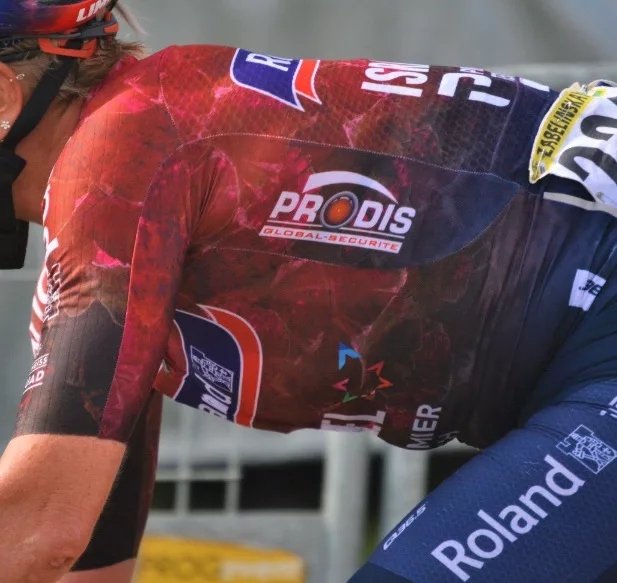
Roland Cogeas Cycling Team’s fight to make it to the start line in 2026 has been framed as a race against time by Le Temps, with the Swiss squad facing serious financial uncertainty after relegation from the Women’s WorldTour.
Yet, even as questions swirl around budgets and registration, the team’s riders have already begun to deliver results on the road. Briton Frankie Hall has made a notably strong start to the year in El Salvador, winning the Grand Prix San Salvador, finishing second in both the Grand Prix Longitudinal del Norte and the Grand Prix El Salvador, and taking third place on stage 4 of the Tour El Salvador. It is the kind of encouraging early-season form that flatly contradicts the instability off the bike.
A proud project, now in a precarious position
The report describes a bleak scenario: a 22-year-old organisation, historically the country’s leading women’s team, may not return this season unless fresh funding arrives quickly. Team manager and owner Ruben Contreras told Le Temps: “The situation is very complicated.”
Roland Cogeas was relegated by the UCI this winter, but could still compete at a lower level if it can secure the resources to run a viable programme. The problem, as laid out in the report, is that survival now depends on urgent sponsorship reinforcement.

Strong results, limited stability
The tension between performance and finances is not new here. Roland Cogeas won races in 2025, including a national title and a cluster of victories in El Salvador:
Mia Griffin won the Irish national road race title.
Kaja Rysz took the Grand Prix Surf City El Salvador.
Mia Griffin won stage 2 of the Tour El Salvador.
Tamara Dronova won the Tour El Salvador prologue.
Petra Stiasny won the Grand Prix Boquerón.
Those wins mattered, but the team’s broader footprint has become increasingly concentrated. The last time Roland Cogeas won a race outside El Salvador-based events or national championships was back in 2023, when Anna Kiesenhofer won the Chrono de Gatineau in September.
That context makes Hall’s current run of podiums feel doubly significant: proof the squad can still find momentum, even as its structure is being tested.

The core issue: sponsorship and unpaid wages
Contreras told Le Temps there is an “ongoing deal” with a potential sponsor, though he could not provide details. The report adds that other sources trace the deterioration in financial health back to 2024, following the withdrawal of the Israel-Premier Tech Roland brand, and notes that the addition of the Dévoluy ski resort as a partner in 2025 has not been sufficient to restore stability.
Most starkly, Le Temps reports that riders were left with unpaid salaries in 2025, with outstanding payments totalling 120,000 Swiss francs, which Contreras acknowledged. He attributed this to sponsor payment delays and said he expected the debts to be cleared “by the end of February”.
A worrying moment for Swiss women’s cycling
Beyond the team itself, Le Temps portrays the situation as a wider structural blow. Switzerland is preparing to host the Tour de France Femmes Grand Départ in Lausanne on 1 August, but its leading riders, including Elise Chabbey, Noemi Rüegg and Marlen Reusser, currently race for foreign teams. If Roland Cogeas disappears, the domestic pathway loses one of its few long-standing, recognisable bridges between Swiss talent and the international level.
In other words, the results are still coming, and Hall’s early-season form is a timely reminder of that. The problem is whether Roland Cogeas will have the funding to keep turning those performances into a season at all.