
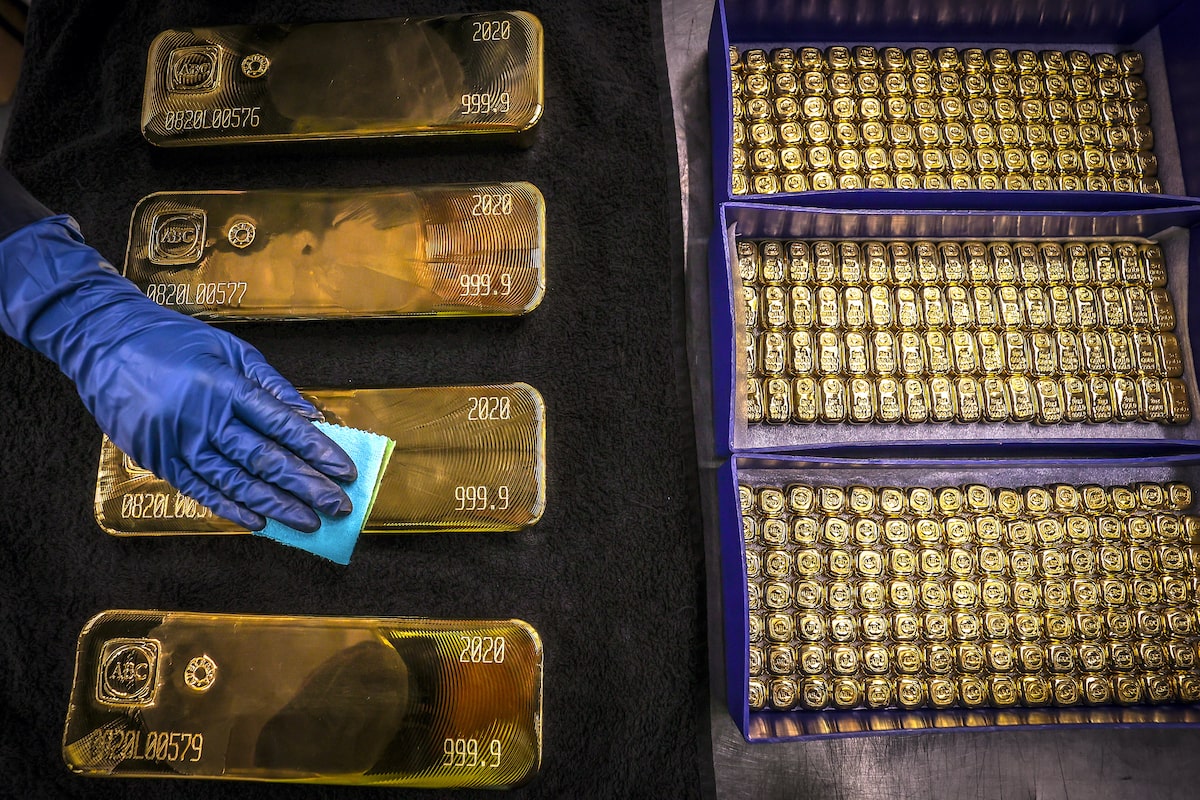
A worker polishes gold bullion bars at the ABC Refinery in Sydney. Mining M&A reshaped the Canadian industry last year, with 803 transactions valued at $61.2-billion, according to a recent report from Bennett Jones LLP.DAVID GRAY/AFP/Getty Images
Surging precious metal prices are expected to keep takeover traffic moving at a brisk pace among gold and silver miners, with large producers boosting their reserves and geographic reach by acquiring junior miners.
On Monday, China’s Zijin Gold International Co. made a $5.5-billion offer for Toronto-based Allied Gold Corp., the ninth billion-dollar-plus takeover involving a domestic gold miner in the past 13 months.
“The consolidation trend appears set to continue through 2026 as producers look to optimize asset portfolios for the best combination of production, costs, and jurisdiction, supported by robust balance sheets,” said a Bank of Nova Scotia report published Tuesday by a team of analysts led by Ovais Habib.
With gold hitting record prices of more than US$5,000 an ounce and silver prices also on a tear, the share prices of large precious metal miners are soaring, along with their cash flow and profit margins.
Is it too late to hop on the gold bandwagon?
Senior miners are now valued at a significant premium to junior miners, most of which are years from producing an ounce of anything. That valuation gap is feeding the current M&A boom.
Potential mid-tier targets highlighted by analysts over the past 12 months include Vancouver-based companies Artemis Gold Inc., which has a $10.3-billion valuation, Skeena Resources Ltd., with a $5.3-billion market capitalization, and Thesis Gold Inc., with an $810-million market cap, along with Toronto-based Seabridge Gold Inc., valued at $4.7-billion.
The share price of all of these miners doubled over the past 12 months.
Mining M&A reshaped the Canadian industry last year, with 803 transactions valued at $61.2-billion, according to a recent report from Bennett Jones LLP. The law firm highlighted the increasing size of gold takeovers, with eight transactions worth US$1-billion or more in 2025, compared to just one deal of this scale in 2024.
Globally, metals and mining M&A activity rose 61 per cent last year. There is an industry-wide push to boost reserves and production of critical minerals such as copper. That sentiment drove the proposed US$20-billion merger of Vancouver’s Teck Resources Ltd. and London-based Anglo American PLC. Shareholders in the two mining companies approved the merger in December. As did the federal government. The transaction still requires approval from other jurisdictions and is expected to close later this year.
10 Canadian gold stocks at reasonable valuations
The hike in mining M&A activity is also expected to include a continued trend to swapping properties, as companies build reserves and reshape their portfolio due to factors such as political risk.
On Monday, Vancouver-based Orezone Gold Corp. paid roughly US$590-million to buy a gold mine in Quebec from Hecla Mining Co., which is based in Coeur d’Alene, Idaho. Prior to the purchase, Orezone owned one mine, in Burkina Faso.
This acquisition will make Orezone a multi-asset producer, said Cosmos Chiu, a CIBC Capital Markets analyst.
“The improvement in geopolitical risk could result in the re-rate of Orezone shares,” he said.
Orezone’s stock price rose 14 per cent on the day after it announced the deal with Hecla.
Miners are expected to share the bounty that comes with rising bullion prices with shareholders, along with plowing cash into acquiring mines. In a report on Tuesday, Scotiabank analyst Tanya Jakusconek predicted senior miners will ramp up share buybacks and dividends this year.
Mining royalty companies, such as Toronto-based Franco-Nevada Corp. and Vancouver-based Wheaton Precious Metals Corp., will boost their dividends as their revenues soar, Ms. Jakusconek said in a report on Tuesday.
In addition to spending money on acquisitions, which comes with risks of overpaying, miners are expected to devote their cash to building out properties they already own.
Canadian mining companies are projected to boost capital spending by 20 per cent to $17.5-billion this year, Ms. Jakusconek said. The increase reflects more spending on projects and accounts for inflation.
Developing projects became acutely more expensive during the peak of the COVID-19 pandemic, and that is still a factor in mining. Scotiabank estimated that for every US$100 per ounce move in the gold price, costs on average increase by $10 per ounce.
“This still implies improved margins of $90/oz for the operators with $100/oz move in bullion,” Ms. Jakusconek said.