
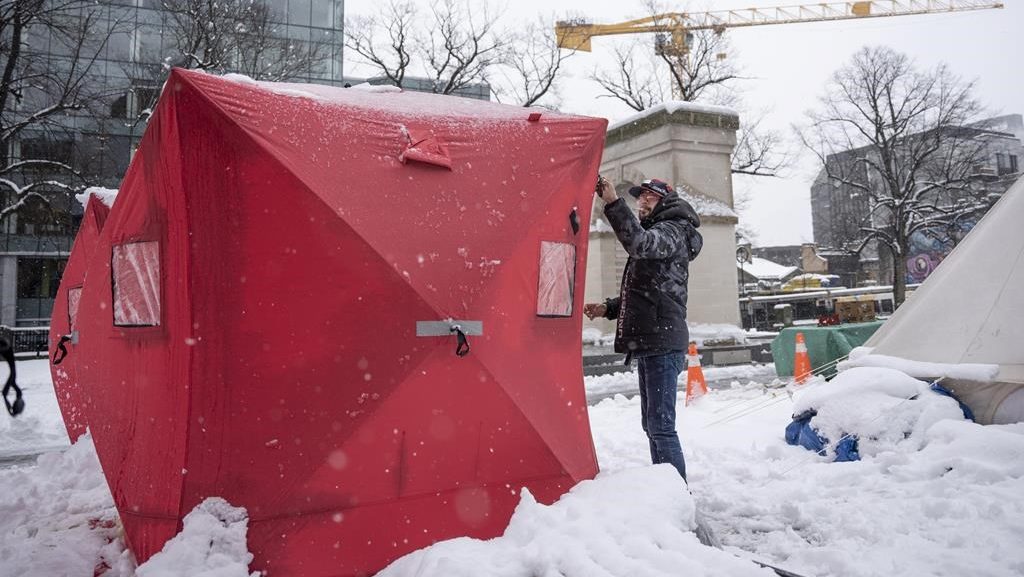
It might not be record-breaking, but it’s a bitterly cold day out in Halifax and across the province.
The polar vortex sweeping across the country is bringing highs of -13 C to Halifax on Saturday. Temperatures will drop throughout the afternoon, with a low of -18 C. With the windchill it could feel more like -28.
The term “polar vortex” has been newly popularized, but the phenomenon is not new. Vortex refers to rotation, John Gyakum, a professor in the Department of Atmospheric and Oceanic Sciences at McGill University, told CityNews. This rotation of frigid air always exists near the Earth’s poles, but at times it expands in the winter, bringing colder air south.
“The aerial coverage of this particular vortex is huge,” Gyakum added. “I would say much larger than typical, even for this time of year.”
The causes of this vortex could be related to a changing climate.
Warmer ocean temperatures surrounding Canada and the United States have created a storm track across the country that Gyakum said he believes has been brewing for some time. When that storm track interacts with the cold air coming from the Arctic, it intensifies the disturbance.
“The fact is, globally, we are getting warmer, but that’s not to say that areas such as where we are today are not going to be getting prolonged cold air outbreaks at all,” he said. “We have to look at the warming that occurs globally, but certainly on a regional basis, it’s quite plausible that we can have some long-term and persistent cold air outbreaks.”
But those extreme colds may not be as extreme as they used to be.
According to Environment Canada, the average minimum temperature for Halifax on Jan. 24 is -11.1 C, meaning that Saturday is set to be colder than average. But the lowest temperature recorded on Jan. 24 in history dropped to a painfully cold -21.9 C in 1991.
The coldest temperature recorded in Halifax since modern records began happened on February 18, 1922. It was -29.4 C.
“If you look at the overall map of temperatures throughout North America, there are significant cold pools of air, which everybody can appreciate, but the strength and the coldness, if you will, of those areas of bitter cold are not nearly as cold as they were in 30, 40 years ago,” Gyakum said. “In other words, the cold air outbreaks are actually more moderate than they used to be. People may not believe that, because it’s awful outside, but that’s the situation.”