
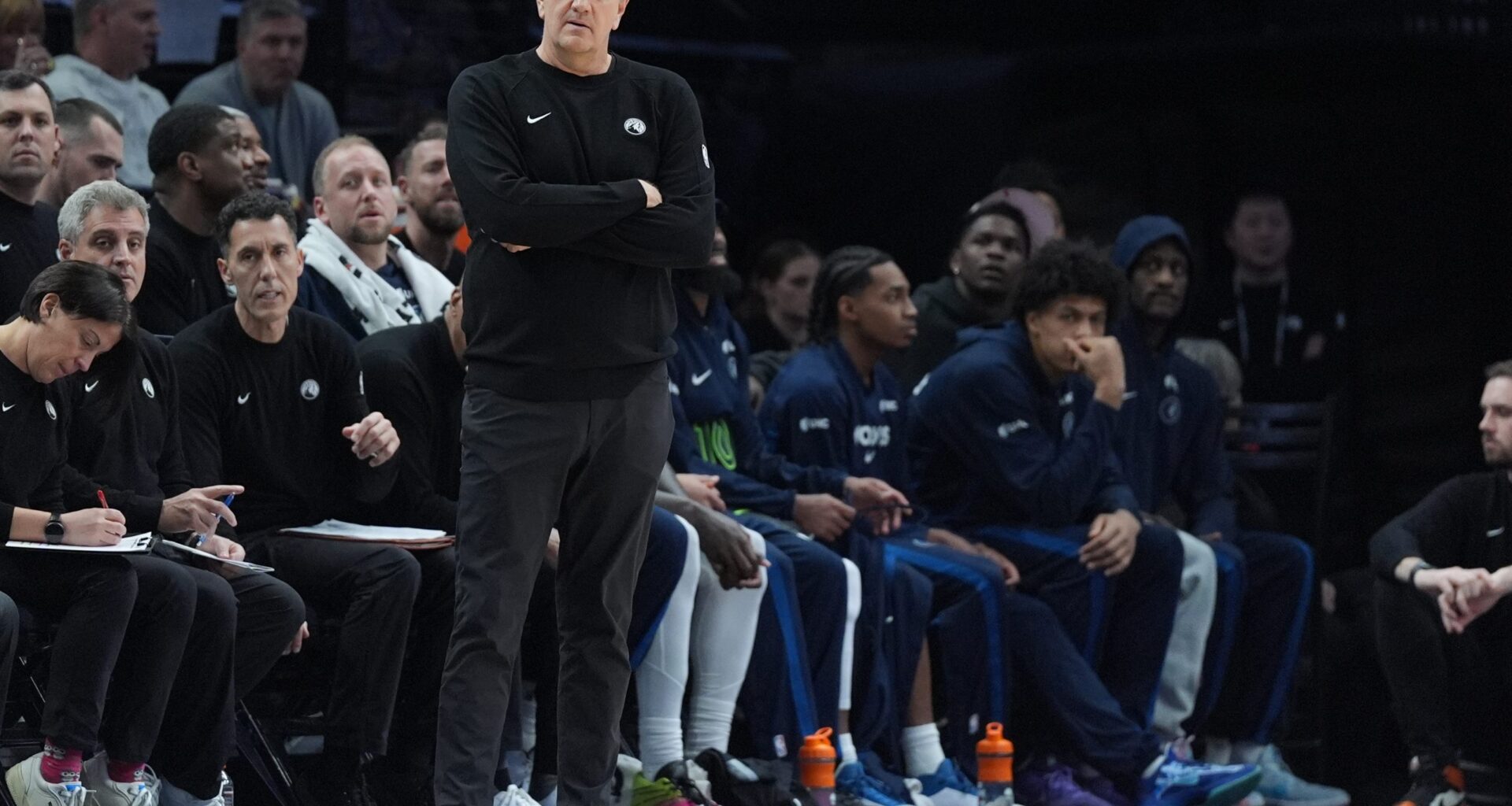
Feels like a squall is coming.
These kinds of atmospheric shakeups are too easily hyped — it’s catnip for clicks, eyeballs, seizures of the algorithms. Everyone loves to gawk at a good storm cloud. But you don’t need a doppler radar to deduce that the Minnesota Timberwolves are ripe for a roster tweak under the current circumstances.
The Wolves came into the 2025-26 season trumpeting their continuity after two straight appearances in the Western Conference Finals. And yet, here they are, just nine days before the February 6 trading deadline, crossing their fingers on contingency plans when dipping just two or three players deep into their bench. At the opening tip of Monday night’s game against Golden State, they were beset by their first five-game losing streak in more than three years, which had sent them tumbling to seventh place — outside automatic qualification for the playoffs — in the conference standings.
For a night the atmospheric pressure eased. Already without Jimmy Butler for the rest of the season, Golden State rested the rest of their best players — Steph Curry, Draymond Green — and then some (Al Horford, Moses Moody, Jonathan Kuminga, De’Anthony Melton). Even without Anthony Edwards (a late scratch with a sore leg) the Wolves whupped this husk of Warriors 108-83 in one of the more desultory “contests” of the season.
But you couldn’t really blame Wolves coach Chris Finch after the game for getting out a blowtorch and soldering on some silver linings. The opening question teed him up, a query about the difference made by Bones Hyland, the recently wayward backup point guard whose spree of contested layups put pace and points on the board when the game was in the mire early.
“Huge,” Finch replied. “Just obviously the production, which was great, but also the pop that he played with. I liked his defense, too.”
Then the reality chaser: “We gotta have those performances on a nightly basis, to be honest with you.”
Asked why the defense looked so much sharper, Finch eventually tried to minimize how much the opponent’s depleted roster made a difference but stayed on theme with his immediate response: “Desperation, of course. Guys just flying around, covering for each other.”
A massive disappointment off the bench
The Wolves’ top six players are arguably as good as any team’s half-dozen in the NBA. The starters — Ant, Julius Randle, Jaden McDaniels, Rudy Gobert and Donte Divincenzo — have logged more minutes together (450) than any 5-player lineup in the league and carry an impressive net rating (points scored per 100 possessions minus points allowed per 100 possessions) of +7.3 over that span. The first man off the bench, Naz Reid, is currently a betting co-favorite (along with San Antonio’s Keldon Johnson) to win Sixth Man of the Year for the second time in three seasons.
Even when measuring just the generic “starters” — the opening lineups including the ten games Ant has missed, along with two absences apiece for McDaniels and Gobert — that starting core is good enough to earn the Wolves the sixth-best net rating at +4.0. That’s slightly better than last season’s seventh-best net rating for the generic starters at +3.3.
But the bench has taken a hit compared to a year ago, when the trio of Naz, DiVincenzo (The Big Ragu) and Nickeil Alexander-Walker (NAW) propelled Minnesota’s generic bench net rating to fourth in the league at +2.5. Even with Naz still in the mix, that has dropped to 12th this season at +0.7.
The problem is fit as well as depth. The only pure point guard on the roster — a natural floor general who prioritizes getting everyone organized and involved, especially on offense — is Mike Conley, who is somewhat dramatically revealing the ravages of 19 years in the NBA at the age of 38. Conley was abruptly replaced by Ragu as the starter for the 2025-26 season opener, and the dominos have fallen in unfortunate directions for the bench ever since.
With Ragu starting and NAW signing a more lucrative offer from Atlanta during the off-season, the Wolves bench was compelled to rely on what Finch calls his “young core,” of second-year pros — Rob Dillingham, Terrence Shannon Jr. and Jaylen Clark. The trio have collectively been a massive disappointment.
Dillingham’s lack of development has stung the most, as he cost the Wolves a 2031 first-round draft pick, traded to San Antonio in exchange for the eighth selection in the 2024 draft, when president of basketball operations Tim Connelly plucked him as Conley’s heir apparent. His sophomore NBA season has shown a slight uptick in three-point accuracy while his shots inside the arc have cratered to a 32.1% conversion rate, a flaw at least partially traced to lack of size and overconfident shot selection. His defense is noticeably better but assist-to-turnover ratio has not improved.
The grade on his pro career is less an F than an incomplete. He hasn’t played meaningful minutes for weeks now and depending on whether you favor the chicken or the egg, either Finch has denied him sufficient chances to grow or Dillingham has squandered the ones provided to him enough to be parked on the pine for a team with genuine championship aspirations.
Related: Timberwolves return home in search of mojo after three-game skid
Shannon has taken a different path to essentially the same place. Although drafted later in the 2024 draft, he was older and more developed, seemingly an automatic “plug and play” wing who could already finish at the rim in NBA competition and was regarded by Finch and the front office as a prospect with room to grow as a defender and playmaker.
Shannon was slotted into NAW’s old seventh-man role on opening night — and in the ensuing months has face-planted, on multiple occasions, as firmly as a ski-jumper who broke a binding in a gale blizzard. Injuries have hampered him, no doubt, but even when healthy he sabotaged the team at both ends of the court, mysteriously bereft of his instincts and his focus. During his 282 minutes on the court, the Wolves have been outscored by 82 points. (Next worst is Dillingham at minus-45 while logging 40 more minutes of playing time.)
The final member of the youth core, Clark, forced his way into the rotation as a rookie last season as a smart, tenacious on-ball defender who understood the game well enough to limit exposure of his obvious flaws (shooting and ball-handling) through hustle, anticipation and movement that created space. It was more of the same for at least the first month or two of this season — he was a key cog in restoring fiber to the defense in the minutes Gobert was off the floor.
Then, in a watered-down version of Shannon’s pratfall, Clark’s proven skills began to dissipate. When I asked Finch about it the other night, he repeated an earlier opinion that Clark was guarding all his matchups the same way, meaning he’d been scouted or simply sussed out by elite scorers. This time Finch also noted that defenders, like shooters, go into slumps.
My eye test is that Clark doesn’t collapse distance between him and his man as adroitly as before, perhaps to avoid fouls (a Finch criticism). The boomlet of accuracy on his three-pointers last season has predictably waned, and his ambush tactics of generating steals from opponents inbounding or coming down with the rebound, and of sneaking along the baseline for offensive rebounds and inferior feeds, are all more notorious now and thus less fruitful.
Nevertheless, of the three second-year pros (Clark was drafted a year earlier but sat that entire first season with an injury), Clark has been the most accomplished. But that’s sort of damning with faint praise.
How much can Wolves bank on Bones Hyland?
The decision to start Ragu instead of Conley was also motivated by the concession that Ant and Randle were scoring playmakers who each needed the ball a lot to deliver the full range of their talents. That has worked out relatively well for the starters — who have propelled the Wolves to a top-ten offense pretty much the entire season — but Conley doesn’t have the offensive firepower to cover for the absence of both Ragu and NAW off the bench, and none of the three young core members can pick up the scoring slack. (Or, in the case of Shannon, Dillingham and even Conley, be a reliably sturdy defender.)
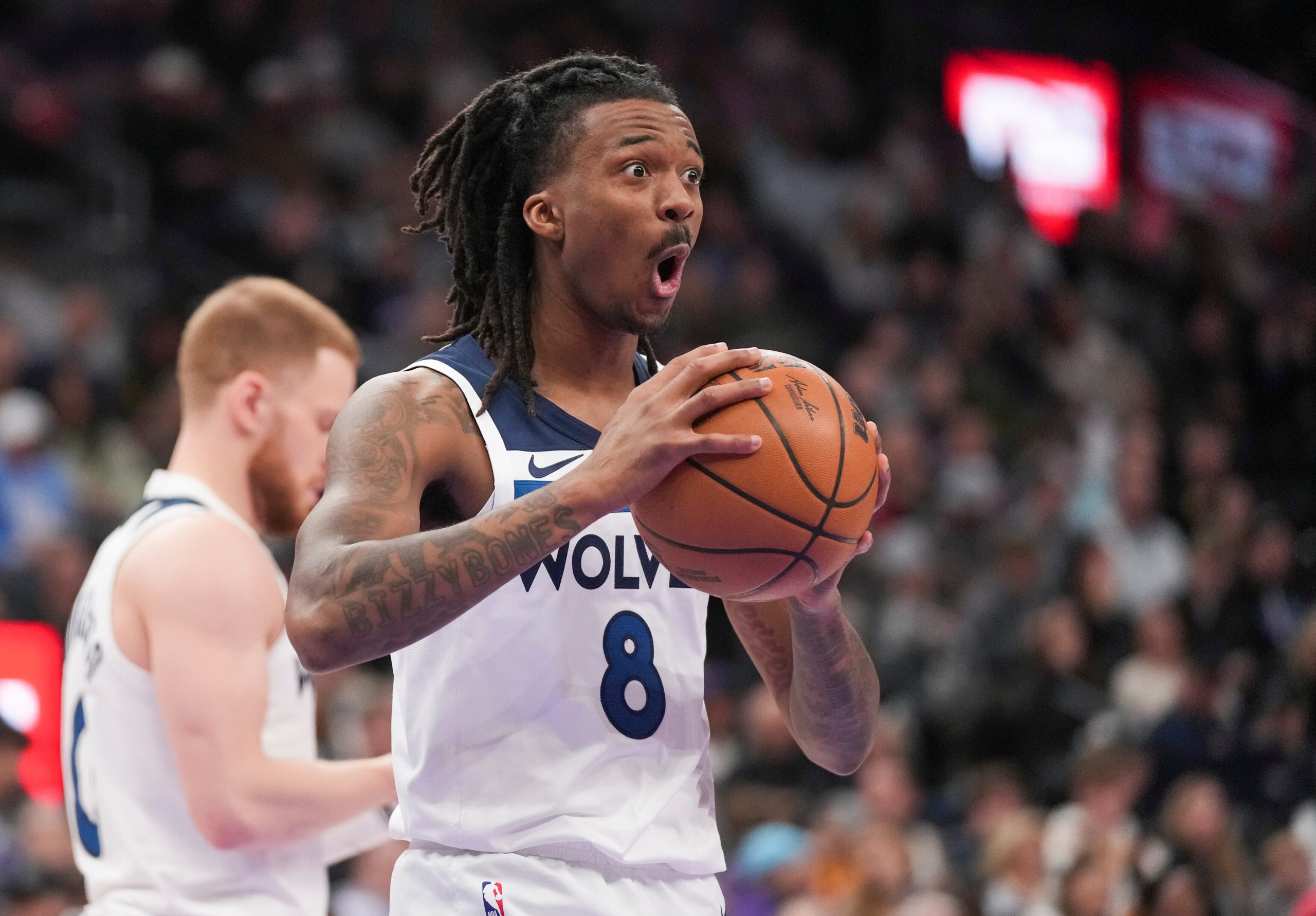 Minnesota Timberwolves guard Bones Hyland (8) reacts to a call during the first half of an NBA basketball game between the Utah Jazz and the Minnesota Timberwolves Tuesday, Jan. 20, 2026, in Salt Lake City. Credit: Bethany Baker/AP
That’s where Bones Hyland has occasionally come to the rescue as a scoring playmaker with the added dividend of being able to accelerate the pace, which is a catalyst for more community and efficiency on offense. I’ve been disastrously chasing the sine wave of Bones’ eventful season — casting doubts on his contributions while he was making his teammates joyous and productive with his style of play, and then embracing the Bones Experience as his mojo sputtered, his shot clanked and his minutes diminished.
Bones rose from purgatory with his trademark elan on Monday, slip-sliding through the Warriors defense for layups that injected confidence in three-pointer and stimulated his teammates. He had 17 points, 7 rebounds and 5 assists versus a single turnover in 24:44, during which the Wolves were +19.
Not coincidentally, the Wolves were +30 in the 25:11 Naz played. He and Bones are kindred pacemakers, pumping heart into the Wolves’ attack at both ends of the court. In the 351 minutes they have shared the court, the team has a net rating of +15.8, the highest of any duo alongside each other for more than 150 minutes.
But there is a reason why Finch was so frankly, joyously relieved by the spangled version of the Bones Experience Monday night. His resume casts doubt on his ability to bear as much weight as the Wolves may require of him as the stakes rise on regular season playoff placement and postseason performance. Less than a year ago, Bones was picked off the scrap heap, inked to a two-way deal after being waived by Atlanta. This season he is signed to a one-year contract for near-minimum money, a titch above $2 million.
Bones may ultimately pan out as a marvelous success story, the sort of semi-savior that graces many overachieving teams — he’s got a head start on the narrative already. But do the Wolves want to bank on it? Do they have a choice?
Planning for postseason chess moves
There is an argument to be made that as rotations inevitably are winnowed down in the postseason, the Wolves can lean into Ant and Randle as their half-court creators and dedicate themselves to a rugged defense that stimulates transition offense and reduces the need for a classic floor general either among the starters or off the bench.
There is also a counter-argument that the reason for playoff depth is less to have a large rotation and more to have an ability to rebut the opponent’s chess moves, the strategic gambits that add drama to any contested series. Then there is the random fortune of matchups. If the Wolves draw the Lakers or the Nuggets, there is less need to worry about full-court pressure and disruption of offensive execution. But getting the Thunder or the Suns requires perimeter poise and high-level playmaking. (Getting the Spurs or the Rockets flips the emphasis to the frontcourt.)
Bottom line, there have been enough examples of a lack of electricity from Bones or other bench personnel short-circuiting the Wolves offense. Mike Conley will rise to the occasion down the stretch, certainly, but only so high and only so often. And after that it is Naz, Bones and discredited young core.
That’s why it feels like a squall is coming. For those who like to indulge in hot rumors and your own creative trade scenarios, have at it. I have been around long enough to know speculating is a fool’s errand — precious few people really know the key details and agenda motivations that can legitimately unlock a trade and the overwhelming majority of those few generally keep their mouths shut.
Trade rumors are made by those trying to wish things into existence, not those who can actually make them happen. Besides, I’m already on record as arguing against a roster tweak — a position that has aged as well as my flip-flop on Bones.
Fortunately, Tim Connelly is exceedingly well qualified for this. A congenital networker who gives glad-handing a good name, he can sort bluffs and believe-its with rare acuity, or simply bypass the shenanigans with well-placed honesty among his brethren.
That’s not in doubt. The mystery is what cards he holds and wants to play. Is Rob Dillingham a mistake to be parted with? Is Shannon exposed or still intriguing? Given the scarcity of first-round picks at his disposal, can he make any meaningful roster tweak without touching his top six? Would karma punish him for trading the classy Conley?
I’ll leave it to the rest of you to debate the merits of vying for Coby White on an expiring contract — short-term rental or potential second-apron buster?
Last but not least: No deal is better than a bad deal.
Related