
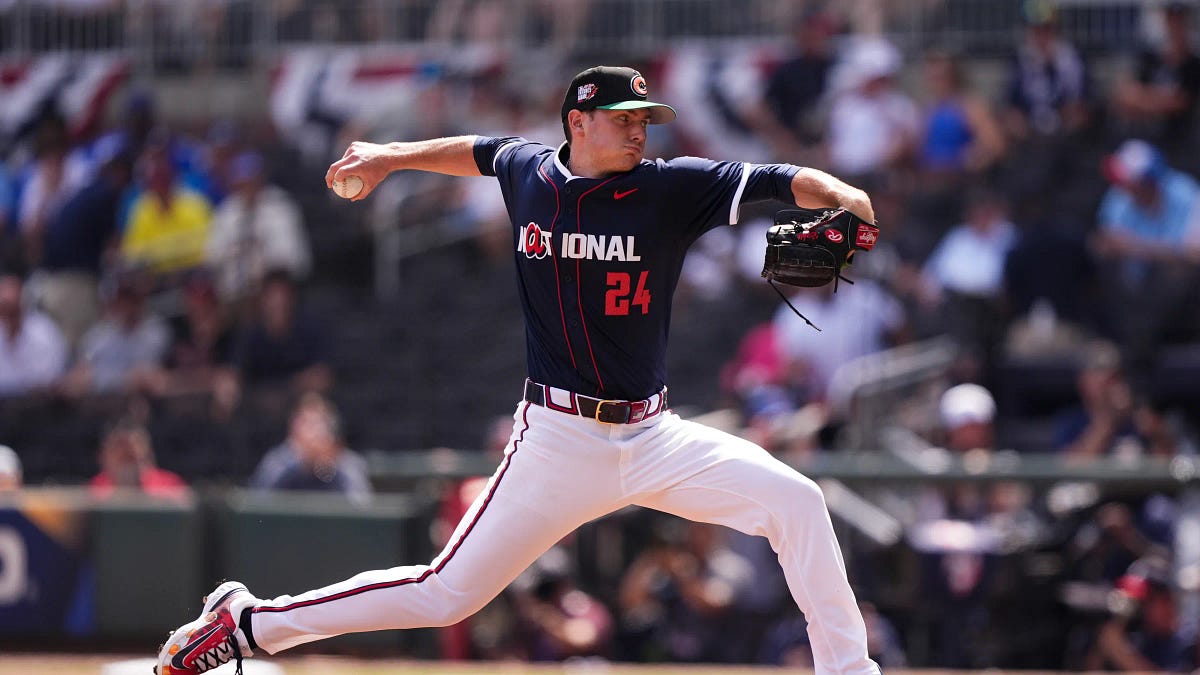
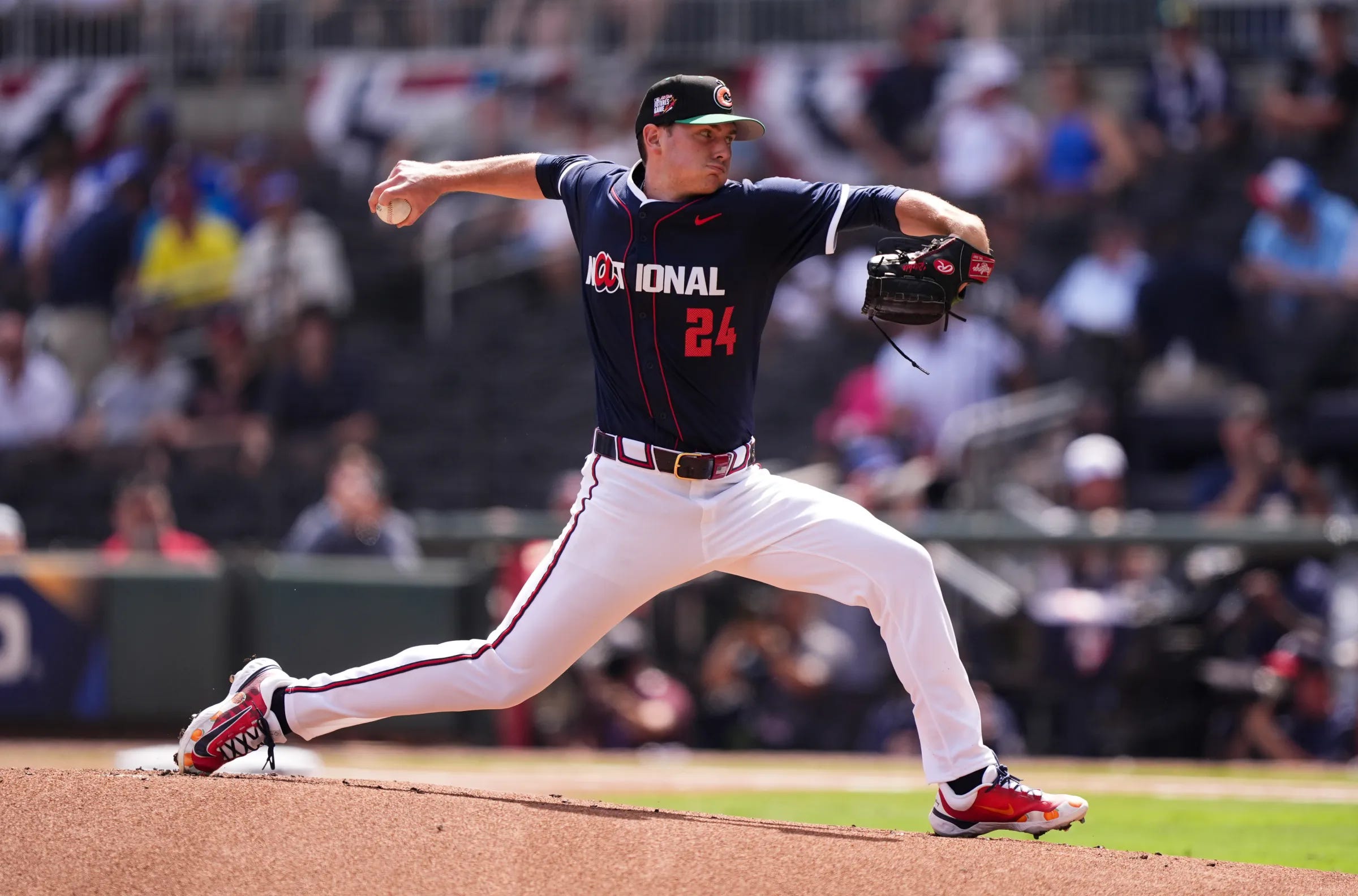
 JR Ritchie started the Futures Game in his home ballpark. Is a Braves game next?
When I wrote about the possibility of extending Ronald Acuña Jr. yesterday, something else jumped out: how many Braves contracts quietly run out after 2026 and 2027.
More than a quarter of Atlanta’s 40-man roster, thirteen players, will either hit free agency or have a team off-ramp in that window, creating a potential $100M+ shift in payroll over the next two offseasons.
That includes the rotation. itself Chris Sale and Reynaldo López are nearing the end of their team control, and while Spencer Strider is locked in a bit longer, his guaranteed money runs out after 2028.
If recent seasons have proven anything, it’s that starting pitching depth can vanish in a hurry. The question is whether the Braves are already positioned to absorb what’s coming next. Let’s talk about it.
We’ve already spilled plenty of ink this winter about all of the rotation depth Atlanta has for this season – Bryce Elder, Hurston Waldrep, Joey Wentz, Grant Holmes, and José Suarez could give Atlanta as many as nine viable rotation options.
Hopefully, this allows the Braves to slow-play their pitching prospects this year. But if the team does need them, there are several who should be able to step up and answer the call.
Ritchie’s the lone Braves prospect to appear on all three PPI-required prospect lists: Baseball America (#84), MLB Pipeline (#90), and ESPN (#89). Now back and with a fully healthy season under his belt after Tommy John surgery in 2023, Ritchie has expanded the three-pitch mix that enticed Atlanta to take him at 35th overall in 2022 into an all-encompassing seven-pitch repertoire. He has all three fastballs at his disposal, sitting at roughly 94 and capable of touching 97 on his four-seamer. He pairs them with a downer curveball in the low-80s, a mid-80s gyro slider, an upper-80s changeup, and the occasional sweeper.
He’s not a finished product, however – the righty seemed to lose the feel for his slider late last season and minimized it down the stretch, while most of his offerings profile as average to above-average, but without a truly dominant offering. Lacking a true ‘out’ pitch likely caps his ceiling as a mid-rotation starter, but either some added whiff on one of the breaking balls or a touch more velocity to the entire package would have the potential to push the ceiling a bit.
‘Burky’ was an All-American closer at Auburn who the Braves have converted to starting in the minors. Despite being only in his second season post-Tommy John surgery, Atlanta moved him to the Gwinnett bullpen after a mid-season promotion to monitor his innings. At his best, Burkhalter’s a cut-ride fastball & cutter-dominant righty with a curveball and what appears to be a kick change (based on the movement profile and velocity last season).
While his ultimate MLB position is likely to be the bullpen, owing to the effort in his delivery and struggles missing bats the 2nd and 3rd times through the order, he should be able to give Atlanta spot starts if needed next summer.
We all watched Fuentes’ four starts last season and saw some impressive stuff…that he couldn’t really control. ESPN’s #88 overall prospect pitched in four games and allowed twenty runs on twenty-three hits in thirteen innings. The FanGraphs Stuff+ model loved the underlying pitch shapes, not grading anything below a 105 and giving his four-pitch arsenal an overall 110 grade, but his Location+ came in at a below-average 94. The inability to get ahead in the count was one of Fuentes’ main issues last year, with eighteen of the twenty-three hits he gave up coming when he was behind or even with the hitter.
Already being on the 40-man roster means that Fuentes’ path to the majors as a spot starter is easier than any other prospect’s. Whether or not the team decides to use him entirely depends on how the 20-year-old’s stuff and command look after he lost the end of last season to a shoulder injury.
ESPN points out that from a mechanical perspective, Bryan Woo of the Seattle Mariners is Fuentes’ closest comparable, while his fastball characteristics resemble those of Minnesota Twins starter Joe Ryan. It’s entirely possible this works out, it’s just dependent on Fuentes harnessing the stuff and understanding how to get the most out of it.
Braun was a sixth-rounder out of college in 2023 and has done nothing but eat innings the last two seasons. Between 2024 & 2025, the righthander has thrown 293.1 innings, rising all the way to Gwinnett last season.
On the mound, Braun’s getting by with more pitchability than pure stuff. He features a large arsenal, with all three fastballs, a sweeper, a curveball, and a changeup…but nothing’s impressive on its own. The four-seamer sits in the low-90s, the changeup’s useful against lefties, but nothing just blows away the Stuff+ model. Instead, Braun’s a sequencing and locations master, walking less than two and a half batters per nine innings and getting by through mixing all of his offerings well.
He’s Rule 5 eligible after 2026, so everything’s primed for the Braves to give him a look but I’m skeptical that he can be anything more than a back-end starter without more velocity or movement.
This is the first season that Atlanta forecasts to be missing a current member of its rotation, as Chris Sale contract expires after 2026. While I still believe that Sale’s the new Charlie Morton – a series of one or one+one deals to get him to retirement – he’s not actually signed anything yet and so I don’t want to assume he’ll be in that rotation.
The pending lockout also complicates this picture. I don’t want to project any debuts from guys who can’t reasonably be viewed as Triple-A options this season, since there likely won’t be many opportunities for Atlanta to evaluate prospects for an eventual call-up during 2027’s spring training, whenever it happens.
The short version: I’m going to be conservative with 2027’s list and push a lot of those on-the-fence options to 2028.
Just as draft mate Ritchie went down for Tommy John surgery in May of 2023, Murphy went down for his own procedure in May of 2024. And just as Ritchie has gotten back to mid-rotation form, so too has Murphy.
2022’s 20th-overall pick put up an impressive performance after returning to the field last season; across six starts and 27.1 innings for High-A Rome, the 21-year-old allowed just four runs while striking out 29. He’s back to his four-seam/slider/curveball ways, although more velocity on the trait-heavy fastball would be a nice development milestone to work towards. Per reports, he’s been working on a kick-change to broaden his arsenal into a true four-pitch mix that covers multiple velocity bands and all possible directions.
Murphy likely begins 2026 in High-A Rome again, but probably won’t be there for long as I imagine he’s ticketed for a quick promotion to Columbus. While he currently profiles as a back-of-the-rotation starter, there’s plenty of time for the stuff to continue to tick up into mid-rotation potential.
There might not be a single pitcher with more runway to become a capital-G Guy than Sinnard. A third-rounder in 2024 that missed his final collegiate season due to Tommy John, he returned to the mound last year and showed that while he’s raw, it’s a package that oozes potential.
The 6’8 righty works out of an unusually high slot, meaning that it’s a very unique downhill sight picture for a hitter. He throws his four-seamer in the mid-90s and can run it up to 96 or 97, while the Braves worked to give him a two-seamer/sinker down the stretch last year. He pairs the heater with several whiff-inducing pitches, a splitter and a slider that both get platooned (slider to righties, splitter to lefties).
Action items for 2026 include working on his curveball, which is a nice velocity-band separate from his two whiff pitches, as well as learning when to pound the zone and when to try and induce chase.
BONUS: Braves Today freelancer Michael McDermott caught up with Sinnard in the Arizona Fall League, where the righty was selected for the Fall Stars Game, to discuss his injury return and his goals for 2026.
 Luke Sinnard’s Fall Stars Nod is the Capstone On a Resurgent Season
As I mentioned above, the pending lockout could put a damper on some early-season prospect promotions and/or hold some guys back in 2027, so 2028 has the potential to catch some of that “close-but-not-quite-there” guys. Let’s cover some of the likeliest suspects.
As he enters his second full season in professional baseball, Caminiti is just now nineteen years old, thanks to reclassifying during high school and being drafted at age 17. That, combined with his two-way play as an amateur, means that he likely has more development available than the usual prep first-round pick.
The lefty missed the start of last season due to forearm tendonitis, but made his debut by early May and settled into the Augusta rotation by the beginning of June. Appearing on both ESPN (#53) and Baseball America’s (#53) Top 100 lists, Caminiti’s 2.08 ERA in Augusta was overshadowed by some struggles against righties, who hit .251 off of him. Part of that stems from his arsenal, with the Braves pushing a sweeper as his primary swing-and-miss pitch and adjusting his two-seam-oriented changeup to more of a kick change last year. Per Baseball America, the Braves are hoping to teach Caminiti a gyro slider-esque breaking ball next year, although whether it takes the form of Spencer Strider’s offering or something more akin to Chris Sale’s (to match Caminiti’s arm slot, which he lowered last year) remains to be seen. He’s also added a cutter, per ESPN’s Kylie McDaniel (as relayed by Augusta PxP voice Noah Adcock-Howeth).

Noah Adcock-Howeth@n_adcock_howeth
Three Braves on Kiley’s predictably brilliant Top 100 but the most interesting piece of info: Cam Caminiti’s incorporating a cutter next year. Diversifies a simple but dominant arsenal, and makes @CrosbyBaseball happy in the process

Kiley McDaniel @kileymcd
It’s Top 100 Day!
The article is stuffed with 25,000 words of tool grades, scouting reports, and notes on the metas that teams are using to find value in scouting and development https://t.co/Yztl4WCXOQ
1:41 AM · Jan 28, 2026 · 382 Views
1 Reply · 1 Repost · 1 Like
Caminiti has the most potential of any pitcher in the system, but one of the longer development paths. 2028 is an ideal middle ground, but he could debut earlier in 2027 if he were to take several leaps or be pushed back to his Rule 5 year of 2028 if he suffers another minor injury or adapts slowly to a new level in the meantime.
Baumann, a prep fourth-rounder from 2023, is another Luke Sinnard-like absolute unit, standing 6’8, 245. Like Sinnard, he also uses his size well, firing a mid-90s fastball downhill. A slider, curveball, and splitter round out the package, but the entire arsenal seems to not miss as many bats as it could – he struck out less than one batter an inning in last year’s 113.2 frames.
Adding additional pitches may be as reliable a path to generating whiffs as tweaking the existing ones – a two-seamer would likely be devilish from that angle, working well in the bottom of the zone to set up his splitter. Four-seamers are traditionally better when they’re elevated, a location that makes it difficult to play vertically-breaking pitches off of without leaving everything in the zone (or impeccable tunneling and late movement, a la 2023 Spencer Strider).
I remarked soon after he was drafted in 2024’s 4th-round that the University of Miami righty was equipped with the ‘Spencer Strider Starter Kit’ of a four-seam fastball with great induced vertical break and a hard gyro-slider. He did nothing to dissuade me after the draft, striking out twelve of the twenty-four batters he faced.
Well, those two pitches alone aren’t enough to make a starting pitcher if you can’t reliably throw them for strikes. Hernandez walked 68 batters last season in 103.1 innings for Rome, finishing with two or less walks in just eight of his twenty-two starts.
He flashed some additional offerings in a splitter and a curveball, but none of them will help him stick as a starter if they can’t consistently be in and around the zone. The actual ERA was good, coming in at 3.57, but just because being effectively wild worked in high-A doesn’t mean it will in the upper minors, never mind Atlanta. The Braves reportedly lowered his arm slot a bit last year – let’s see if the adjustments pay off and he stays on the starting track, or if he ends up moving to the pen and letting it eat for an inning at a time.
There are a few pitchers that, whether because of injury or ineffectiveness, I just can’t reliably give them an ETA for the majors. Let’s briefly list a few, along with their main issue last year.
Drue Hackenberg: Ineffectiveness. Atlanta’s 2nd-rounder in 2023 rode the struggle bus last year, putting up a 6.99 ERA across 18 starts in an injury-marred season for the Clingstones. His best month was actually after the injury, throwing to a 4.09 ERA in five starts in August, and even that was with sixteen walks to just seventeen strikeouts in twenty-two innings. He’s fallen off of most common Top 30 lists and needs to rebuild his value, likely in Double-A again next year.
Cade Kuehler – Tommy John. The righty was impressing for Single-A Augusta in 2024 (2.52 ERA in 50 innings), albeit with disappointing strikeout totals (44) for a college draftee before going down to injury. Per reports, he’s been training in South Carolina this offseason and is expected to be available for most of the 2026 campaign, likely in Augusta with a quick promotion to High-A Rome if everything looks right.
Carter Holton – Tommy John. The 2nd-rounder in 2024 has a grand total of two professional innings under his belt, coming after the draft prior to his surgery. 2026 will really be his first extended time as a professional pitcher, so putting an ETA on the lefty is impossible.
Landon Beidelschies – Inexperience. The lefty out of the University of Arkansas was one of my requests to be selected on day two, which the Braves obliged, but he got only six professional innings after last year’s draft. Scouting reports point out his two-pitch mix, with a low-to-mid-90s fastball backed up by a mid-80s slider. His velocity development on the heater and search for a third pitch – he threw an occasional changeup in college – will determine if he sticks as a starter or ends up in the pen.
Briggs McKenzie, Raudy Reyes – No stateside professional innings – both youngsters have not appeared in domestic games for the Braves. The flamethrowing righty Reyes pitched exclusively in the Dominican Summer League last year, striking out thirty-five but walking twenty-nine in his twenty-seven innings, while the lefty McKenzie never got into official game action after being taken in last summer’s fourth round.
What stands out most when you zoom out isn’t any single prospect or projected debut date. It’s the overlap.
Atlanta isn’t staring down a pitching cliff so much as a series of rolling transitions. There is real upper-minors depth for 2026, credible reinforcements for 2027, and a high-ceiling group that could crest in 2028 if development stays on track. That doesn’t guarantee outcomes, but it does give the front office options, which is ultimately the point.
It also helps explain why the Braves have been so selective about adding long-term rotation pieces. When you already have multiple waves coming, the risk isn’t failing to find arms. It’s blocking them, rushing them, or forcing them into roles before they are ready.
Some of these pitchers will stall out. Others will end up in the bullpen. A few will surprise us and move faster than expected. That’s how this always works. But the broader takeaway is that Atlanta’s future rotations are less about replacing one veteran with one prospect and more about managing timing, health, and opportunity across several years at once.
The next Braves rotation isn’t being built in one offseason. It’s already taking shape, one wave at a time.