
How scientists constructed this dark matter map
To indirectly detect large sources of dark matter across this particular patch of sky, scientists used a technique called gravitational lensing.
A massive cosmic object like a galaxy or galaxy cluster can cause light from a more distant source to bend and appear distorted. In a phenomenon called “strong lensing,” light from the distant source is brightened, such that it appears magnified or even warped around it like a ring. But in this case, researchers were looking for more subtle “weak lensing,” in which galaxy shapes are ever so slightly distorted or displaced because dark matter disrupts the trajectory of light. A large number of galaxies is necessary to calculate the amount of dark matter responsible for the weak lensing effect.
“The galaxies, or whatever we’re looking at, get bent into these characteristic shapes, like a funhouse mirror, or like looking through a kitchen a bathroom window,” Massey says. “And we work out how much dark matter there is by figuring out how it distorted the shapes of these background galaxies.”
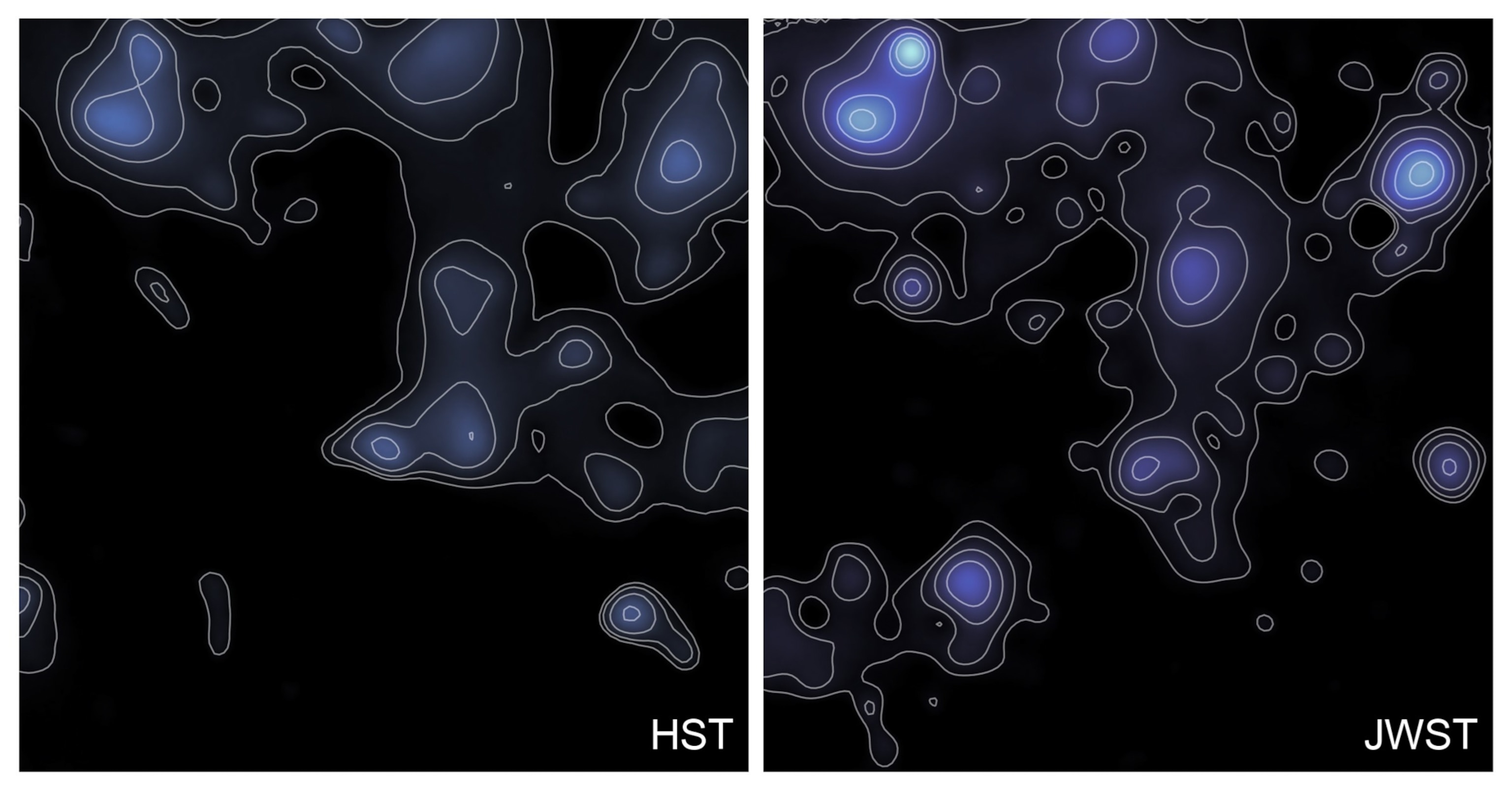
Here are the Hubble (left) and Webb (right) maps of dark matter in the COSMOS field. The overlaid contour lines mark regions of equal dark-matter density.
Dr Gavin Leroy/Professor Richard Massey/COSMOS-Webb collaboration
Measuring dark matter indirectly in this way is akin to observing the trees and inferring that wind causes the movement of leaves and branches, Massey says. That’s no small feat when it comes to calculating subtle changes in hundreds of thousands of galaxies. Researchers looked at the same patch of sky with Webb for 255 hours, representing the biggest survey from the first year of the telescope’s scientific operations, which began in 2022.
More than just this map
The map itself is just the beginning, however. Rachel Mandelbaum, a physicist at Carnegie Mellon University who was not involved in this study, looks forward to future science that comes from the map, which may include analyses of how particular types of galaxies relate to the amount of dark matter in those galaxies, how galaxies are distributed, and better understanding galactic “voids,” regions where there are fewer-than-average galaxies.