
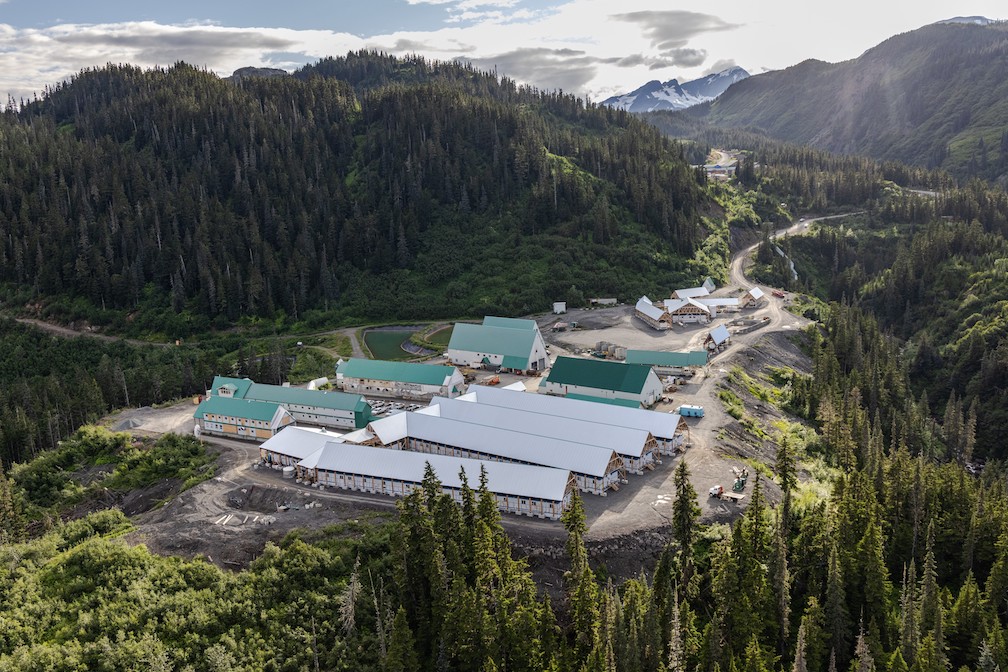
Skeena Resources’ Eskay Creek gold-silver project in B.C. Skeena Resources photo
The government of British Columbia has issued an environmental assessment certificate to Skeena Gold & Silver (TSE: SKE) for the restart of the former Eskay Creek mine located in Tahltan territory.
Issuance of the certificate follows the successful review of the project’s environmental assessment by Canada’s Minister of Environment and Climate Change and its approval under the Federal Impact Assessment Act.
According to Skeena, the Environmental Assessment Office (EAO) carried out a collaborative assessment process with the Tahltan Central Government (TCG), the first to be guided by a consent agreement. This represents a major milestone in government-to-government decision-making for major projects, it said.
Eskay Creek, a former Barrick Mining property in BC’s Golden Triangle, was once regarded as the highest-grade gold mine in the world. Over an estimated 12-year life, the proposed mine would produce 320,000 oz. of gold-equivalent annually, including 455,000 oz. of gold within the first five years, according to a 2023 feasibility study.
Receipt of the EAC concludes a rigorous environmental assessment process initiated in August 2024, which included more than 60 engagement sessions within local communities and over 500 meetings with TCG, Skeena said in a press release.
The Tahltan Nation’s consent to the project is embedded within the EAC, marking a historic first in Canada through a landmark Section 7 agreement signed in 2022 between British Columbia and TCG.
TCG’s board of directors provided notice of Tahltan consent for the project as part of the Eskay Creek project’s decision agreement, established under Section 7 of the Declaration on the Rights of Indigenous Peoples Act and the Environmental Assessment Act.
The ministers applied 38 legally binding conditions on the project. These include specific conditions co-developed with TCG to mitigate impacts identified in Tahltan’s risk assessment and provide an ongoing role for Tahltan in monitoring compliance throughout the life of the project.
Other conditions include requirements to monitor and manage effects to water, fish, air quality and human health to ensure mitigations are effective and effects do not exceed those predicted in the assessment.
Nisga’a Lisims government, which the EAO consulted as a treaty partner, provided letters of support for the project. The EAO also consulted Gitanyow Nation, Tsetsaut Skii km Lax Ha Nation and Alaska Tribes, as well as Métis Nation of BC on behalf of the federal government.
The project is expected to generate about 1,000 jobs during peak construction and more than 770 jobs during peak operations, along with projected capital expenditure of C$713 million and approximately C$1.2 billion in provincial revenues.
“The issuance of the EAC reflects this collaboration and reinforces Eskay Creek’s position as setting the standard for responsible, world-class development in British Columbia,” Skeena CEO Randy Reichert said in a news release.
“I further extend my appreciation to the Skeena regulatory engagement team for their tireless efforts in advancing a rigorous environmental assessment,” Reichert continued. “The team set new benchmarks for meeting timelines while skillfully navigating new challenges associated with the Section 7 agreement.”
Under the environmental assessment certificate, the Eskay Creek mine must be substantially started by 2036.