
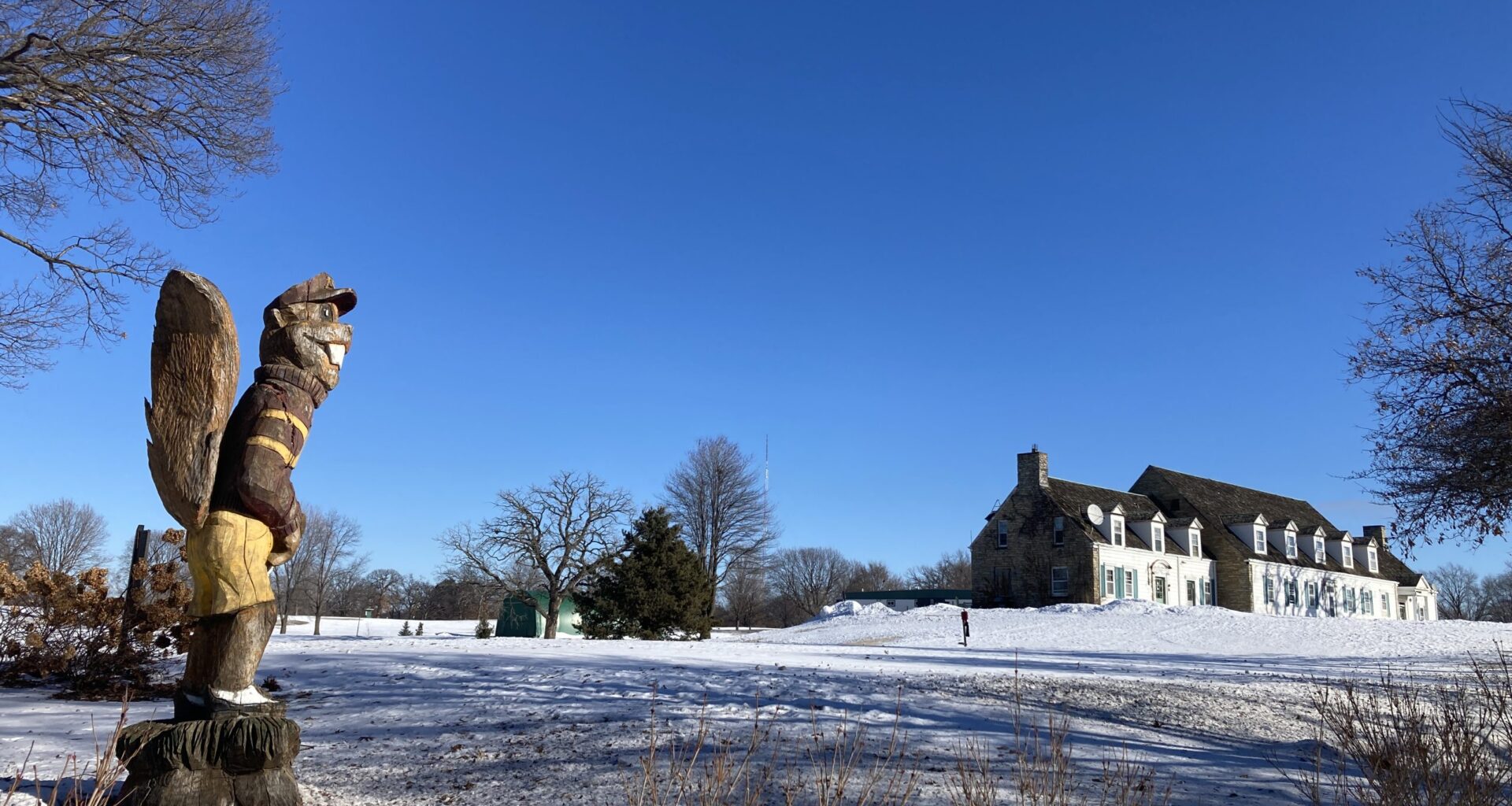
During a terrifying federal occupation on the coldest night of the year, three dozen people assembled nonetheless in the small Falcon Heights City Hall to discuss the future of a golf course.
The long-planned Jan. 22 meeting was put together by two groups focused on climate action and sustainability: Transition Towns – All St. Anthony Park and Sustain St. Paul. Even in the cold, the folks in the room were spurred to action by the impending sale of the Les Bolstad Golf Course, the 141-acre property on the border of Falcon Heights, St. Paul and Lauderdale.
The golf course sale is a huge change for Falcon Heights. With a population of only 5,000, and half of its usable land devoted to either the State Fair or the University of Minnesota, there’s not much room to grow. Given the scale of the golf course site, the city’s population could theoretically double in the next decade or so, which is why the folks in the room wanted to get on the same page.
One big goal was to clarify how to increase community density and sustainability by using land for low-carbon housing. That’s a big change for space long used mostly as a scenic backdrop for small groups of people to whack tiny balls, or for cross-county recreation (both skiing and running). Previously a cow pasture, the course has been university property since 1916 and enjoyed special zoning status under state law.
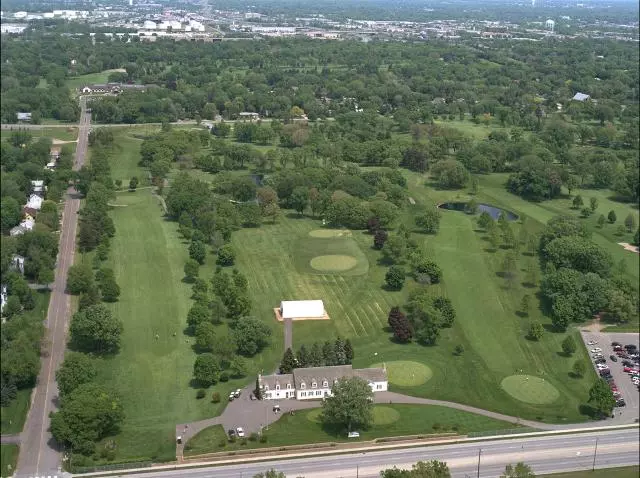 Falcon Heights is beginning to consider the future of the University of Minnesota’s Les Bolstad Golf Course property, which is up for sale. Credit: University of Minnesota
But due to a budget crunch, university administrators put the course up for sale last year, and the moment the sale goes through the land will be under Falcon Heights’ zoning jurisdiction. That means the city is already playing an active role in the sale process, but whatever happens, it will be a big change for the city.
The general vibe in the room last week was that people wanted to learn more about the possibilities and process for changing the land. The message from the three panelists was to preach about the need for a sustainable 21st century neighborhood.
Related: Rules of the road are at the center of the ICE occupation and resistance
The first speaker, state Rep. Larry Kraft, DFL-St. Louis Park, has emerged over the last few years as one of Minnesota’s leaders on climate and housing. In the Legislature, he’s sponsored a large bundle of ambitious bills covering zoning reform, transportation, taxation and other policies focused on the intersection of public policy and climate action.
That night, he patiently explained to the audience of mostly older white people why they should welcome density. He told the story of how got involved in housing policy issues by knocking on doors around his St. Louis Park neighborhood, and realizing that housing affordability was top of mind for his constituents.
“We can’t subsidize our way out of this,” Kraft said, citing state funding for affordable housing. “We have to get the market working for us, and so I’ve been working on housing bills for the past seven years. It’s a tough issue.”
Citing both bipartisan support and bipartisan opposition, he called for folks to push for more housing in the area, close to the city, where carbon emissions will be lower than just about anywhere else you might build a new home.
He was followed by Spencer Miller-Johnson, a planner from St. Paul with a passion for design, who introduced the audience to a few nearby examples of how future development might look. Pointing to Midwestern case studies, he gently moved the bar up from single-family typologies into more of what he called the “missing middle” or medium-density housing scales of two to four stories.
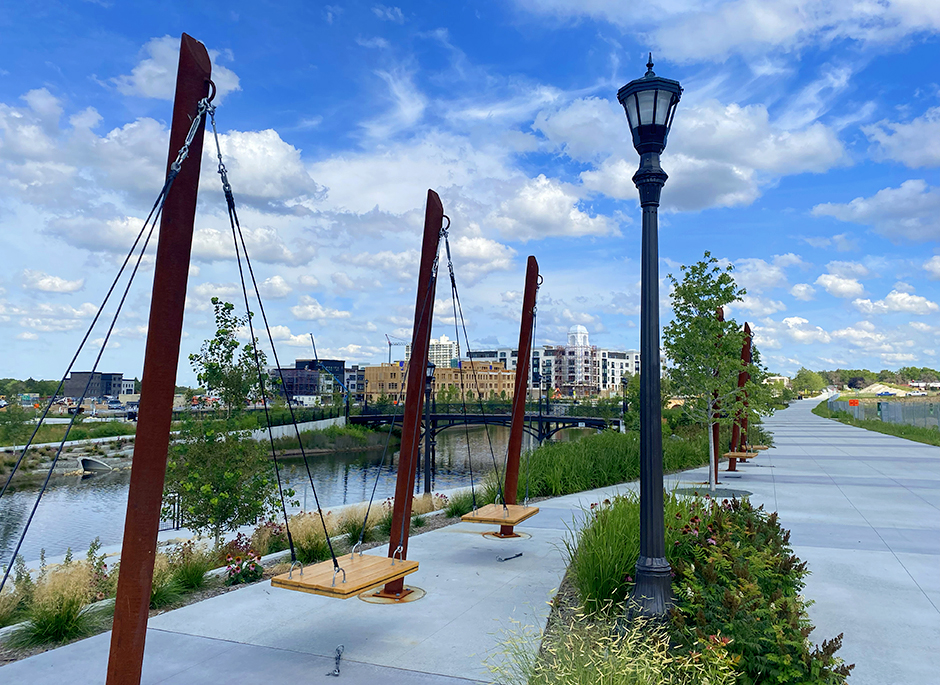 St. Paul’s Highland Bridge project is being looked at as Falcon Heights prepares to zone and plan the future of the University of Minnesota’s Les Bolstad Golf Course property. Credit: MinnPost file photo by Bill Lindeke
For example, Miller-Johnson invoked the nearby Highland Bridge development in St. Paul, about the same size in terms of acreage but (likely) a higher scale of density: around 4,000 housing units. Miller-Johnson pointed to the varied housing types in Prairie Queen, a 50-acre suburban development in Omaha, Nebraska, as a model to emulate.
Regarding the 135-acre Highland Bridge development, built on an old automobile factory site, Miller-Johnson cautioned that he “didn’t want to scare anybody” by invoking greater density. But he praised the way that Highland Bridge was financed, using tax increment financing (TIF) to build public space before actual housing. That process fostered community and a sense of place early on, and Falcon Heights should consider that approach.
“At the end of the day, I think density can be super beautiful,” he said.
The final speaker, Mike Hirabayashi, a volunteer and activist for Unidos St. Paul, who has been involved in development at The Heights in St. Paul. Another obsolete golf course, The Heights offers a great parallel for the Bolstad property. Hirabayashi’s main point was that advocates should ask for top-shelf climate infrastructure, specifically a networked geothermal heating and cooling system like the one currently being installed on the other edge of town.
Related: Minnesota’s riverfront cities can learn a lot from Stillwater
Calling it a “gold standard” that is “by far the most efficient, longest-lasting, and cheapest [option] to maintain, Hirabayashi cautioned that it would not be easy. He said that for The Heights project, developers and funders kept pushing back against the initial upfront costs and added complexity, and it took sustained pressure from the community to invest in low-carbon infrastructure.
(This rings true for me: the proposed Minneapolis geothermal aquifer system I wrote about back in 2021 never did bear fruit; the developer pulled out of a commitment to the infrastructure project for undisclosed reasons.)
It should be noted, Hirabayashi also warned that the ground was likely horribly polluted with mercury and other chemicals. It’s one of our society’s great ironies that golf courses, long assumed to be the ideal representation of “nature,” are deeply toxic underneath the surface. Once testing and cleanup take place, Hirabayashia’s hope is that the folks in the room will take on the climate baton, and build “net zero” housing before it becomes more expensive down the road.
Rethinking a golf course is never easy. Around the country, golf course developments have gone go notoriously wrong as development of these sprawling properties, laden with upper-class symbolism, plays out in the small-town politics of suburban city halls. Given the strong commitments of the folks in the room, many with long climate track records, and all of whom braved 20-below-zero weather, I’m hopeful that Falcon Heights’ story might be different.
Related