
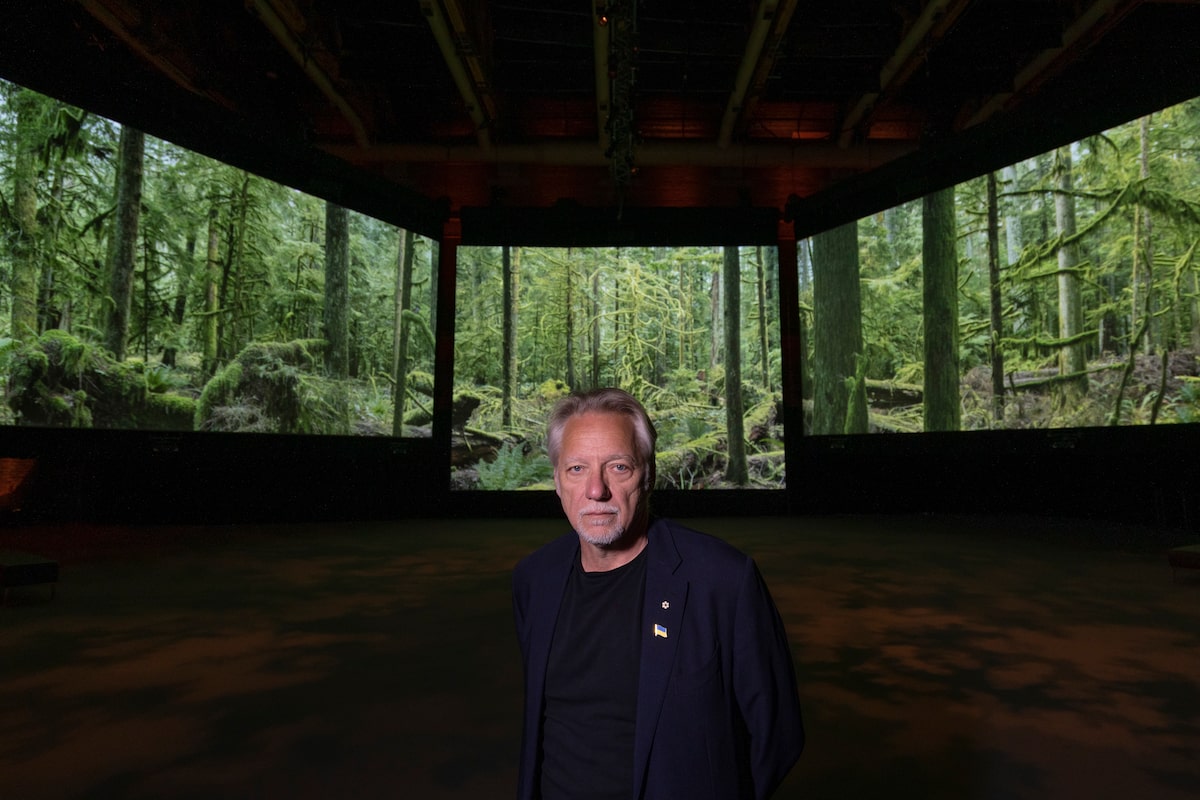
Edward Burtynsky will be returning to his hometown, St. Catharines, Ont., to present In the Wake of Progress, a 22-minute work of photography and video spanning his career.Jim Panou/Supplied
Fishing and foraging, canning and gardening in Niagara’s fertile landscape. Biking to the Welland Canal to watch the ships go through. Working on car parts at the General Motors and Ford plants. Every one of these experiences influenced photographer Edward Burtynsky while growing up in St. Catharines, Ont.
Burtynsky now lives in Toronto, and left St. Catharines in the late seventies to attend university, but his hometown has stayed with him.
“A lot of what I’ve gone on to do in my life with my work has been informed in many ways by those formative years,” he says.
On Jan. 30, he’ll be returning to the city to present In the Wake of Progress, a 22-minute multimedia work, at the inaugural Art in Action: Climate festival, which takes place at the FirstOntario Performing Arts Centre.
Besides Burtynsky’s piece, programming for the 10-day festival also includes cinema, music and dance – along with a climate symposium and education series, wine tastings and culinary events.
It all began four years ago when Colleen A. Smith, CEO of the centre, saw the debut of Burtynsky’s immersive large-scale work at the Luminato festival in Toronto.
At FirstOntario Performing Arts Centre, In the Wake of Progress will be shown on three massive screens, and comprises photography and video that spans 40 years of Burtynsky’s career capturing the complicated relationship of human development, technological advancement and the environment, accompanied by an original score. “It’s like walking into a television or a computer,” Smith says.
The work will be presented on three huge screens at the FirstOntario Performing Arts Centre.Jim Panou/Supplied
“When I saw his work in Toronto and came to the realization that Ed is born and raised here, there was no question in my mind that this work has to come home. That has been a four-year journey of making sure that the availability of the people, the equipment and Ed himself were able to be here,” she adds.
The festival, she says, is intended to be “an entryway to empathy for our community,” similar to the role Burtynsky sees his work playing for audiences who are polarized around topics like climate change. “We’re losing a lot of what ‘community’ means, and when you’re in amongst a group of people, the energy is different,” he says.
For those disputing or ignoring the impact of carbon emissions and contemporary industrial production methods on the environment, and how they contribute to climate change, “In the Wake of Progress is a call to your consciousness to think about the world that we are creating,” he says. “The raising of consciousness is the beginning of change.”
Creating a personal connection to what his photography captures – gaping holes in the landscape caused by mining, orange rivers of nickel tailings, factory floors so dense they look like patterns endlessly repeated – is, he hopes, motivation to think critically about one’s understanding of the world, something more important than ever at a time when we are inundated with images.
When asked what influence photography can have when we’re overwhelmed with visual communication, he says it’s not an easy question to answer.
“We use photography for a thousand things now – shorthand for logging things, for future references, sometimes for posterity, and sometimes for our memories, whereas, in the past, cameras came out when you travelled, on Sunday when everybody’s dressed up, as a family picture before you go to an occasion,” he says.
The ease with which we can take and consume photos, coupled with AI-generated imagery is, Burtynsky thinks, “one of the greatest issues of our time.”
He describes it as a battle of messaging. “Now somebody can prompt thousands of images in their pyjamas without ever going outside with a camera or ever picking up a camera,” he says. “It’s putting not only our health at risk and youth at risk, but our politics at risk, democracy at risk.
Photos and videos from Burtynsky’s career capture the complicated relationship of human development and the environment, accompanied by an original score.Marzieh Mohammadmiri/Supplied
“Everybody’s got their own feed and their own narrative and their own people they are listening to. So everybody has different worldviews. We’re now all atomized in clouds. And how people are accessing those clouds and manipulating those clouds is an interesting thing, between TikTok and Instagram and all of that. So we’ve entered a new domain where images are at the centre of that attention deficit economy.”
Jennifer Dockstader, co-programmer for the festival’s climate symposium, community advocate and member of the Oneida of the Thames and Bear Clan, says this separation between groups was part of the inspiration for the lens with which her and Dr. Julia Baird, a professor in the Environmental Sustainability Research Centre at Brock University, designed the sessions.
“We really thought about, how is Niagara going to receive this? What do they want to hear? What do they need to know?” she says. Along with artists, staff members of the Niagara Peninsula Conservation Authority, brewery owners and Indigenous knowledge keepers, politicians were invited to participate, but were asked to think beyond their current campaign promises.
“We want to put them nine years in the future,” says Dockstader. “What would they think without a partisan lens? How could Niagarans ask questions in a safer space? Let’s get some answers as to what political parties would actually think without constraints and let’s dream what could be possible.”
Marrying art, culture and science, Dockstader hopes, will prompt solutions. “Fear tends to paralyze and polarize. But the Indigenous community, the arts community and the scientific community, they tend to push us into different ways of thinking. And when you bring those communities together, what you find is action, not polarization.”
Burtynsky has his own ideas for solutions, and they are rooted in photography and how that medium has weathered the transition to a digital world.
Of the two trillion images taken every year, “less than 1 per cent are ever printed, whereas 25 years ago, 100 per cent were printed,” he says, as photography transitioned from chemical or analog to digital. “Paper and film, which is plastics, gelatins that would suspend the emulsions and silver – all things of the earth,” he says. “Gelatin was suspended in silver from silver mines, plastic from oil, paper from forests.”
Now, he says photography has moved away from those materials to “ones and zeroes,” a paradigm shift worth looking at for inspiration.
“Quite frankly, it occurred to me that for us to save the planet, it’s the exact same thing. We have to go from consumables – oil, gas and coal – to durables: solar panels, wind turbines, geothermal plants. All those things are going to be our energy sources, and then batteries to help us store it when we need to and use it when we need it.”
But this requires lithium and cobalt, copper and aluminum – things found in the mines that Burtynsky has been photographing, the extraction of which leaves scars on the landscape. “It’s a counterintuitive thing, but to save the planet, we’ve got to mine,” he says. “Because the only other way is burning more fossil fuels. How else are we going to do it?”
Art in Action: Climate runs Jan. 30 to Feb. 8 at the FirstOntario Performing Arts Centre in St. Catharines, Ont. For more information visit artinactionniagara.ca.