
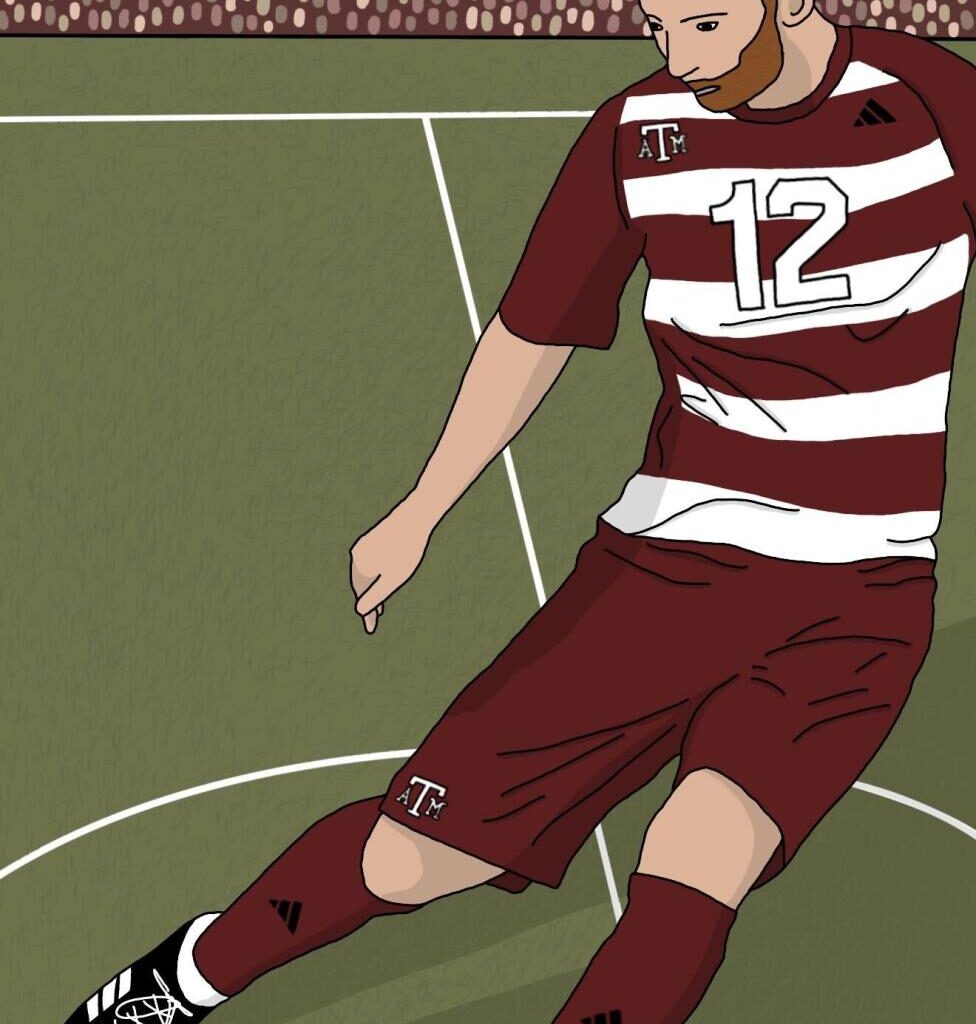
It’s ludicrous that Texas A&M doesn’t have a men’s soccer team.
We have a women’s team and a men’s club soccer team, but we don’t have a men’s team that competes at the Division I level. Even though this is primarily due to Title IX regulations and equity regarding men and women student-athlete scholarship opportunities, something as important as soccer should never have been neglected in the first place.
For the Americans who may read this and not understand this sport and its importance, you should step outside our country’s bubble and take a look at any other nation on our planet.
Soccer is the world’s most popular sport, and there’s not even a close second. Billions tune in to cheer on their favorite teams every week like a religious practice. Sometimes, fans will even watch their team play during their own religious services; the teachings of their spiritual leader become background noise as they listen faithfully to the coach preaching a sermon to their players in hopes it’ll be enough for their team’s salvation — a win.
Stadiums become cathedrals as chants become hymns — there’s no other feeling in the world that can quite match the intensity and excitement this sport brings.
For many, soccer may seem like two teams just running around on a field for 90 minutes, all for the game to end in a meaningless 0-0 draw. While that might be true, it just as easily could’ve been the greatest game you’ve ever seen.
In every game played, passion drives both players and fans. If people think Kyle Field is intimidating, they should go and witness a game in Europe; brawls aren’t started because of an attack on a person’s ego, but rather to fight for their team like soldiers in the military. Fans wear jerseys like a uniform, and the badges over their hearts brand their souls for everyone to see who they pledge their allegiance to.
The euphoria of a 97th-minute winner is unlike any other feeling as fans jump on top of each other and players run to the corner flag to celebrate — the greatest party on Earth has started. The rush when a player scores a “golazo,” sending out echoes of stardom that are heard around the globe and earning the moment endless replays on social media, or the anxiety fans face in a penalty shootout as players hold the fate of their team in their hands, hoping to either become legends if they score or public enemies if they miss. These kinds of feelings can’t be felt anywhere else.
No other sport in the world can match what this one means to people and the impact it has on individuals and communities.
I was born in Malaysia, a country whose home team currently sits below the top 100 men’s soccer teams in the world, according to FIFA. While our national team may be awful, soccer is nonetheless a part of every citizen.
Chefs trade in their aprons for soccer jerseys as they cook to the sound of commentators announcing a game. Mamak stalls stay open all day to broadcast midnight soccer games, the late hour becoming the peak time for these restaurants as fans swarm to get a glimpse of their team. Even though communities like Malaysia may seem insignificant on the world stage, soccer’s contribution to the nation’s cultural identity has gone a long way in shaping what Malaysia is today.
If you feel left out, don’t fret, because this will all be happening in our country this year.
As the 2026 World Cup finds its hosts in Mexico, Canada and the United States, Americans will finally be able to get a glimpse of what the rest of the world has been waiting for us to experience; it’ll be a major stepping stone for the growth of this sport in our country.
Because of this, A&M should really consider creating a men’s soccer team after seeing what happens at the World Cup.
As the development and expatriation of American soccer players to other countries grows exponentially, college soccer still presents a pathway for players to go professional. With academies trending upward, there will be players who want to go to college before playing professionally, and A&M should give them this opportunity.
By neglecting to place a greater emphasis on soccer, we regress as a university. Yes, the Aggies reached the College Football Playoff and our volleyball team won the national championship, but if we fail to invest in soccer by not giving the most popular and greatest sport in the world the attention it deserves, A&M will never expand across the globe athletically.
We worship Marcel Reed as our quarterback and football leader, but American teenagers are already considered stars who have been recruited by the greatest academies in the world and have etched their names in history books. Imagine if A&M had a role to play in that, producing the kind of talent that’s showcased and worshiped across the world. We do it in every other sport — why not soccer?
As a new page is turned in A&M women’s soccer with former head coach G Guerrieri’s retirement, we need to start a new book for men’s soccer. People are going to realize when soccer touches down in the Americas this summer what all the hype is about, and A&M is going to regret not supporting a new men’s soccer program.
Joshua Abraham is a kinesiology senior and associate opinion editor for The Battalion.