
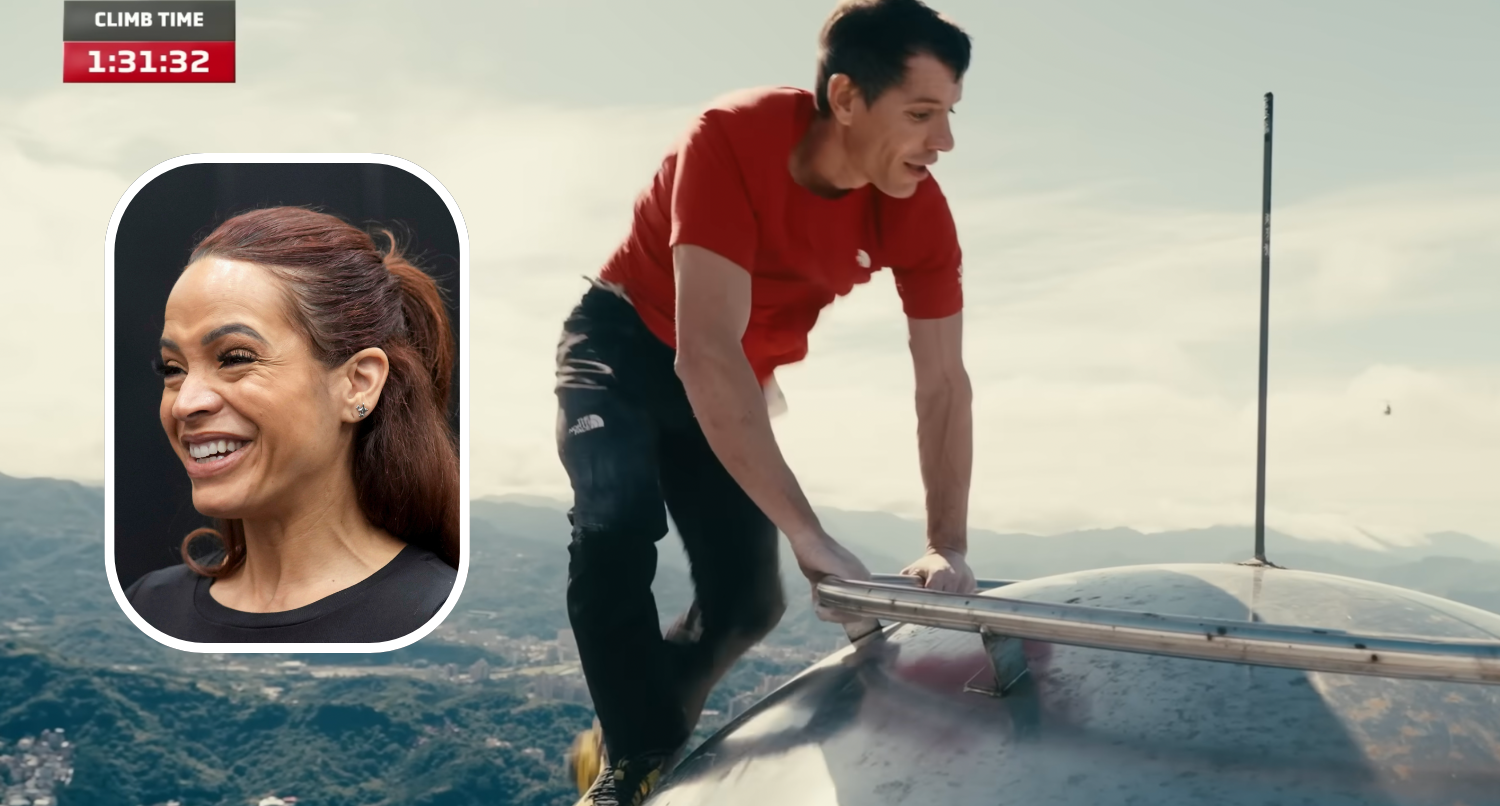
Elle Duncan went back to her hotel room after Skyscraper Live wrapped and did something most broadcasters don’t do. Before checking her phone, before reading any of the countless texts telling her the broadcast was awesome, before looking at social media reactions, she watched herself back.
“What I believed I was doing was managing my anxiety really well, and right away I went to watch the show,” Duncan said on the Awful Announcing Podcast. “I watched it back, and I was like, I was at a 10. I was incredibly, I was very anxious, and I think that it showed in a way that I didn’t feel like when I was doing it.”
As part of her first assignment for the streamer, Ducan hosted Netflix’s live broadcast of Alex Honnold climbing Taipei 101 — without ropes — which amassed 6.2 million views for the streamer. The event drew criticism focused on Duncan’s performance at the desk, with viewers saying she talked too much and her tone didn’t match the moment. Duncan recognized the problem herself before anyone told her. She watched an hour and 45 minutes of herself, starting at a 10 and staying there the entire time. When she gets anxious, she talks faster, trying to talk through the anxiety. She could see how that would wear on people. It would have worn on her, too.
Five minutes before going live, someone handed Duncan a card. It contained what she should say if Alex Honnold fell off the building and died. “There’s something to be said when five minutes before you go on air, someone slides you a card of what you’re gonna say if a person falls off the building and dies,” Duncan explained. “That was certainly not an experience I had ever had before.”
Nobody has ever narrated someone climbing a building who could die at any second while millions watched live. Duncan and the production team went in with objectives about telling Honnold’s story, but they didn’t know how he’d respond. Honnold had never free soloed in front of anyone before. Duncan asked him at dinner the night before how he thought he’d feel, whether he’d want to talk to her. He told her honestly, you never know. Sometimes you get on the wall, and you’re not feeling it at all, and you bail. They’d seen that in Free Solo when he abandoned one attempt. Sometimes you’re feeling it enough to just focus and get through it. And sometimes you can revel, and enjoy, and look around. You really don’t know until you’re up there.
Honnold got on the wall and started playing to the crowd, waving and interacting. Everyone realized this would be more celebratory than doom and gloom. Duncan was broadcasting from a dog park across from the building with a thousand people around her. They were gasping, and cheering, and laughing at everything Honnold did. When Duncan went back and watched, she realized she’d been broadcasting for those people, the ones amplifying everything through their reactions. If she had to do it again, she’d broadcast for the people at home. She’d watch her tone more carefully.
“My tone probably didn’t match to some of those moments, and that I didn’t need to sell the drama,” she said. “I went back and watched it, and I was like, the drama is this dude’s doing this crazy thing, like, look at these incredible images — that’s really all that I need. I didn’t need to paint that picture, but I didn’t know that going in.”
The production team prepared for 30 different scenarios. They had packages about the challenges Honnold would face that would have given viewers a break from Duncan’s voice. A lot of those packages never ran. The producers were feeling it in the moment, deciding they didn’t need certain elements or moving things around. Duncan had to contextualize on the fly when those pieces disappeared. They went in with a plan, but understood that plans change when you’re doing live TV. You have to be flexible and nimble.
That flexibility extended to how Duncan processed what happened afterward.
Duncan doesn’t go to social media for feedback. She knows the viewer’s voice matters — these broadcasts are made for them — but she treats both praise and criticism the same way. She goes back and watches herself with the same critical eye, whether people loved it or hated it. Even broadcasts that receive universal acclaim get picked apart when she sits down to review them. She’ll find things she wishes she’d done differently, moments where she could have made a better choice.
“I think as a broadcaster, to steal from Nick Saban, it’s a little bit like rat poison,” Duncan said. “There’s been things that I’ve done that have been really widely regarded and praised, and I go back and watch it with my own sort of critical analytical eye, and I go, oh, I could have done this different, or like, man, I wish I would have.”
Being the host means you’re the face of the broadcast. When things go well, the on-air talent gets all the credit. When they don’t, the on-air talent takes all the responsibility.
“If I’m the face of an experiment that people feel could have gone better, I’m OK with that,” she added.
What they attempted had never been done before. Nobody has ever hosted a desk where someone is climbing a building and could literally fall to their death at any second. There was no blueprint. They were the test case, the control in a science experiment with no past data to reference. Duncan gave herself grace for not sticking the landing while still being honest about the shortcomings.
Duncan worried that her performance would overshadow everything else the team accomplished. The production pulled off something massive from a logistical standpoint. The images were beautiful. The feat itself was incredible. She didn’t want what happened at the desk to take away from any of that.
“I’m disappointed that I personally didn’t stick that landing, but ultimately, I don’t want people to lose the forest through the trees,” Duncan continued. “It was a very large undertaking logistically, and I hope that anything that happened on the desk doesn’t take away from how beautiful it was, how beautifully shot it was, the incredible feat that he was doing.”
Duncan says she’d take another shot at it if Netflix gave her the chance. She knows what works and what doesn’t now. But she’s still proud of what they put together and proud of the team that made it happen.
“Ultimately the goal of what can you take away from watching Alex Honnold climb, which is that as he said, ‘Life is finite,’ and if you have an opportunity in your life to do something that scares you and challenges you and pushes you, then you should do it, because we have so little time,” Duncan said. “That to me was a success. I think we showed all that, we showed who Alex was.”
Listen to the full episode of the Awful Announcing Podcast featuring Elle Duncan beginning Thursday, Jan. 29. Subscribe to the show on Apple Podcasts, Spotify, and wherever you get your podcasts. For more content, subscribe to AA’s YouTube page.