
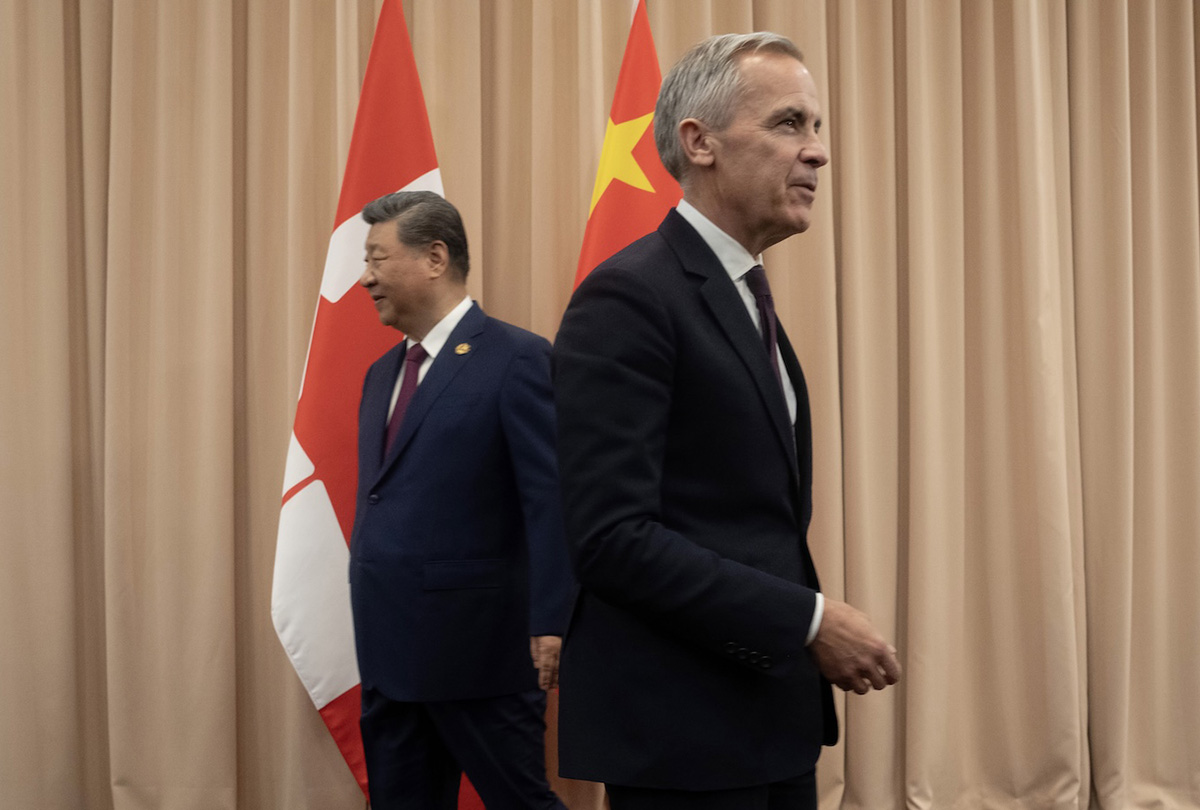
The PM should have known that negotiating a trade deal with China and poking Trump in the eye in Davos would elicit a response
By Barry Appleton
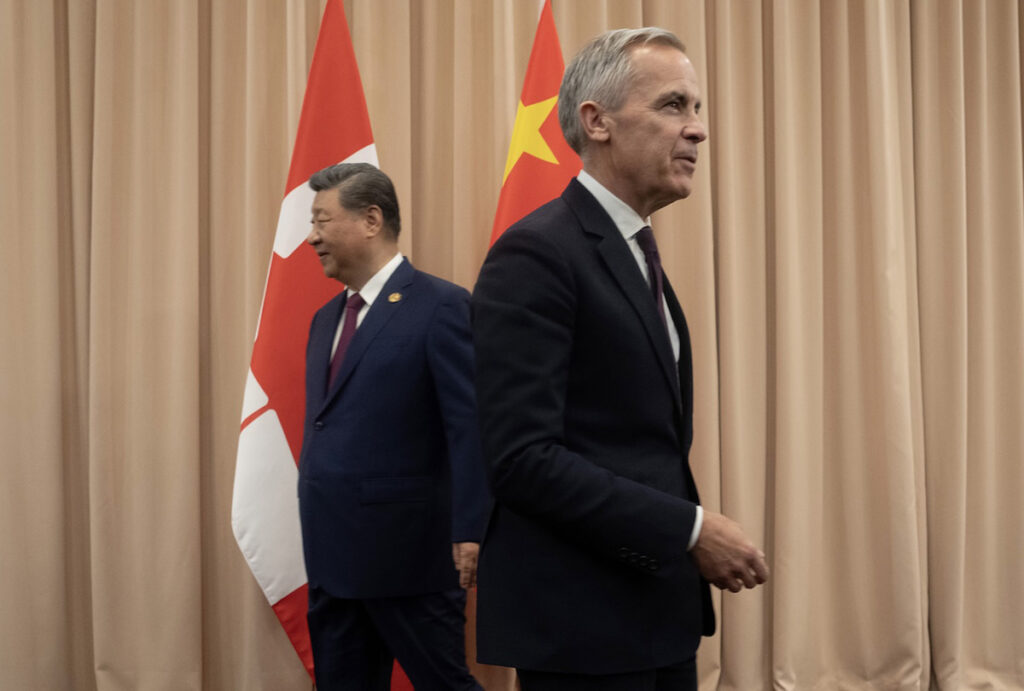
On Saturday, U.S. President Donald Trump threatened Canada with 100 per cent tariffs on all goods if Prime Minister Mark Carney proceeds with his China trade deal. The president’s language was characteristically blunt: Canada would become a “drop off port” for Chinese goods, and “China will eat Canada alive, completely devour it.” This is the predictable consequence of Carney’s reckless foreign policy.
Get the Latest Canadian Focused Energy News Delivered to You! It’s FREE: Quick Sign-Up Here
Carney rolled the dice on Canada’s economic future, but the table was rigged against him from the start. By courting Beijing on electric vehicles and canola, he was testing the structural limits of the Canada-United States-Mexico Agreement (CUSMA). Anyone who has read the treaty could have told him how this would end.
The danger lies in CUSMA Article 32.10 — the agreement’s infamous “poison pill.” This provision requires Canada to notify the United States three months before negotiating a “free trade agreement” with a “non-market country” (read: China).
Article 32.10’s power lies in what it doesn’t say: CUSMA nowhere defines a “free trade agreement,” and under the Vienna Convention, undefined terms are interpreted by their ordinary meaning and effect — not by what the parties choose to call them. An arrangement exchanging preferential tariff reductions for market access fits any functional definition of trade liberalization, and the absence of a definitional safe harbour means the interpretive ambiguity favours the broader reading Washington is entitled to assert.
If Washington dislikes the resulting deal, it has the unilateral right to terminate CUSMA and replace it with a bilateral U.S.-Mexico agreement. Canada would be entirely out of the North American trading bloc.
Carney appears to have believed he could sidestep this tripwire. Canada’s announcement of a trade arrangement with Chinese President Xi Jinping — swapping market access for Chinese EVs in exchange for lowered tariffs on Canadian canola — was a direct provocation.
The first black eye to Washington came with the deal itself. The second came in Davos, Switzerland, when Carney warned of a “rupture” in the American-led world order without naming the president directly. Trump noticed. He responded by disinviting Canada from his Board of Peace and, on Saturday, by threatening to shut down trade entirely with our biggest trading partner.
The prime minister’s defenders will say he is standing up for Canadian sovereignty. But the better part of valour is discretion. Strength without wisdom is provocation. There is nothing bold about gambling the livelihoods of Canadian auto, steel, aluminum and softwood lumber workers on a bluff you cannot back up.
Canada is, undeniably, the leveraged party in this relationship. As Jared Kushner candidly admitted in 2020, CUSMA’s sunset clause was designed as a “16-year lease” to provide Washington with ongoing leverage over its smaller partners. The agreement was engineered to keep Canada dependent. Taking steps that violate the spirit of that agreement might work if you have countervailing leverage. It is suicidal when you do not.
This dependency runs deeper than canola and cars. CUSMA’s digital chapter already restricts Canada’s ability to govern data flows, demand source code transparency or mandate data localization. We signed away the keys to our digital kingdom years ago. Now, by inviting Chinese EVs — mobile surveillance platforms on wheels — into our market, we have layered a national security crisis onto a trade dispute. Trump’s “drop off port” accusation is the logical American reading of what Canada has done.
I have argued for years that Canada needs to diversify its trade relationships. We are over-exposed to the U.S. market, and now we have almost two decades of trade-laziness to clean up. But there is a profound difference between building domestic capacity in critical minerals and semiconductors to supply our allies and pivoting to a strategic adversary.
We are waving a rule book at a bulldozer. Canada lacks the institutional machinery to handle this confrontation. While the United States deploys hundreds of security-cleared advisors through its Industry Trade Advisory Committees to scrutinize every move we make, Ottawa’s trade strategy appears to rely on improvisation and hope. That is not a strategy, it’s gross negligence.
Thankfully, Canada retreated. A 100 per cent tariff would be catastrophic. It would devastate the auto sector, cripple steel and aluminum and send shock waves through every export-dependent industry in this country. It would gut CUSMA and tell foreign investors that Canada is radioactive for inbound investment. The Trump administration does not need a dispute panel to impose it. It will use powers under Section 232 of the Trade Expansion Act or Section 301 of the Trade Act and dare us to sue. What comfort do we offer Canadian workers when our own prime minister handed Washington the legal and political ammunition it needed?
It pays to know the zoning rules when you have a difficult neighbour. It strains credulity that the prime minister pursued a China reset without consulting trade officials who know the terms of CUSMA. If he did consult them, he likely ignored their advice. If he did not, that is worse. Either way, the result is the same: Canada now faces the most serious trade threat in a generation, and we provoked it ourselves.
Carney bet that the United States needs our energy and resources too much to retaliate. He was wrong. In the eyes of this U.S. administration, trade law is a suggestion, and leverage is the only currency. By ignoring the poison pill of Article 32.10, Canada acted like a tenant trying to sublet a room to the landlord’s sworn enemy. The eviction notice is now on the table.
National Post
Barry Appleton is an international trade lawyer at Appleton & Associates International Lawyers LP, distinguished senior fellow and co-director at the Center for International Law at New York Law School and a scholar and fellow at the Balsillie School of International Affairs.
Share This:
More News Articles