
Breadcrumb Trail Links
Our athletes no longer just own the podium, they’ve stormed it in a wide array of sports. How attitude, talent and money came together
Published Jan 29, 2026 • Last updated 1 hour ago • 18 minute read
You can save this article by registering for free here. Or sign-in if you have an account.
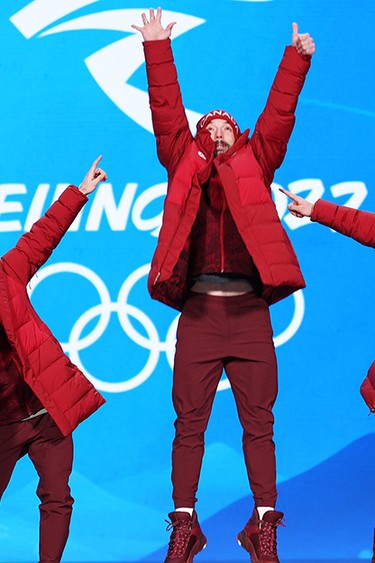 BEIJING, Fev. 17, 2022: Gold medallists Charles Hamelin, Steven Dubois, Jordan Pierre-Gilles, Maxime Laoun and Pascal Dion of Team Canada celebrate during the Men’s 5000m Relay medal ceremony on Day 13 of the Beijing 2022 Winter Olympics. Photo by Sarah Stier/Getty ImagesArticle content
Natalie Spooner stood in the bowels of an arena in Beijing four years ago and said something that seemed very un-Canadian.
The Canadian women’s hockey team had just beaten their American rivals in the preliminary round of the Olympic tournament. Like every game between those two teams, it had been dazzling: 60 minutes of intensity punctuated by moments of skill.
Article content
Article content
Advertisement 2
This advertisement has not loaded yet, but your article continues below.

THIS CONTENT IS RESERVED FOR SUBSCRIBERS
Enjoy the latest local, national and international news.
Exclusive articles by Conrad Black, Barbara Kay and others. Plus, special edition NP Platformed and First Reading newsletters and virtual events.Unlimited online access to National Post.National Post ePaper, an electronic replica of the print edition to view on any device, share and comment on.Daily puzzles including the New York Times Crossword.Support local journalism.
SUBSCRIBE FOR MORE ARTICLES
Enjoy the latest local, national and international news.
Exclusive articles by Conrad Black, Barbara Kay and others. Plus, special edition NP Platformed and First Reading newsletters and virtual events.Unlimited online access to National Post.National Post ePaper, an electronic replica of the print edition to view on any device, share and comment on.Daily puzzles including the New York Times Crossword.Support local journalism.
REGISTER / SIGN IN TO UNLOCK MORE ARTICLES
Create an account or sign in to continue with your reading experience.
Access articles from across Canada with one account.Share your thoughts and join the conversation in the comments.Enjoy additional articles per month.Get email updates from your favourite authors.
THIS ARTICLE IS FREE TO READ REGISTER TO UNLOCK.
Create an account or sign in to continue with your reading experience.
Access articles from across Canada with one accountShare your thoughts and join the conversation in the commentsEnjoy additional articles per monthGet email updates from your favourite authorsSign In or Create an Account
or
Article content
Spooner said she and her teammates had wanted to send a message to the American team that had beaten them for Olympic gold four years earlier. The Canadians, she said, a smile on her face, wanted to show Team USA that “they didn’t belong on the ice with us.”

Long Story
Thanks for signing up!
Article content
Goodness. A Canadian athlete being not just confident, but boastful? It was a big win to be sure, but everyone knew there would be a rematch in the gold-medal game a week later. And here was Spooner, a veteran of so many Canada-USA wars, not being shy about her feelings. If the single most common expectation of Canadians is that we will be unfailingly polite, Spooner was going for something else entirely — swagger.
 Photo by DARCY DAVIS, WATERLOO CATHOLIC DISTRICT SCHOOL BOARD
There has, in recent years, been a lot of that going around with Canadian athletes.
Shai Gilgeous-Alexander from Hamilton, Ont., is the reigning NBA MVP and Finals MVP after leading the Oklahoma City Thunder to the championship last summer. Brooke Henderson won the CPKG Canadian Women’s Open for the second time, while Victoria Mboko won Canada’s tennis national open, copying the meteoric rise of countrywomen Bianca Andreescu and Leylah Fernandez earlier this decade. Felix Auger-Aliassime finished the 2025 season with a win in Brussels and a run to the semis of the ATP Finals, pushing his world ranking to a career-best fifth. Olivia Smith, a 21-year-old soccer player from the Toronto suburbs, became the first woman to command a transfer fee of £1 million when her contract was bought by London giants Arsenal. Jonathan David, the leading scorer for the men’s national team, moved to Italy’s Juventus, one of the grand old clubs of European soccer.
Article content
Where once Canada was mostly great at hockey and curling, now our athletes are competing at the highest levels across a dizzying array of disciplines. Rugby. Freestyle skiing. Snowboarding. Hammer throw. Ski jumping. And, in a bit of a throwback, alpine skiing: Jack Crawford, who won a surprise bronze medal in the alpine combined at the Beijing Olympics, has since become a world champion and, in January 2024, won the downhill on one of the most famous slopes in the Alps, the Hahnenkamm in Kitzbühel, Austria.
This stuff might seem normal to younger Canadians who are used to seeing this country’s athletes hoisting trophies and standing on podiums, but for those of us who are Gen-X or older, it can be a little disorienting: We’re good at what now?
Scott Russell, the longtime CBC reporter and anchor who retired last year after three decades of Olympics coverage, has seen the transformation up close.
He tells a story from his final Games, in Paris last summer.
“I’m hosting,” he says, “and we’re going on the air in what is prime time in Canada. And the Canadian women in beach volleyball, Melissa Humana-Paredes and Brandie Wilkerson, are playing for a medal, and my producers are telling me, ‘Oh, no, we’ve got to go to track and field.’”
Article content
Article content
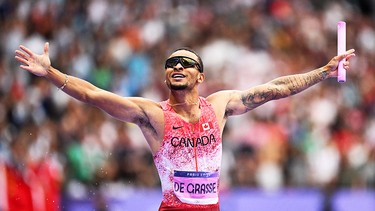 Andre de Grasse celebrates after winning the men’s 4×100-metre relay at the 2024 Summer Games in Paris on Aug. 9, 2024. Photo by KIRILL KUDRYAVTSEV/AFP via Getty Images
The Canadian men’s sprint relay team, anchored by Olympic champion Andre de Grasse, was about to race.
“And I’m going, ‘Yeah, but these guys are playing for a medal! And they’re going, ‘That’s OK. We’ll get to it. We’ll bring it back.’”
Russell is laughing now.
“In the old days, when I was first covering the Olympics, that was not a problem,” he says. “If there was a Canadian with even medal potential, well, we’d be there because there wasn’t anything else of great import. Now, it’s like, to use an old expression, it’s like shooting fish in a barrel.”
David Shoemaker, chief executive of the Canadian Olympic Committee, says that success has had a noticeable impact on the way Canada’s athletes approach their highest-stakes competitions, inside and outside the Olympic sphere.
“There’s a belief among athletes that we can, whatever the sport, compete with the world’s best and win,” he says. “And that’s a belief that is, you know, kind of new for Canada, and it’s wonderful to see.”
Canadians ‘among the world’s best’
So, what happened? How did Canada go from a country that didn’t win a single gold medal at the Montreal Olympics in 1976 to one that is routinely winning them in high-profile events such as swimming and track and field and winter sports?
Article content
It hasn’t happened by accident, Shoemaker says.
“I think that this is very much a 20- to 25-year result of investment focus and prioritization in sport,” he says. “As well as seeing the results of what I call inspiration and aspiration for young Canadians and belief among athletes that they can be among the world’s best.”
We’ll get to the inspiration part later, but first let’s consider the rather dry-sounding “investment focus and prioritization” that Shoemaker mentions. It’s another way of saying, simply, money.
Canada had long provided funding support for its amateur athletes, but around 20 years ago a plan was hatched to provide major financial backing for those athletes with Olympic medal potential.
What became Own the Podium was launched with about $110 million in contributions from the federal government and corporate donors, and that large pot, spread over a five-year period, wasn’t distributed evenly. A larger share would go toward the national sports organizations, and their athletes, that were seen as podium threats.
This approach, which has come to be known as targeted funding or incremental funding, brought with it a certain ruthlessness. An athlete who might be the best in Canada in their sport won’t get much in the way of government backing unless they are also among the world’s best.
Article content
Article content
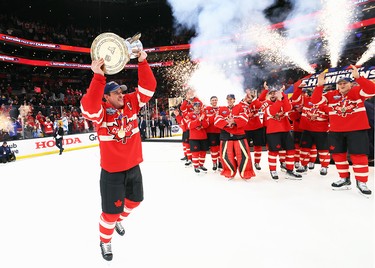 Sidney Crosby hoists the trophy in Boston after Canada defeated Team USA in the 4 Nations Face-Off on Feb. 20, 2025. Photo by Bruce Bennett/Getty Images
The results are unequivocal. Team Canada was 21st in the medal table, with 12 podium finishes, at Athens 2004. Two decades later, Canada left Paris 11th in the table with 27 medals. Perhaps not surprisingly, Canada’s Winter Olympic success has been even more extreme: more gold medals than any nation at Vancouver 2010 and finishing Beijing 2022 with the fifth-most medals of any country, just ahead of the United States.
Again: ahead of the United States.
Anne Merklinger, the chief executive of Own the Podium, says buy-in throughout the country’s sports ecosystem was an important early factor.
“Not all the winter sports had evidence of medal potential when the first concept was introduced,” she says. “But they all came together and agreed unanimously that the country needed to do this, and that we needed to deploy this approach.”
The transformative part hasn’t just been about providing extra money to talented athletes so they can spend more time in the gym or in the pool, Merklinger says, but in driving a high-performance culture across any sport that is trying to turn out elite athletes. Training, coaching, scheduling, nutrition, mental performance — the list of ways in which Own the Podium tries to help Canadian athletes is extensive.
Article content
Private funding has also been tapped to help drive athletic success. Donors or corporate backers can fill in some of the financial gaps that national sports organizations are unable to cover, meaning that an elite athlete is more likely to be able to devote more time to training and development than, say, going to work to earn rent money. Sometimes that private support can be more formal, through organizations such as b2ten, which is almost like a smaller, philanthropic version of Own the Podium, backed by wealthy investors who provide a select group of competitors with resources to help them prepare to compete.
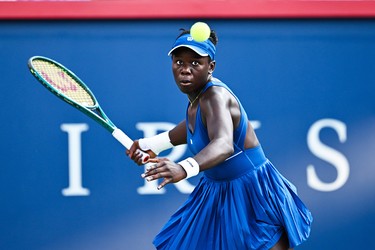 Canada’s Victoria Mboko won the Canadian Open against Japan’s Naomi Osaka at Montreal’s IGA Stadium on Aug. 7, 2025. Photo by Minas Panagiotakis/Getty Images
However the financial backing and support makes its way to an athlete, the applications are different from sport to sport.
Guillaume Marx, the vice-president of high performance for Tennis Canada, says it’s important to control the pathway of a young tennis player who shows elite potential.
“When you have someone from Canada, it’s not like when you’re from Spain, Italy or France, where you get so much competition, and there are so many clubs everywhere, and you can even play outside all the time,” he says. Those kinds of tennis nations can produce stars almost organically because their developmental systems are so robust — not unlike Canada and hockey.
Article content
With Canadian tennis, “we’ll never have the structure that will bring you close to the top 100 (on its own),” Marx says. “So we have to create that environment ourselves, with experienced coaches, experienced staff that can just stick to the best standards. If you don’t stick early to the international standards, there are really low chances you’re going to have something good just happening by accident later.”
And so, players such as Auger-Aliassime, Andreescu and Gabriela Dabrowski, who won her fourth career Grand Slam title — two in doubles, two in mixed doubles — at the U.S. Open in September, have come through a national-team program that is much more structured and focused than it was a couple of decades ago.
Canadians value performance, and they value medals.
Scott Russell
Golf Canada has undergone a similar revolution. Where once a handful of Canadians made it to the pros, now there is an entire developmental system that identifies young talent and supports players through national amateur programs and into the early part of their professional life.
“For us, it’s, ‘How do we effectively pool resources, essentially, where we reach economies of scale,’” says Emily Phoenix, Golf Canada’s director of high-performance, a program that includes 55 players. “How does it make sense to provide support and services that many elite players may need, while still having flexibility to tailor it to their individual needs?”
Article content
Henderson, with 14 LPGA wins to her credit, is Golf Canada’s crown jewel, but in recent years a half-dozen of its graduates have won tournaments on the PGA Tour, most notably Nick Taylor’s playoff victory in the RBC Canadian Open in 2023.
The impact of financial investment, whether directly from the government or through corporate backers or other philanthropic ventures, might not make as romantic a story as, say, Sidney Crosby shooting pucks into a basement laundry machine as a kid, but it’s coldly effective.
Yet the emphasis on winning does not come without risks. Canada Soccer, amid the best stretch in its history by some distance, was tarnished by a drone-spying scandal at the Paris Olympics that was as pointless as it was embarrassing. Hockey Canada was accused of shielding its elite junior players from scrutiny after allegations of sexual assault were made against members of the 2018 World Junior team. (A criminal trial ended last year with no convictions.) More recently, decorated Olympian Penny Oleksiak accepted a two-year ban from competitive swimming for “whereabouts” violations. Athletes are required to update their locations constantly to allow for out-of-competition drug testing, although there has been no accusation that Oleksiak took performance-enhancing drugs. (Oleksiak has said her failure to update her whereabouts information was “a genuine mistake.”)
Article content
Even the way dollars are allocated has come under criticism. Because targeted funding means the pie is not split equally, athletes in sports that have not been earmarked for success can be left to fend for themselves, trying to raise money from friends, families or local casino nights, not unlike trying to pay for a wedding. In its winter-sport allocations for 2024-25, Own the Podium is directing more than $4 million to freestyle skiing and more than $2.7 million to snowboard. Biathlon, to pick one example at the other end of the table, is receiving $265,000. That wouldn’t cover many bullets.
And if all of that sounds a little ruthless, that’s because it is. There’s an old saying that comes to mind: check the scoreboard.
“Canadians value performance, and they value medals,” Russell says. “And producing medals and targeting successful programs that will produce medals, begets success. You have to target and nurture success so that it produces more success.”
Inspired by the success of others
Nurturing success can come in different forms. For every athlete whose performance has been honed and trained using the best techniques and modern science, there are also those who have been inspired to greater heights by Canadians who came before them.
Article content
“That old expression comes into play: ‘To be it, you’ve got to see it,’” says Russell. He goes on to talk about basketball at the Pan Am Games that were held in Toronto in 2015.
“The Canadian men were coached by Steve Nash” — the two-time NBA MVP — “and they won the silver medal, right? And Shai Gilgeous-Alexander was 17 years old at the time. He didn’t play in the tournament, but I’ll bet you he watched that tournament. Jamal Murray played in the tournament, Anthony Bennett played in it. And then, you know, the ball gets rolling.”
Murray, an NBA champion with the Denver Nuggets, is one of the 23-strong Canada contingent in the league, more than any country outside the United States. Bennett was a former first-overall NBA draft pick.
Two years before Nash had his first MVP season with the Phoenix Suns in 2005, golfer Mike Weir authored one of Canadian sport’s signature moments with his victory in the Masters. That win is still talked about with reverence among the Canadian men who followed Weir onto the PGA Tour, and for some of them it is a formative golf memory. Mackenzie Hughes has said that tournament is the first time he can remember watching the Masters as a kid. Weir isn’t just an inspiration, he’s a literal mentor, playing a practice round at Augusta National with whichever Canadians have qualified for the Masters each April. Just the fact that he can have a standing date with fellow Canadians on Augusta’s manicured fairways — and usually fill out a foursome — is indicative of how deep the country’s talent pool has become.
Article content
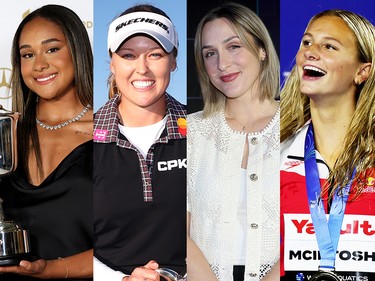 From left, soccer star Olivia Smith plays for Arsenal; golfer Brooke Henderson; Gabriela Dabrowski has four career Grand Slam titles; and swimmer Summer McIntosh posted one of the greatest years in Canadian sport in 2025. Photo by Postmedia News files
Henderson is only 28, but she’s been a successful professional for long enough that she’s had a Weir-like impact on the women’s side of the game.
Canada has 12 women — some of them girls, technically — ranked inside the top 200 on the world amateur golf ranking, led by 15-year-old Aphrodite Deng from Calgary, who is 15th on that list. Vancouver’s Anna Huang, meanwhile, turned pro at 17 in 2025 and joined the Ladies’ European Tour, where she has won twice to move into the top 100 of the world rankings.
Phoenix, of Golf Canada, says having successful players such as Weir and Henderson has been “really powerful within our system.”
“It’s someone that players can connect to,” Phoenix says. “If she did it, I can do it, too, right?”
For decades, it was rare for a Canadian tennis player to come anywhere near the top of the world rankings, with the notable exception of Daniel Nestor in doubles, where he won multiple majors. But in the early 2010s, Milos Raonic and Eugenie Bouchard broke through to make deep runs in multiple Grand Slam tournaments, cementing the idea that Canada could be a tennis nation, too.
“Little by little, you break barriers,” says Marx. “After Milos and Genie, I can say that everybody was kind of believing that (Canadians) could do something, even in singles.”
Article content
Andreescu became the first Canadian to win a Grand Slam title at the U.S. Open in 2019, and Leylah Fernandez made the final at the same tournament a couple of years later. Canada has also won the Davis Cup and the Billie Jean King Cup — the premier men’s and women’s international tournaments, respectively — in the years since.
Seeing really has meant believing.
“That’s what 2010 did, right?” says Merklinger, referring to Canada’s medal haul in a home Olympics. “Our country saw the athletes and teams in the Vancouver and Whistler Olympic Games and Paralympic Games win, and so they wanted to win. They believed that they could win.”
“I want to see someone who looks like me do well,” Merklinger continues, putting herself in the role of a young, aspiring athlete. “And that inspires me to say, ‘Hey, that person can do it. So, can I sign up? Where do I sign up?’ ”
Russell points out that even some of the Canadian success stories in lesser-known sports have a forebear. Dylan Armstrong, who won a shot-put medal at the 2008 Olympics, became a coach who teaches other Canadians to throw very heavy things. Among his students is Ethan Katzberg, who became an Olympic champion in the hammer throw last year. Canadian Camryn Rogers took gold in the same event for women.
Article content
Article content
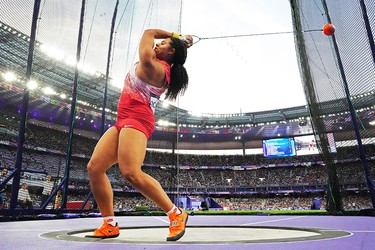 Camryn Rogers from Richmond, B.C., competes in the women’s hammer throw final at Paris 2024, where she earned the gold medal. Photo by PAWEL KOPCZYNSKI/POOL/AFP via Getty Images
Armstrong’s success, Russell says, was the “appearance of a role model” that has since influenced the next generation.
Canada’s sporting success has also been contagious across disciplines.
“One of my fonder memories from my Winter Games experience was when I went to go watch Cynthia Appiah compete in a bobsleigh in Beijing in 2022,” says Shoemaker.
These were the COVID-19 Games, with empty stands and no tourists allowed.
“But I was up at the start area, and I looked down the track and I saw a bunch of red and I was like, ‘What is this?’ And as I zeroed in on it, I realized it was our women’s national hockey team.”
Marie-Philip Poulin, Natalie Spooner and the whole gang had made the trek up to the sliding centre. (And it was some trek, requiring a high-speed train and several buses to reach a facility that was so isolated it might as well have been on the moon.)
“They had all come out on a day off to see the bobsled, to cheer on fellow Canadians,” Shoemaker says. “It’s … there’s something special about our country.”
Canadian men’s soccer a cultural mosaic
Failure is an orphan while success has many parents, and the Canadian experience in sports is no different. Beyond investment in training and the emergence of role models, there are other notable factors in the change over decades. Canada is a lot bigger now, which expands the athlete pool, and generations of immigration have grown the athlete pool in a different way.
Article content
Canadian kids aren’t automatically having skates strapped to their feet at a young age, but are playing in sports that might be a bigger deal in the homelands of their parents and grandparents. No group exemplifies this trend better than the Canadian men’s soccer team, which is a cultural mosaic all on its own.
Alphonso Davies, the superstar left-back, was born in a refugee camp in Ghana and came to Canada when he was five. Defender Derek Cornelius was born in suburban Toronto to parents from Barbados and Jamaica. Winger Ali Ahmed was born in Toronto to Ethiopian parents. Midfielder Ismael Koné was born in Ivory Coast and came to Canada when he was seven. Almost to man, there is some kind of origin story involving the Old Country, a trend that isn’t limited to Canada’s soccer exploits.
 From left, Alphonso Davies, Derek Cornelius, Ali Ahmed and Ismael Koné. Photo by Postmedia News files
Russell also points to investment of a different sort, with Canada having played host to major international tournaments over the past several decades. He rattles off a list: the world athletics championship in 2001, the world road cycling championship in 2003, the world aquatics championship in 2005, the Olympics in 2010, the Pan Am Games in 2015, the Women’s World Cup that same year and the men’s version next summer. Those big tent-pole events aren’t cheap to host, but they improve the sporting infrastructure and they can have knock-on effects that last for years.
Article content
Or, as Russell puts it, “Young Canadian hopefuls are exposed to high-performance sport in their own backyard, and then they want to be it.”
The influence of those events is on display every couple of years, when the huge Canadian contingent is introduced at an Olympics.
“When my colleagues among other national Olympic Committees ask me how big our winter team is,” Shoemaker says, “They kind of go, ‘Whoa.’” Canada will send more than 200 athletes to Milan-Cortina 2026. “We’re still medium-sized in the Summer Games,” Shoemaker says. “But I think what’s changed is, when you get the start of the 100-metre dash, let’s say, people look across and they say, ‘Oh, shoot, there’s Canada.’ In the swimming pool, you line up on the blocks, ‘Oh, boy, there’s Canada.’ We intimidate. People take us seriously on the world stage. And that’s nice.”
Russell says he has seen the attitude of Canadian athletes shift over the years.
He points to the example of the men’s 4×100-metre relay team at the Paris Olympics. “They thought they should win that gold medal,” he says.
“They knew, you know, they were the world champions in 2022 and they knew they had a great coach, Glenroy Gilbert, an Olympic champion, sure,” Russell says. “But they went in saying, ‘We’re not here to win a medal. We’re gonna win.’ And they took the trash-talking from the USA. And they just said, ‘That’s fine. We’ll go about our business.’ ”
Article content
Article content
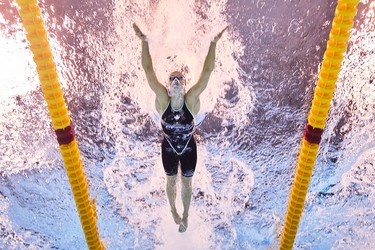 Toronto’s Summer McIntosh competes in the women’s 200-metre butterfly on July 30, 2025, at the 2025 World Aquatics Championships in Singapore. Photo by Adam Pretty/Getty Images
Was it that attitude that made the difference as Andre de Grasse delivered his stunning anchor leg to take the gold medal? The confidence certainly wouldn’t have hurt.
Meanwhile, “The swagger of that Canadian women’s swimming team is immense,” Russell continues. “I mean, when you have Summer McIntosh in there … and she talks about now winning, what, five individual gold medals in L.A.?” (Los Angeles will host the 2028 Olympics.) McIntosh had one of the greatest years in Canadian sport in 2025, winning four gold medals at the World Aquatics Championships in Singapore, the kind of haul that has only been matched at a single meet by some of history’s greatest swimmers.
“So, no,” says Russell, “the attitude has changed completely.”
Marx says that confidence can express itself on the tennis court in a lot of different ways.
“It’s not just confidence that you can achieve a result, but it goes into the details,” he says. “It’s confidence that you are fast enough, confidence that your body can stay strong for three hours. It’s confidence that you have shots that are technically at the highest level.”
Marx, who has worked with Auger-Aliassime since he was first tipped for tennis stardom, notes that his strong finish to the 2025 season wasn’t just from an attitude shift, it was rooted in tactical improvements: a better serve, a more confident backhand and a sustained period of good fitness. That allowed Auger-Aliassime to play more aggressively, and some of the best tennis of his life.
Article content
Confidence isn’t just a mindset, Marx says. “It’s a mental thing, yes, but it’s a mental thing that’s related really to everything that you do in the other areas (of your game). This thing is always there.”
That Canadian athletes have their chests puffed out more than normal would be a notable development on its own, but in the current geopolitical climate, where the country’s once-great friend and ally has adopted the mannerisms of a schoolyard bully, sporting contests have taken on a little extra edge.
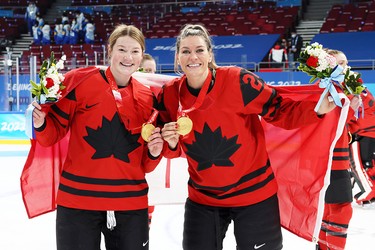 Ella Shelton and Natalie Spooner celebrate Team Canada’s gold-medal win over Team USA at the Winter Games in Beijing on Feb. 17, 2022. Photo by Bruce Bennett/Getty Images
The Star-Spangled Banner gets booed in Canadian arenas. The waving of the Maple Leaf takes on a deeper meaning. And sometimes, a bunch of hockey players start fighting each other as soon as the puck drops, as took place between the Canadian and American players in the 4 Nations Face-Off — an exhibition that only existed because hockey fans had become bored by the All-Star Game — last February.
“I think Canadian athletes would tell you they feel as though there’s a little extra at stake in today’s world,” Shoemaker says. “Certainly, the hockey players in the 4 Nations felt that way.” He gives another example: “I’d argue that all of the extra energy and the way in which the (Toronto) Blue Jays swept the nation along on their journey to the World Series had an element of that in it, in that they were competing for a World Series, but they were also competing for Canada.”
Article content
That makes some sense, at a time when everyday Canadians are diligently checking the labels of their grocery items to avoid buying American, ditching plans for a Florida vacation and swapping out bourbon for rye. Why wouldn’t the Canadian athletes who are taking the field, court or ice have just a little bit of extra motivation?
Not that Natalie Spooner and her teammates would need it, mind you.
Main image: Canadian speedskaters Pascal Dion, Charles Hamelin, Steven Dubois, Maxime Laoun and Jordan Pierre-Gilles celebrate their gold medal for the men’s 500-metre relay at Beijing 2022. Photo by Sarah Stier/Getty Images
Article content
Share this article in your social network