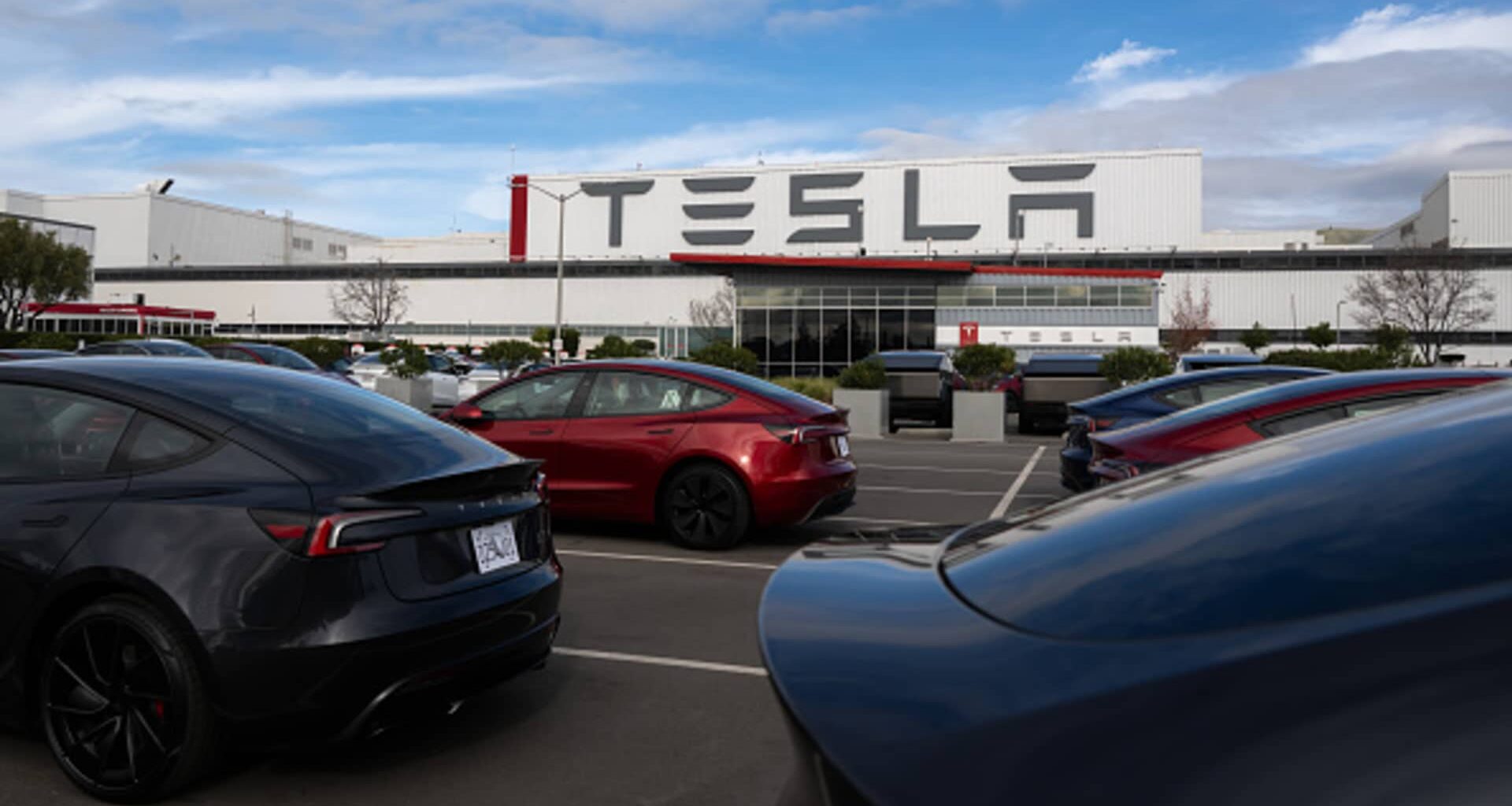
Tesla may have topped fourth-quarter expectations , but Wall Street was far more focused on what comes next — a massive investment that analysts believe will be costly, risky and slow to pay off. Tesla’s “fuzzy” fourth-quarter outperformance, as described by Wells Fargo analyst Colin Langan, did little to shift that focus. Instead, analysts honed in on Tesla’s lofty new capital expenditures plan, which they said was emblematic of the company’s attempt to erase its image as a traditional automaker. Tesla CEO Elon Musk said on the company’s earnings call Wednesday that it would put an end to production of its aging Model S and X vehicles. Instead, Tesla will convert factory lines to make the forthcoming Optimus humanoid robots. Barclays analyst Dan Levy called the transition a “symbolic baton pass for Tesla from Automotive and into Physical AI.” “Paving the path for growth will be costly — and the more critical takeaway of the call was the sharp spike in capex Tesla will see in ’26, with guidance of $20bn+, more than double the $9bn Tesla spent in 2025,” he wrote. “While Automotive remains Tesla’s core business for the time being, we believe the end of S/X marks the symbolic baton pass for Tesla from Automotive and into Physical AI, with autonomy (Robotaxi, [full self-driving]) and bots to be Tesla’s core growth focus for the years to come,” he wrote. “In case it wasn’t clear before, it’s more than abundantly clear now that Tesla is not an auto company.” Analysts said the strategy shift would require increased investment and that it was not without risks, which could include longer than expected timelines, according to Langan. UBS analyst Joseph Spak said “big goals require big cash.” However, he said the shift introduces more uncertainty for investors. “Our view remains that we believe Tesla has great tech capabilities with rapidly improving autonomous driving and humanoid robot tech. But we’d also argue that the risk profile of an investment in TSLA has now increased,” he wrote. “Big dreams require big risk, and the timing of when the payoff might be for some of these ventures becomes critically important.” He added: “We believe TSLA is in a period where they need to grow into that valuation before further value appreciation occurs.” Jefferies analyst Philippe Houchois noted the new capex budget reflects not only Tesla’s new ambitions, but the need to have the proper infrastructure to reach these goals. In the fourth quarter, Tesla earned 50 cents per share after adjustments, five cents higher than analysts surveyed by LSEG had estimated. Tesla’s revenue of $24.90 billion also beat expectations of $24.79 billion. However, revenue for 2025 fell to $94.8 billion from $97.7 billion in 2024. The 3% drop was the first time Tesla has recorded an annual decline. Tesla cited a “decrease in vehicle deliveries” and “lower regulatory credit revenue” as culprits in the slump. Bottom line, analysts appeared to adopt fairly divisive stances towards Tesla’s future. Here’s how some of Wall Street’s biggest shops reacted. Wells Fargo: underweight rating, $125 price target The bank’s price target, down from $130, implies about 71% downside from Tesla’s close Wednesday. “TSLA guided to > $20B in capex (vs. $8.5B in 2025). We see > $10B in ’26 FCF burn w/ capex likely remaining elevated post 2026. Robotaxi & Optimus timelines were pushed out. And TSLA announced an xAI collaboration raising questions about AI tech control. We remain UW as fundamentals remain weak & FCF now looks materially worse.” Jefferies: hold, $300 Jefferies’ forecast corresponds to downside of 30%. “Tesla delivered its most interesting earnings call in many quarters. Healthy beat on core auto margin and cash. Outlook vague and low in numbers, except a whopping $20bn capex for 2026 and beyond across 6 units. Multiple launch milestones likely to be missed and undermine confidence in earnings. Funding may become a topic despite a $44bn cash pile. Announced investment in xAI suggests meeting supercompensation targets may rely on Musk-related corporate deals.” UBS: sell, $352 UBS’ forecast, up from $307, implies downside of 18%. “Over the past few years, Tesla has shifted the narrative to becoming a physical AI company, and pivoting from an EV company. However, they weren’t spending like an AI company, averaging ~$10bn in capex over the past 3 years. That number is set to double to ~$20bn in 2026 (prior indication was > $11bn) which we view will put TSLA into cash burning mode (we forecast $6bn cash burn in 2026). This is also before the $2bn investment in xAI. This is a large inflection in spending to fund TSLA’s ambitious AI goals. Thus, bulls are likely to view this as confirmatory of their thesis.” Barclays: equal weight, $360 The bank’s target calls for 17% downside going forward. “Passing the baton from Auto to AI — it’s all about the next chapter of growth, but it’ll be costly to get there. Key Takes: 1. ’26 focused on execution of Physical AI – Robotaxi scaling, Optimus V3 launch, Unsupervised FSD developments; 2. $20bn+ ’26 capex guide surprising, elevated capex in near/mid-term on infrastructure investments; 3. Inhouse Terafab chip production plans reiterated.” Goldman Sachs: neutral, $405 The bank’s forecast is 6% below Tesla’s closing price Wednesday. “While a large part of Tesla’s implied valuation has long been tied to future profits associated with its AI related efforts (e.g. FSD, robotaxis, robotics), we believe success in these areas will be even more in focus going forward given the company’s planned increase in capex (to $20 bn+ for Tesla in total in 2026, in part to fund its AI training compute, and we now expect negative overall FCF this year for Tesla) and plans for its auto business (including winding down S/X production this year and converting the space over time for Optimus). We continue to believe Tesla is making progress in its AI related efforts, especially with FSD (Supervised) v14 where some users have reported driving multiple thousands of miles between critical intervention on X and FSD v14 getting several positive reviews (e.g. from Barron’s and MotorTrend).” Morgan Stanley: equal weight, $415 Morgan Stanley’s forecast was about 4% below Tesla’s current valuation. “The wind down of Model X/S is symbolic of TSLA’s journey into physical AI. At the same time, it is materially ramping spend, yielding $8bn in cash burn in 2026 (MSe). While this may become an overhang on the stock, the investment is needed to cement TSLA’s leadership in AV, robotics and energy.” Deutsche Bank: buy, $500 Deutsche’s target equates to 16% upside. “Management implicitly and explicitly guided on several metrics and factors for 2026. Big picture, the goal now is clearly to build a foundation for a new era of growth driven by physical AI.” RBC Capital Markets: outperform, $500 “For Tesla bulls, the capex step up is expected and will facilitate the company’s path towards innovation. The robotaxi launch schedule is a welcome detail for investors keen on concrete timetables. Finally, while Tesla is focused on its humanoid path, we could envision a scenario where the company could make a strategic pivot to specialized form factors to satisfy demand.”