

The government of New Brunswick is dipping its toes into the world of artificial intelligence with the implementation of a website called ChatGNB that’s available exclusively for government employees.
While there aren’t many details on exactly how it’s being used, the Department of Finance and Treasury Board, which has been piloting the program for the past year, says it’s mainly being used for translating internal documents.
And that has some translators concerned.
“There are certain ethical considerations here that we should take into account, because translators fear that they may lose jobs, or that their source of income may diminish.” said Sergey Petrov, a certified translator and the president of the Corporation of Translators, Terminologists and Interpreters of New Brunswick.
He said many of the corporation’s 110 members are individual contractors, and some may get less work if AI is used in their place.
“It can make your work a lot easier, but at the same time, of course there are some valid concerns,” he said. “Concern for accuracy of translation, and also translators’ jobs may be at risk just as well.”
 Sergey Petrov is president of the Corporation of Translators, Terminologists and Interpreters of New Brunswick, and says he worries about translators losing work as the government adapts to using AI for translation. (Victoria Walton/CBC)
Petrov said when it comes to accuracy of translating, context is key.
“Without the proper revision and without what we call localization … you can’t really achieve the accuracy we want to achieve without that,” he said. “Because a good translation is first a precise one.”
WATCH | Translator worries about ‘accuracy’ of AI translation: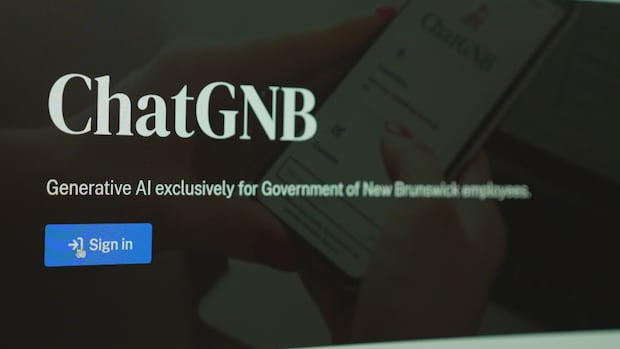
How the New Brunswick government is using generative AI for translation
he government claims the service reduces spending on translators, but at what cost?
When translating between English and French in Canada’s only officially bilingual province, Petrov said it’s important to protect minority languages.
“It’s no secret that a lot more content is translated from English to French into French and vice versa,” he said. “Over time, if we use AI a lot for that purpose, we will have a lot more translations produced by AI in French and that may deteriorate, to an extent, the integrity of the French language and the French culture in this bilingual country.”
Will AI use grow?
The provincial government said ChatGNB was created with the support of the Office of the Chief Information Officer, and that it’s being used because it’s more private and secure than other AI models out there.
“The tool developed was to address the need for meeting privacy and security requirements not previously available from commercial services, while safely exploring benefits from AI,” said a statement from a representative with the Department of Finance.
The government said it can be used for “idea generation, drafts, explanations, and summaries,” and is being used to make government work “more efficient” and “reduce costs.”
In fact, the government said there was no cost to get ChatGNB up and running.
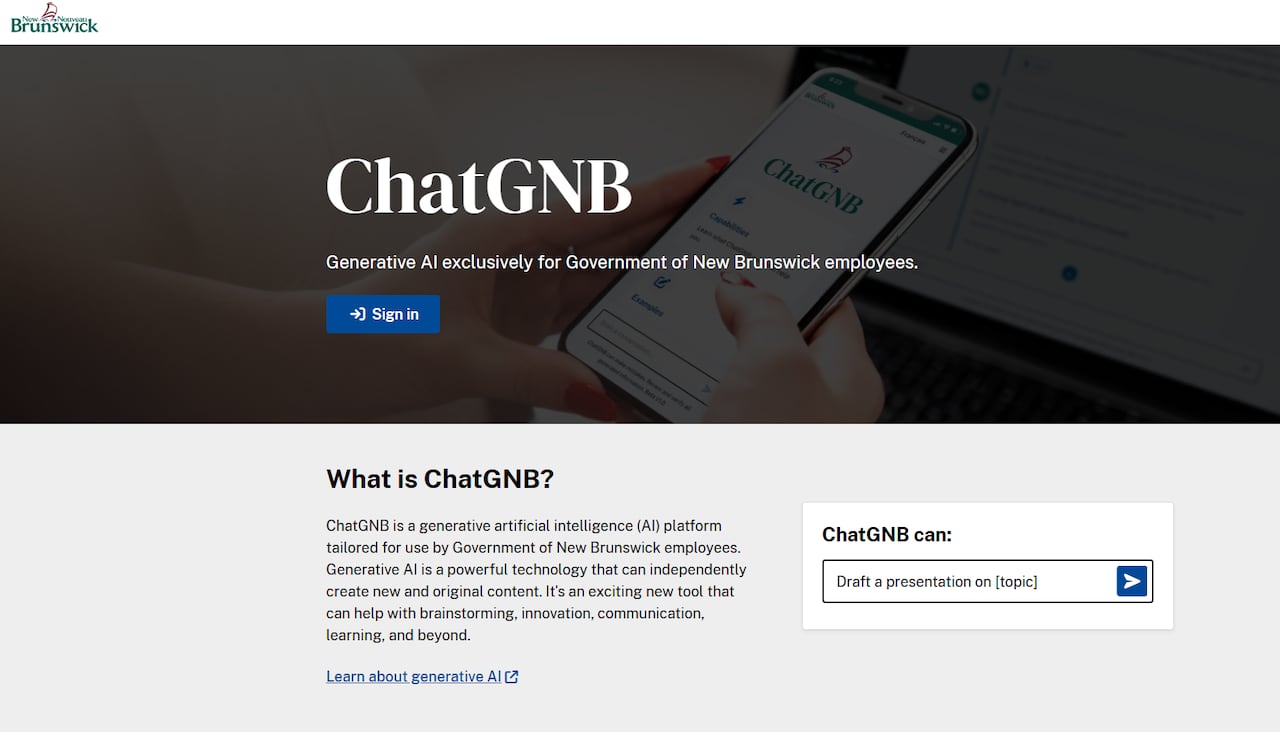 The ChatGNB website is powered by Microsoft Azure, and users must log in with a valid GNB email account to be able to access the full website. (Government of N.B.)
CBC News has determined that Microsoft Azure’s GPT-4 Turbo model is the AI program powering the website.
According to the website’s source code material, the directives given to those using ChatGNB say, in part, that the AI is “trained on a diverse dataset” of books, articles and websites available up until April 2023. But that it “does not have knowledge of events or developments that occurred after that date,” and does not have access to the internet.
The instructions highlight that the program is “not approved for sensitive or personal information“ and there is potential for both human and systemic bias, warning users to review translations for accuracy.
“Generative AI lacks empathy and understanding of human emotions and situations,” says one line of the site’s Javascript, the website’s programming language.
“Generative AI models use probability to create responses and may provide believable, but incorrect information,” it goes on to read.
A ‘red flag’
Petrov said he doesn’t personally know anyone who’s lost work because of AI. But he thinks it opens the door for AI to be used for more and more tasks.
“There should be a human being in charge who can be held responsible for what they produce,” he said.
The Department of Finance said in a statement that documents like collective agreements, contracts, policies and external-facing documents will continue to be translated by Service New Brunswick’s translation services, even as AI develops.
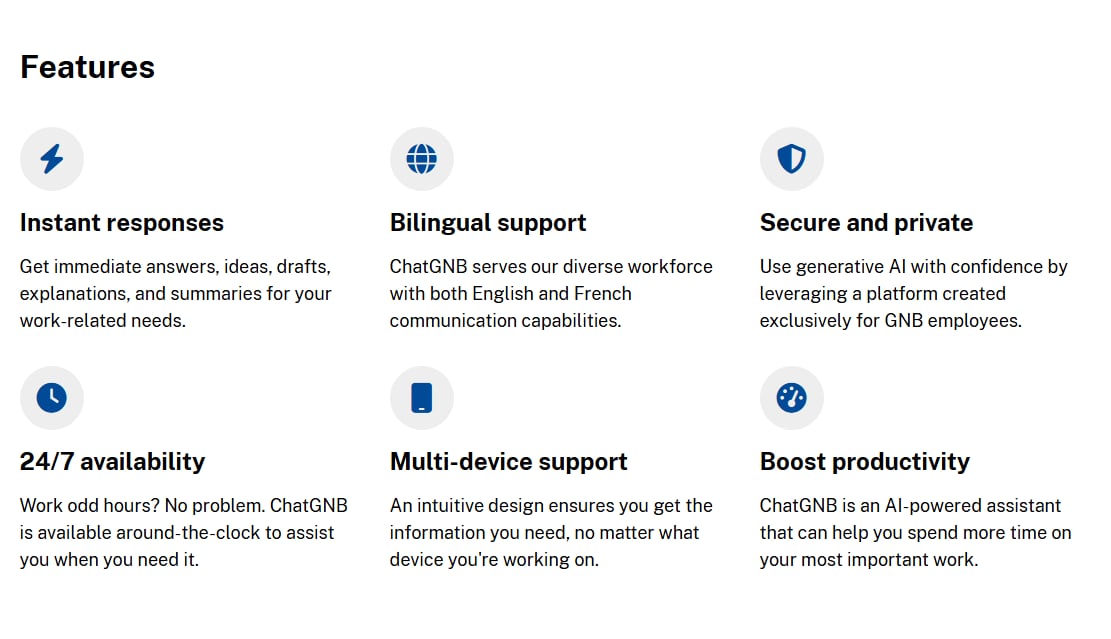 The ChatGNB website said it can provide immediate answers 24/7 in both English and French. (Government of N.B.)
Petrov said the government also told the corporation representing translators that “employees are encouraged to review translation for accuracy and formatting.”
But he doesn’t think that guideline goes far enough, and he said the corporation will be issuing a formal statement suggesting the government require AI translations to be reviewed and corrected by a real human.
“This immediately for me is a red flag,” he said.
“Because if you want to produce something that’s intended for public use, or that has a serious nature such as legal documents, legally binding documents or technical documentation or commercial documentation without a review, you are set for trouble sooner or later.”