
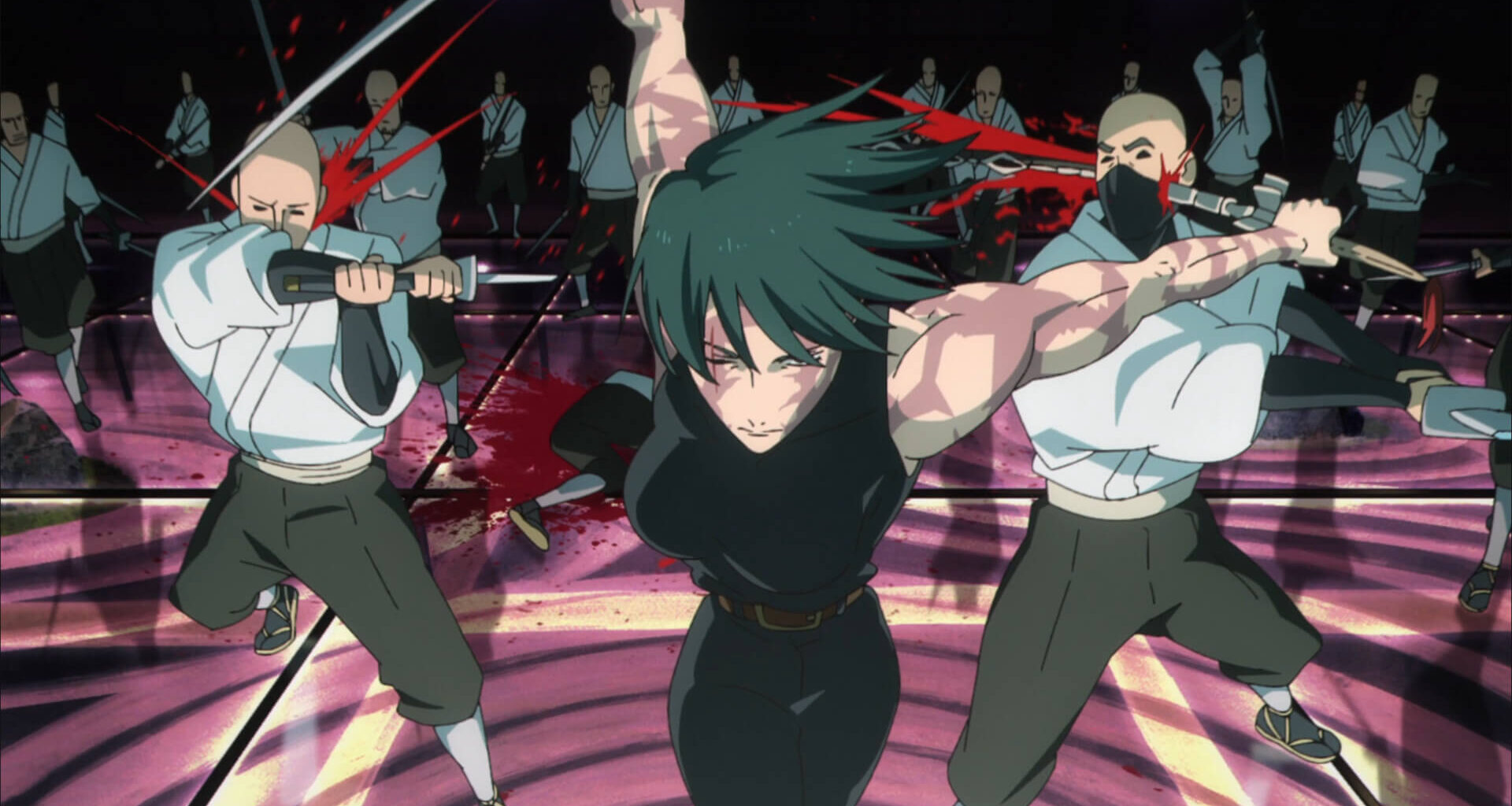
Even with its massive popularity, the battle shonen animanga Jujutsu Kaisen has been more than a little divisive. After an initial season that balanced fight scenes and slice-of-life moments, its second run eventually sidelined character development for non-stop spectacle as it laid out a 16-episode slugfest via the “Shibuya Incident.” Based on murmurs from manga readers, it felt fair to assume that the third season of the show would pick up where its predecessor left off with an overemphasis on bombast. But then something unexpected happened. The most recent episode, “Perfect Preparation,” not only delivered the single best fight sequence that the series (and maybe MAPPA as a studio) has ever produced, but also accomplished something that had been missing since the Hidden Inventory arc: It gave us a reason to care. Focusing on Maki Zenin, these 28 minutes of bloodletting paid off the series’ longstanding critiques of traditionalism and broken bureaucracies as our heroine very literally sliced through her family’s deeply entrenched misogyny.
As Maki returns to the Zenin Clan as part of a mission to help stop a world-ending menace, she’s attacked by her own father. He aims to kill both her and her twin sister, Mai, who is the only Zenin that Maki cares about, because of their plans to work with the clan’s political rivals (who are essential in stopping the big bad from killing everyone). The man cuts both sisters down and drags the pair to a sacrificial pit while admonishing their weakness.
Maki’s father fits neatly into the series’ portrayals of cruel patriarchs, specifically the all-male governing body that oversees sorcerer society, Jujutsu Headquarters. Portrayed via the aesthetics of Japanese traditionalism (i.e., sliding screen doors that hide visages), the organization is a cabal of callous, conservative old men whose main pre-occupation seems to be maintaining their power rather than doing what’s best for their peers or for humanity writ large. Case in point, whether out of ignorance or willful stupidity, they’d prefer to bitterly fight for scraps of influence, rather than unite with their adversaries to battle a greater threat—they excommunicate Satoru Gojo the second he is captured, because he was a check on their authority. In a broad sense, their presence is a critique of how traditionalism and an adherence to unquestioned centuries-old rules come at significant peril. More specifically, they could be read as a critique of Japan’s long-in-power Liberal Democratic Party, which ruled the country almost unopposed since the end of World War 2. It’s a party that, among other ills, consistently demeans women while celebrating the country’s colonial past.
As Maki and Mai wait to die from filicide, Mai cradles her sister in her arms. She reveals that twins are considered “one person” by the metaphysics of jujutsu; essentially, this means their strength and abilities are split between them, weakening both. In Mai’s view, she’s holding her sister back, keeping her from fulfilling her full strength. Maki doesn’t care, and in a move that directly spurns the “power at any cost” worldview that her family tried to drill into her, she pleads for her sister to stay. Maki wakes up from the dream in a fetal position, a symbol of rebirth, and calls out to her lifeless sibling. Mai saved her life by transferring the last of her energy. She had one request in exchange: “Destroy it all.” Maki holds up her end of the bargain. Using her newfound power, she kills every member of the Zenin Clan.
It isn’t an exaggeration to say that the next few minutes are an utter triumph of not just action animation and choreography, but most importantly, of how to grant a fight scene an underlying emotional weight. First, Maki ends her father with the nonchalance of swatting a fly. Then comes the most ostentatious bit of the episode, a one-versus-100 fight where she goes through the family’s foot soldiers in what can only be described as a massacre, her brutally efficient swipes and superhuman awareness animated with a sharpness that draws blood. A lot of blood. Kurosawa-esque arterial sprays color screen doors red until, in a bit of macabre comedy, Maki uses the gore to slip and slide her way up to an underling before one-inch-punching him into a pool of his comrade’s blood. Tarantino heads will immediately spot the many visual references to Kill Bill’s famous Crazy 88s fight scene, and while these homages risk undermining the scene’s originality, the allusions work because of the overlap between the two stories: Both are about betrayed women warriors out for revenge against male violence.
For the thematically fitting grand finale, she faces off against her cousin Naoya, the embodiment of the Zenin’s abusive family culture. If Jujutsu Headquarters is nasty, this proud, thousand-plus-year-old clan is a fermentation of these kinds of vile impulses. They treat the ability to use Cursed Techniques (magic powers used by sorcerers) as the end-all, be-all of a person’s worth. Those with little Cursed Energy, such as Maki, are viewed as subhuman, setting up a strict hierarchy where the “weak” serve the “strong.” They previously shamed and punished Toji Fushiguro, a man born with no Cursed Energy, so intensely that he trained until he was strong enough to bring down the family singlehandedly. While he decided to spare them, it was inevitable that some future inheritor of this power would not do the same.
On top of heaping verbal and physical abuse on those lower on the ladder, the Zenin Clan is also intensely misogynistic and patriarchal, believing women aren’t strong enough to be true fighters and that they exist to serve men. This is best represented by Naoya, who, even with minimal screentime, manages to fill almost every second with chauvinistic drivel, going as far to force Maki and Mai’s mom to tie his shoes while he talks about her daughters as sexualized pieces of meat. Earlier in the episode, Naoya demeaned Maki as “trash” due to recent burn scars that, in his words, “ruined” her appearance, which he claims was the only thing she had going for her. This guy is very efficient at disgusting comments per minute, and he would feel over-the-top if it weren’t for the ongoing epidemic of Andrew Tate-worshipping young men who behave exactly like this.
As he and Maki spar, Naoya gloats while running around very fast, claiming that she is a “fake” compared to Toji. The fact that this family continues to openly mock those similar to a man who literally could have killed all of them if he felt like it proves that not only are they cruel, but so cruel that they’re willing to risk creating another “monster” so that they can affirm their place in the social hierarchy.
After Maki fully internalizes Naoya’s movements, she hits this grinning sleazeball with a punch so crushing that the animators wisely choose to play it back four times in slow-motion, each punctuated by the victim’s hilariously pathetic “bwauh?!” before we get an X-ray shot of his skull being reduced to a fine powder. She leaves behind this loser, whose most iconic moment was doing a hair-flip as he inflicted zero damage. It’s a fitting capstone to one of the most satisfying beatdowns the medium has seen in a long time.
But what gives the sequence lasting impact (beyond the inherent satisfaction of watching horrible men get their deserved comeuppance) is the tragic finale. After dispatching nearly every Zenin at the family estate, Maki calls out to her mother in a hauntingly innocent tone while stepping over the bodies of her relatives. She finds her mom, who is in a panic, and asks why she tried to dissuade her from heading deeper in the estate earlier: When she called out, was she trying to save Maki from the ambush? The mother says she doesn’t know what Maki is talking about, and the daughter brings down her sword.
On the surface, Maki’s mom seems complicit in a system of abuse that demeaned her and every other woman in the clan. However, it turns out to be more complicated. Even after having his pretty boy face smashed in, Naoya is just barely still alive. That is, until Maki’s mom falls on the horrible young man with a dagger, her eyes resolute. We see a shot of her smiling with her daughters in a field of flowers. “I’m glad I gave birth to you,” she says as she dies. It turns out that her response to Maki’s question was one last performance, in this case, one working for her daughter instead of against, with her playing the bad guy so this family and its terrible legacy could be destroyed for good.
As Maki walks into the foreground to hunt down the remaining survivors (which is a visual bookend to the sequence’s opening shot), it feels like a fulfillment of everything Jujutsu Kaisen could be, combining sharply directed, lavishly animated combat with a cause worth fighting for. While this series may well peak with “Perfect Preparation,” it’s an episode that slices through the battle shonen genre’s longstanding problems with women warriors, vindicating Maki’s strength and motives even as she carries out some very bloody business. In all honesty, this show doesn’t always live up to the promise of foregrounding badass leading ladies. But maybe some future series inspired by Maki’s wrath just might.