
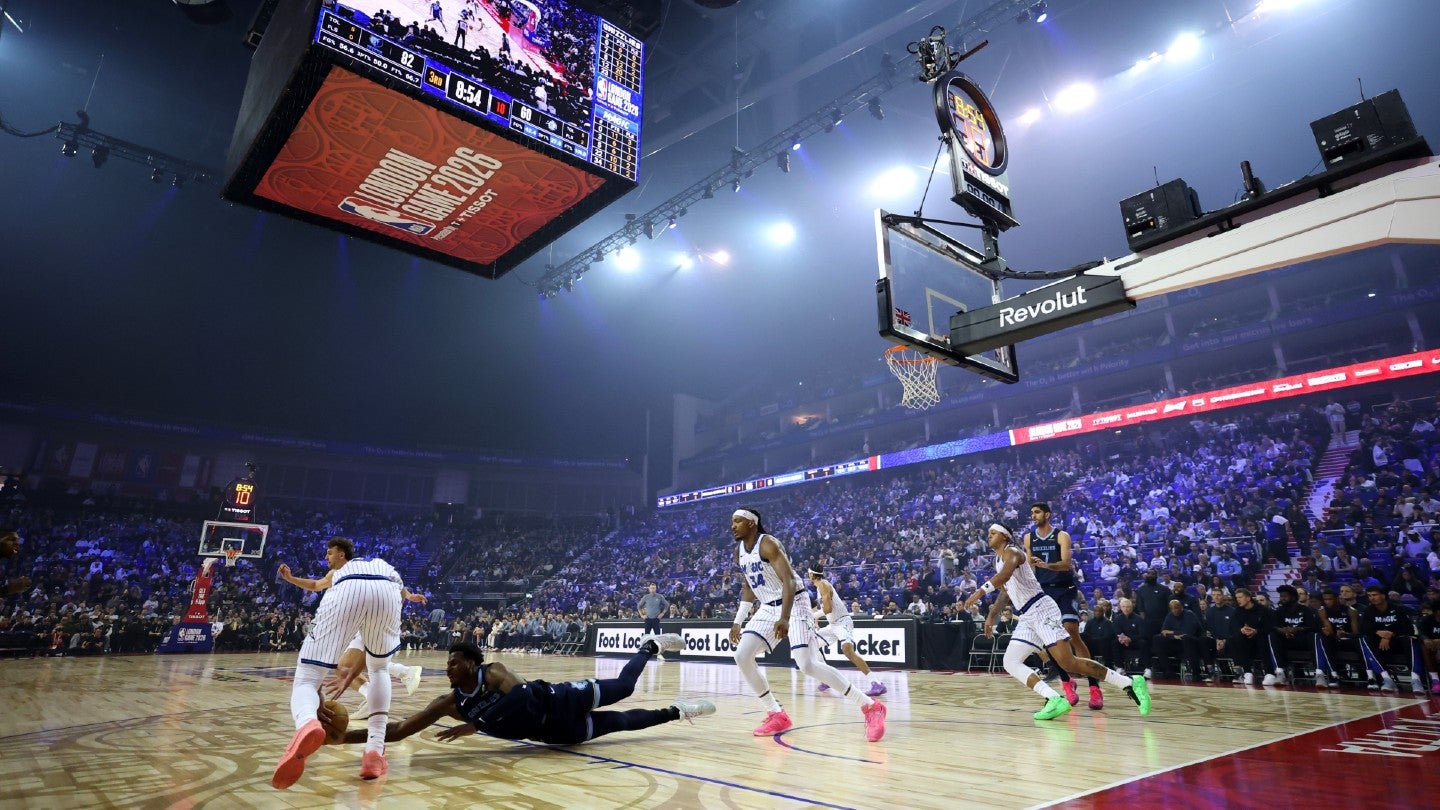
Revolut, Foot Locker, and title sponsor Tissot, were just some of the brands that sponsored the NBA London Game. (Justin Setterfield/Getty Images)
A collaborative piece by Sam Scott, head of commercial partnerships at full-service commercial, marketing, and events agency Verve.
The recent NBA London game was a sell-out. On the surface, it looked like another successful international fixture. Strong attendance. Global broadcast. Big-name talent on court.
 Discover B2B Marketing That Performs
Combine business intelligence and editorial excellence to reach engaged professionals across 36 leading media platforms.
But the real story wasn’t the game. It was everything built around it.
Between timeouts, fans played tic-tac-toe on the big screen using Revolut-branded basketball cards instead of noughts and crosses. Sponsors from Tissot to Budweiser, Nike to Emirates, activated not just through logos, but through participation. Around the venue, fans weren’t simply watching basketball; they were stepping into an ecosystem of fashion, music, creators, and culture that felt deliberately designed for them.
That distinction matters because it explains why US sports leagues, particularly the NBA, NFL, and MLB, are making such confident inroads into Europe. They’re not exporting games. They’re exporting ecosystems.
From leagues to lifestyles
Most European sports have historically grown through inheritance. You support the team your family supports. You learn the rules before you learn the culture. Loyalty is local, tribal, and passed down.
US leagues, by contrast, know that outside their home markets, none of that is guaranteed. European audiences didn’t grow up with these sports. The rules aren’t always intuitive. The rivalries don’t automatically resonate. So the leagues have adapted.
Instead of leading with competition, they’ve led with culture.
Basketball arrived in Europe through sneakers, streetwear, and hip-hop long before many fans could name a starting five. American football found its audience through spectacle, storytelling, and entertainment as much as athletic nuance. Baseball, too, has leaned into heritage, design, and lifestyle cues when entering new markets.
The result is a fundamentally different growth model. One built around identity before allegiance.
Experience before expertise
The smartest US leagues understand that fandom doesn’t start with understanding the game. It starts with how the game makes you feel.
That’s why live moments are designed less like sporting fixtures and more like cultural events. Fashion collaborations sit alongside fan zones. Music, food, and creators are treated as integral, not peripheral. The NBA London game didn’t feel like an American product dropped into Europe. It felt like a European cultural moment, with basketball at the centre.
This is where some international sports expansions fall short. Not because European leagues lack global appeal, the Premier League proves the opposite, but because certain overseas fixtures prioritise broadcast reach and star power over building a surrounding fan culture.
A match can generate headlines. It can sell tickets. But without the layers around it, it rarely creates habit, identity, or long-term connection on its own.
US leagues have learned that experience lowers the barrier to entry. You don’t need to know the rules to belong. You just need to feel part of something.
Year-round touchpoints, not fly-in moments
Crucially, this approach isn’t limited to event day. The real investment happens between fixtures.
Pop-up courts in urban neighbourhoods. Creator-led community runs. Collaborations with local artists and designers. Digital storytelling that extends the narrative year-round. These touchpoints allow leagues to show up consistently, not just when tickets are on sale.
The same strategy underpins initiatives like the NFL’s rollout of grassroots flag football across Europe, creating participation pathways that turn casual awareness into long-term fandom well before people enter the paid ecosystem. This isn’t philanthropy. It’s pipeline building. Familiarity becomes participation. Participation becomes loyalty.
From a commercial perspective, that matters enormously. It creates audiences who feel they’ve grown with the brand, not been sold to by it.
What this unlocks for brands
For brands, this shift opens up a much bigger opportunity than traditional sponsorship ever allowed.
When sport becomes culture, brands can stop behaving like badge-holders and start behaving like contributors. The most effective partnerships don’t just borrow attention; they add value to the experience itself.
One of the best examples of this is Guinness’ relationship with rugby. Guinness hasn’t just sponsored rugby; it has embedded itself in the behaviours that surround it. The pre-match pint, the post-match conversation, the shared social space once the game ends. That matters commercially. Guinness embeds itself in the rituals around the game, reducing friction between brand and fan. The payoff isn’t just visibility, but repeat behaviour, loyalty, and long-term brand strength. By participating in rugby culture rather than interrupting it, the partnership consistently outperforms more transactional sponsorship models.
This can be seen at the NBA London game; Revolut’s involvement wasn’t just visible, it was participatory. As Deborah Wajsbrot, Revolut’s Head of Growth, put it, the partnership is helping the brand transition “from a functional utility to an entertainment brand.” That’s a powerful shift, and one driven by experience.
We see the same commercial logic play out wherever brands integrate meaningfully into the ecosystem rather than sitting alongside it. This is the difference between sponsorship as exposure and sponsorship as integration.
Brands that understand this don’t ask, “How big is the logo?” They ask, “What role can we play that makes this better for the fan?”
Experience as a performance channel
US sports leagues are increasingly designing experiential as a performance channel, not a supporting act.
They’re clear on what these experiences need to deliver emotionally, socially, and commercially. They’re built to drive behaviour, not just impressions. Attend. Participate. Share. Return.
This is why the model scales. Experiences are designed as systems. Each touchpoint reinforces the last. Each season builds on the previous one. The result is momentum, rather than novelty.
By contrast, international expansion can struggle when it’s treated as a series of isolated moments. One-off games. One-off campaigns. One-off announcements. Without connective tissue, it’s hard for fans, or brands, to stay invested.
You only have to look at the recent Spanish Super Cup staged in Jeddah. The focus was on relocating a high-profile match, rather than building a surrounding fan experience that could deepen connection beyond the ninety minutes. Reach was achieved. Cultural embedment was limited.
The contrast is instructive.
When expansion stops at the game, reach is the outcome. When it’s built around culture, participation, and continuity, belonging becomes the growth engine, and that’s where scale really starts.
What comes next
With the NBA openly discussing a future European league, and the NFL continuing to deepen its presence across the continent, the direction of travel is clear. US sports aren’t testing Europe anymore. They’re committing to it.
For brands, this raises the bar. Passive sponsorship won’t cut through. The expectation is contribution, creativity, and cultural fluency.
The winners will be those who understand that sport is no longer just something people watch. It’s something they step into. And the brands that thrive will be the ones that help make that step feel worthwhile.
Because in a world where attention is optional, the experiences that win aren’t the loudest.
They’re the ones people choose to be part of.

Sign up for our daily news round-up!
Give your business an edge with our leading industry insights.