
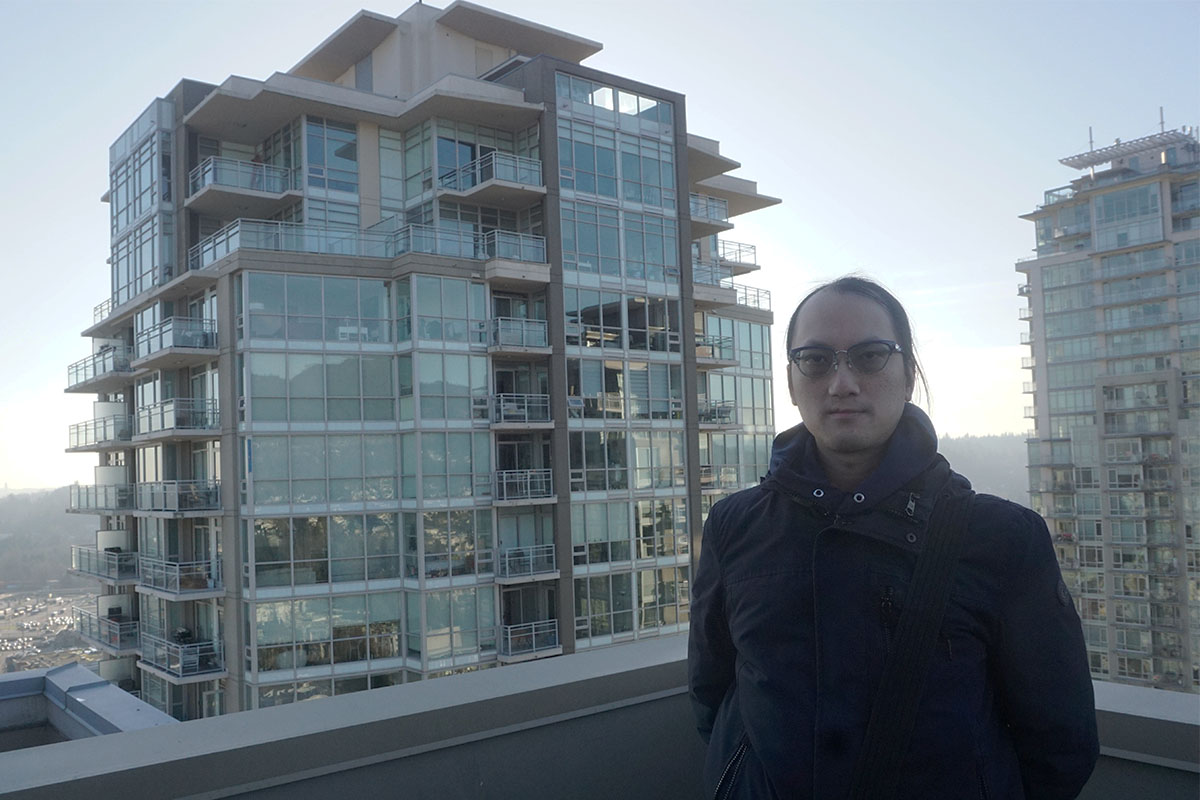
 Strata councillor Simon Ng standing on the roof of Grand Central 1. Patrick Penner photo
This is second article in a Tri-Cities Dispatch series on Grand Central’s governance crisis. Read part one here.
Many owners at Grand Central said they knew what the result of a second strata election would be before a single vote was cast.
When a BC Supreme Court judge adjourned enforcement of the first election and ordered a re-vote, owners were stunned. If the meeting was organized by the former council, there was little faith it would bear any resemblance to the fair-procedure rules set out in the law.
That did not stop frustration from boiling over as the special general meeting (SGM) stretched past hour five on Dec. 19. By the end of the meeting, the live Zoom chat was being bombarded by owners alleging the vote had been “rigged” and results were invalid.
“This is Canada, and strata governance should follow basic democratic principles,” one owner wrote. “Silencing owners and controlling outcomes is not acceptable.”
Video recordings of the election – saved by owners as evidence for future court proceedings – were shared with the Dispatch.
Prosprise Realty, despite having been fired and being under a court injunction barring it from acting on behalf of the strata, hosted the meeting. The chair, who claimed to be a neutral third party, spoke through the Prosprise screen and refused to turn his camera on. The email provided to verify proxy votes was the same account used by the former president.
No discussion was permitted. Anyone raising procedural concerns was removed from the meeting or simply muted. Furious owners began to hold up signs in protest after their microphones had been cut.
The chair refused to count all 190 proxy votes in support of the council elected three months earlier. When the chaotic affair had finally concluded, most members of the former council – removed in September after months of organizing by owners – once again claimed power.
One owner, Shelly Wade, said she was skeptical beforehand but what she saw left her in “disbelief.”
“I can’t imagine another situation where votes are simply not counted because they’re not in your favour,” Wade said. “If the meeting had been run fairly, we would have won.”
For supporters of the September-elected council, the conduct of the meeting exemplified a governance culture they say has defined Grand Central for years: tightly controlled meetings, minimal transparency, and the systematic silencing of dissenting voices.
Simon Ng said he recognized it immediately.
When Ng first began attending strata council meetings at the massive Coquitlam complex, he said it quickly became clear something was wrong.
Meetings were always held over Zoom. Councillors refused to turn their cameras on. Owners were required to hold government-issued ID up to their webcams and state their unit numbers or be kicked off the call. Anyone who asked pointed questions was muted or removed.
Debate and discussion never occurred. Councillors could often be heard speaking Mandarin with one another, and would only ever utter one-word responses in English to agree with Hai Zhou, the strata president.
“Zhou was effectively running the show,” Ng said. “The other councilors – we don’t know their faces – we don’t even know who the hell they are.”
Ng, a first-time homeowner who bought into Grand Central in 2023, was one of the councillors elected in September following the ousting of the old council. He and a large body of other owners allege Grand Central’s governance had, for years, been effectively centralized in the hands of just one individual.
They say what occurred on Dec. 19 was not an anomaly, but a continuing pattern of autocratic behaviour, enabled by a weak regulatory system that allows bad actors to become entrenched in governance.
The Dispatch repeatedly requested comment from Zhou and Prosprise for this series, but they did not respond.
Proxies, power and secrecy
At the centre of the dispute is the use – and concentration – of proxy votes.
Grand Central has many language barriers, and around 40 percent of the units are rented out by absent or foreign investor-owners. Zhou’s opponents say these structural factors are a key reason why he has been able to amass nearly 150 proxies – a dominating voting bloc in the 642-unit strata.
At the same time, Zhou held four positions simultaneously, serving as president and treasurer of both the strata and residential sections.
Supporters of the council elected in September say that combination allowed him to control agendas, rubber-stamp decisions, alter or sanitize meeting minutes, block disclosure of records, and effectively determine who could sit beside him on the councils.
They allege only pre-selected candidates – always Mandarin speakers – were ever elected to executive positions.
“There have been three empty seats for years,” said Peyman Majidi, president of the council elected in September. “And one person is basically in charge of approving and cutting all the cheques.”
Multiple owners described a management culture that discouraged scrutiny and participation.
After Zhou gained power in 2021, they said annual general meetings (AGM) immediately stopped being held at the nearby Douglas College and were moved to different cities and at inconvenient times.
Requests for contracts, invoices, and financial records, and an owners list were frequently ignored or denied, despite clear provisions in the Strata Property Act (SPA) – allegations that have surfaced repeatedly in court and tribunal hearings involving the strata.
Suminder Mann, vice-president of the council elected in September, said his “jaw dropped” when he first observed a meeting. He recalled seeing an owner removed simply for asking about the state of the contingency reserve fund.
“It was absurd,” Mann said. “As owners, we’re entitled to that information.”
For many years, the only window into the council’s activity was through Shireen Nadim, the longtime commercial president.
Despite her position on the strata council being mandated under the bylaws, she said she was largely excluded from governance.
Nadim said the council frequently made decisions without her, approved motions outside of meeting quorum via email, issued contracts without getting quotes, and forced her to pay for financial records freely available to other councillors.
“The council did not recognize me at all,” she said. “They don’t let anybody participate.”
Despite the roadblocks, Nadim methodically kept track of invoices and repeatedly flagged irregularities, including expensive contracts awarded to unqualified contractors. Her objections were always ignored, she said.
In 2023, she filed a complaint with the province after finding that building security was being handled by a pool-supply company. In 2025, she filed an identical complaint after finding a moving company were hired as the pool company’s replacement. Provincial investigations led to warnings being issued for operating without a proper licence.
More troubling, Nadim alleged, was that a sitting council member had been paid more than $35,000 to work as a security guard for both companies.
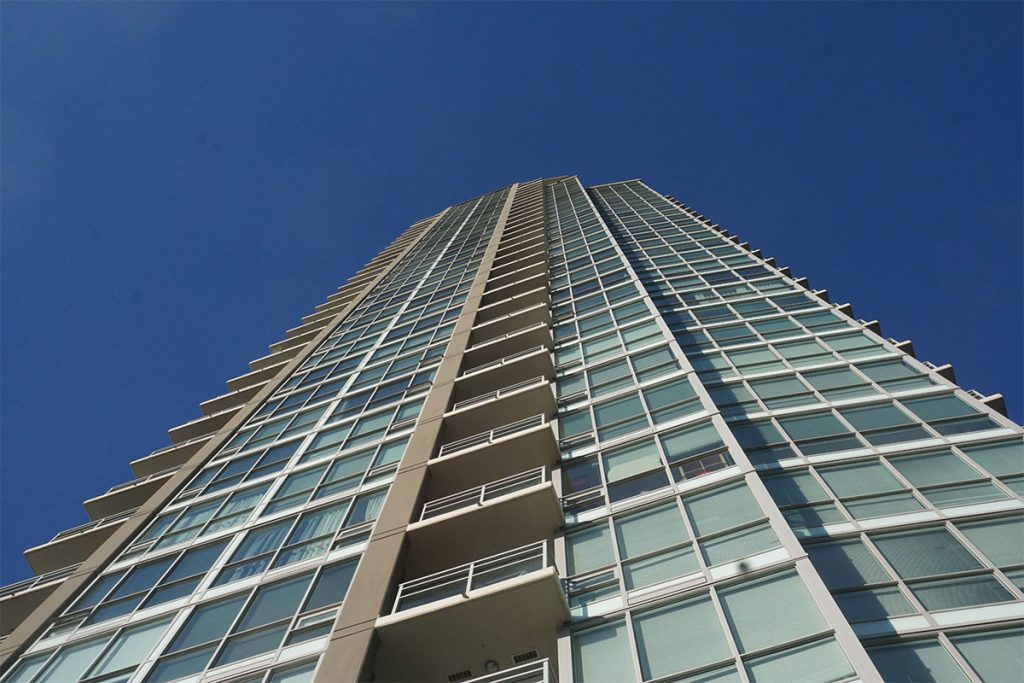 View up the 37-storey Grand Central 3, one of three towers in the 642-unit complex. Patrick Penner photo
Numerous instances have also been documented where motions raised at meetings were not reflected in the official minutes.
Ng said he first became involved in Grand Central’s politics after seeing a motion – one simply acknowledging the number of proxies Zhou held – completely excised from the minutes circulated to owners.
“Even if a motion doesn’t pass, it has to be recorded,” Ng said. “I didn’t know how deep it went.”
In another example, Majidi’s nomination to sit on council at the 2024 AGM was removed entirely from the record.
After gaining access to internal emails following the September election, Ng said he discovered Zhou had instructed the property manager to cut all mention of Majidi – falsely claiming the bylaws prohibited more than one commercial representative on council. The bylaws expressly permit multiple commercial representatives.
Ng said the records are riddled with information gaps and omissions.
“Now that I’m on council and I have access, I can see how incomplete a lot of these minutes are,” he said. “They’re not reliable.”
Retaliation and intimidation
Supporters of the council elected in September have also been tracking what they allege are acts of retaliation or intimidation against owners who speak out.
Some reported being issued fines or chargebacks they claim are baseless. Others say service requests and repairs were delayed or denied.
One resident, Ana-Marija Svarc, filed a complaint with Fraser Health after her children suffered skin irritation following a swim in her building’s hot tub. Shortly afterward, she was charged nearly $700 for allegedly refusing contractor access – a claim contradicted by the contractor’s own records.
She said the strata repeatedly ignored her request for a hearing and the charge has stayed on her file.
“I’m at the end of my rope with this strata, and we can’t leave soon enough,” Svarc said. “I don’t feel safe in our building.”
Nadim said she was repeatedly targeted after helping owners file disputes with the B.C. Civil Resolution Tribunal (CRT).
The glass door of her commercial unit was broken multiple times at midnight, and the strata refused to cover repairs, forcing her to obtain a CRT order. She was even issued a chargeback after emailing the strata’s lawyer with a complaint, instructing her to pay the legal fees.
In another recent example, the CRT found the strata acted in a “burdensome, harsh, and unfairly prejudicial” manner toward commercial owner Ferdows Soltani, allegedly delaying the opening of a restaurant for months and costing him more than $500,000. After the council learned he had filed a CRT dispute, it refused to hold a necessary vote or grant him access to common property.
Organizers of the push to oust the council in the spring of 2025 also claim they were targeted.
On May 8, Majidi filed a defamation lawsuit against four council members personally, the strata corporation, and then property manager AWM-Alliance Real Estate Property Group, alleging he was subject to a “campaign of vilification.”
That suit, which is still before BC Supreme Court, claims the strata began sending out a series of emails, text messages, meeting minutes, and printed letters to hundreds of owners, falsely claiming that Majidi had “forged” proxies at the previous AGM and engaged in fraudulent or criminal conduct.
One such notice, posted in Grand Central’s elevators in both Mandarin and English, alleged Majidi had obtained private information illegally and called for legal or police action against him.
Numerous cease-and-desist demands seeking retractions, apologies, and disclosure of records related to the allegations went ignored, and the smears continued, according to the suit.
“Controlling the process”
Legal counsel for the new council have appealed the BC Supreme Court judgement allowing Zhou’s Dec. 19 SGM to go forward. Numerous owners said they could not understand the logic behind the Nov. 26 order.
Ng, who attended the hearing in person, said it was a “disappointing” result.
He said Zhou’s use of proxies to call another election essentially allowed the former council to sidestep all their prior conduct and legal arguments, which he claims would not have held up under scrutiny.
For instance, the former council’s forgery claim – which was the entire basis for refusing to call the prior SGM – are based on minor clerical errors that have been repeatedly “debunked” by parties on both sides of the dispute, according to Ng.
“The whole point of this tactic is to avoid having the whole case be judged on its merits,” Ng said. “We want it to be tried so the court and the world can see their behaviour.
“This is exactly how Zhou has maintained control. . . . Not by winning arguments, but by controlling the process.”
The council elected in September expects their appeal of the November order to land before a judge by late February.
That date can’t come soon enough. After gaining access to the strata’s records, concerns are rapidly mounting over the physical and financial health of Grand Central.
But until the legitimacy question is resolved, owners say any plans to address these concerns are paralyzed.