
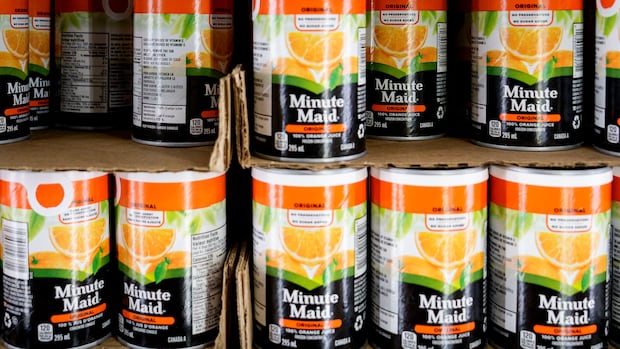
Attention, lemonade stand vendors: You’ll have to squeeze the fresh stuff this summer. Minute Maid is discontinuing its line of frozen juices as consumer demand declines and tastes change, and it may have been the only company still selling the concentrated products into the Canadian market.
The brand’s frozen canned orange juice, lemonade, Fruitopia fruit punch and Five Alive juice blend will be discontinued by April, a spokesperson for parent company Coca-Cola confirmed to CBC News.
The company is leaving the frozen can category in both Canada and the U.S. “in response to shifting consumer preferences,” the spokesperson said, as it focuses on products that “better match” what its customers want.
While it’s certainly the biggest, Coca-Cola isn’t the only juice maker shifting priorities. The combination of Coca-Cola’s withdrawal, less than a year after another major Canadian juice producer did the same, could functionally mean Canadians will be unable to purchase frozen concentrated juice, after decades of availability.
WATCH | Say good-bye to frozen, canned, concentrated juice: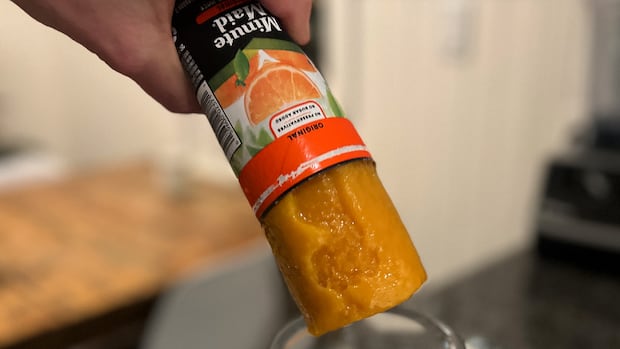
The last schhhhhlorp: Why frozen juice just died
It’s the end of an era for popular frozen juice concentrate brands as Coca-Cola announces it is discontinuing Minute Maid, Fruitopia and FiveAlive products in Canada, over changing consumer habits.
Lassonde, a Canadian company behind juice labels like Oasis, Kiju and Rougemont, told CBC News that it left the category last year after demand for frozen-from-concentrate juice waned.
In addition to its own brands, Lassonde manufactures products for grocers like Sobeys, Metro, Loblaw and Walmart. It also owns and previously produced Old South frozen-from-concentrate orange juice in Canada. Old South, along with the store brands for Canada’s largest retailers, were confirmed as unavailable for purchase at multiple retailers.
When both flagship brand names and generic competitors exit the market, “it sends a clear signal that the problem is not branding or pricing, but that the product has very low market demand,” said Zhe Zhang, an assistant professor of marketing at Western University’s Ivey Business School.
“Even the most basic version of the product is no longer going to be sustainable in the marketplace. It really indicates that the product is approaching the end of its lifecycle.”
Why consumers aren’t feeling juicy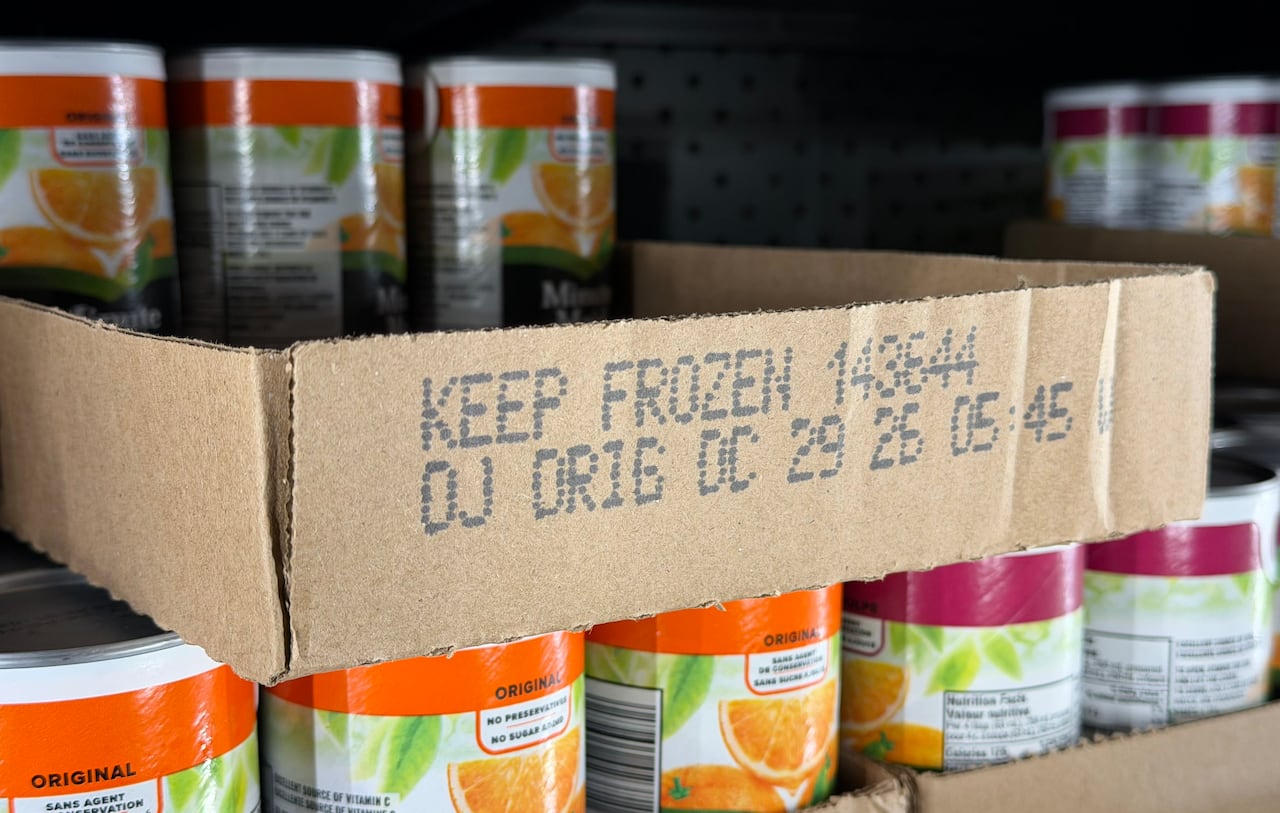 Consumers are pulling back on their juice drinking. (Anis Heydari/CBC)
Frozen juice from concentrate was invented during the Second World War, when food scientists were tasked with improving food and beverage quality for American soldiers.
But it was a Bing Crosby-Minute Maid partnership in the late 1940s that transformed the product into a household staple and a moneymaker.
Fast-forward nearly 80 years, and the consumer’s taste for juice — frozen or otherwise — just isn’t what it was, according to Emma Balment, the Toronto-based director of market strategy and understanding at Ipsos, a market research firm.
Juice brands are losing what beverage analysts refer to as “share of throat.” But the cold and canned are bearing the brunt of that loss. “Out of all of the cups of juice that Canadians are consuming, only about seven per cent is from frozen concentrate,” Balment told CBC News, noting that it’s the smallest and least profitable juice subcategory.
As other beverage makers get more innovative, frozen juice has largely stayed the same, she added. That’s just one of the trends that has weighed on the juice industry in recent years.
Canadians are drinking more tap water now than they did a decade ago; parents are more sensitive to their children’s sugar intake; and the functional beverage market — which includes drinks that promise some kind of health benefit (e.g. kombucha or prebiotic soda) — have become increasingly popular, according to Balment.
“For people who want a cool, refreshing, fruity flavour, that’s where all of the emerging new drinks are playing in. So juice is particularly targeted,” she said.
Discontinued products ‘an opportunity’
Over the last few years, several well-known food brands have disappeared from Canadian shelves — like Yves Veggie Cuisine and Delissio Pizza, both sold in Canada but owned by parent companies operating in the U.S.
“When you have less choices for consumers, that’s always an issue,” said Gary Sands, senior vice-president of the Canadian Federation of Independent Grocers.
WATCH | How this nostalgic treat became a hit for resellers:
Discontinued Cherry Blossom treats resell for big bucks online
Hershey Canada’s Cherry Blossom treat has disappeared from Canadian store shelves, but not from the internet. Since the company discontinued the century-old chocolate earlier this year, resellers have been listing them for steep prices online.
Smaller grocers “have to differentiate,” said Sands, adding that it would be difficult for an independent to develop its own generic product line to fill a void, like the one left by Minute Maid frozen juices, for example.
“When we’re looking at multinational companies discontinuing the line of products in Canada, I think the way we have to look at it now is the glass being half-full and not half-empty of orange juice here,” he said.
“When product lines like this disappear, it does offer an opportunity to small and medium-sized Canadian companies to enter a market or to [develop] a product line.”
A nostalgic drink
For some Canadians, the drink is nostalgic. The cans are an ingredient, for example, in “slush” — a cocktail of frozen juice concentrate, sugar and booze that is prepared in a bucket and popular among Newfoundlanders at Christmastime.
“Aw, we’ll have to change our slush recipe!” said Jenna Hopkins, who spoke to CBC News outside a grocery store in St. John’s. “We have to figure out something new to use. That’s so sad.”
Marilyn O’Grady reckoned she would have to change her slush recipe, too: “I guess I could use fresh juice. I’d have to, right? Maybe not quite the same.”
Elsewhere, the end of frozen juice might get overlooked. Munther Zeid, the owner of grocery store Food Fare in Winnipeg, said he’s suspected for a while the drink would be discontinued.
“It’s been a dying category for a few years now,” he said.
“I don’t think anybody’s even going to notice that it’s gone.”