
Chelsea’s Reece James and teammates celebrate alongside U.S. President Donald Trump after winning the FIFA Club World Cup in July, 2025.Hannah McKay/Reuters
Paul Cohen is an associate professor of history at the University of Toronto, where he teaches a course on the history of football.
It began as a low rumble, when Donald Trump was re-elected as U.S. President in 2024. What would it mean for the world’s most important sporting event to be hosted, at least in part, by a country with a stridently illiberal government?
This anxious clamour intensified to a dull roar as football-watchers saw ICE agents kidnap people going about their daily lives, National Guardsman deployed on city streets, and increasingly restrictive visa rules and travel bans implemented. What kinds of risks would foreigners face when travelling to the U.S. to support their team? What if U.S. border agents detained the dazzling French attacker Ousmane Dembelé, or denied the fearsome Brazilian winger Raphinha entry?
Then, as ICE and Border Patrol agents turned Minneapolis into a battleground at the same time that Mr. Trump ratcheted up his bellicose threats to seize Greenland by force, this inchoate roar came increasingly into loud, probing harmony. Perhaps the World Cup shouldn’t be organized in a country whose government espouses hate, threatens peace abroad, and unleashes state violence at home.
Whispered musings that fans should stay home have crystallized into public calls for national teams to boycott the 2026 World Cup. In the Netherlands, where support for the national team is a joyous, deeply held secular religion, a petition demanding that the Oranje stay home swiftly garnered more than 150,000 signatures. In mid-January, two members of the Bundestag proposed that the four-time-World-Cup-winning German national team withdraw from the tournament to bring Mr. Trump “to his senses,” and Oke Göttlich, a vice-president of the German football federation and president of the top-flight Bundesliga team FC St. Pauli, declared that the “time has definitely come” to weigh a boycott. Even former FIFA president Sepp Blatter has joined the growing chorus of voices encouraging fans and national teams alike to stay away from the United States.
FIFA says it has received over 500 million ticket requests for 2026 World Cup
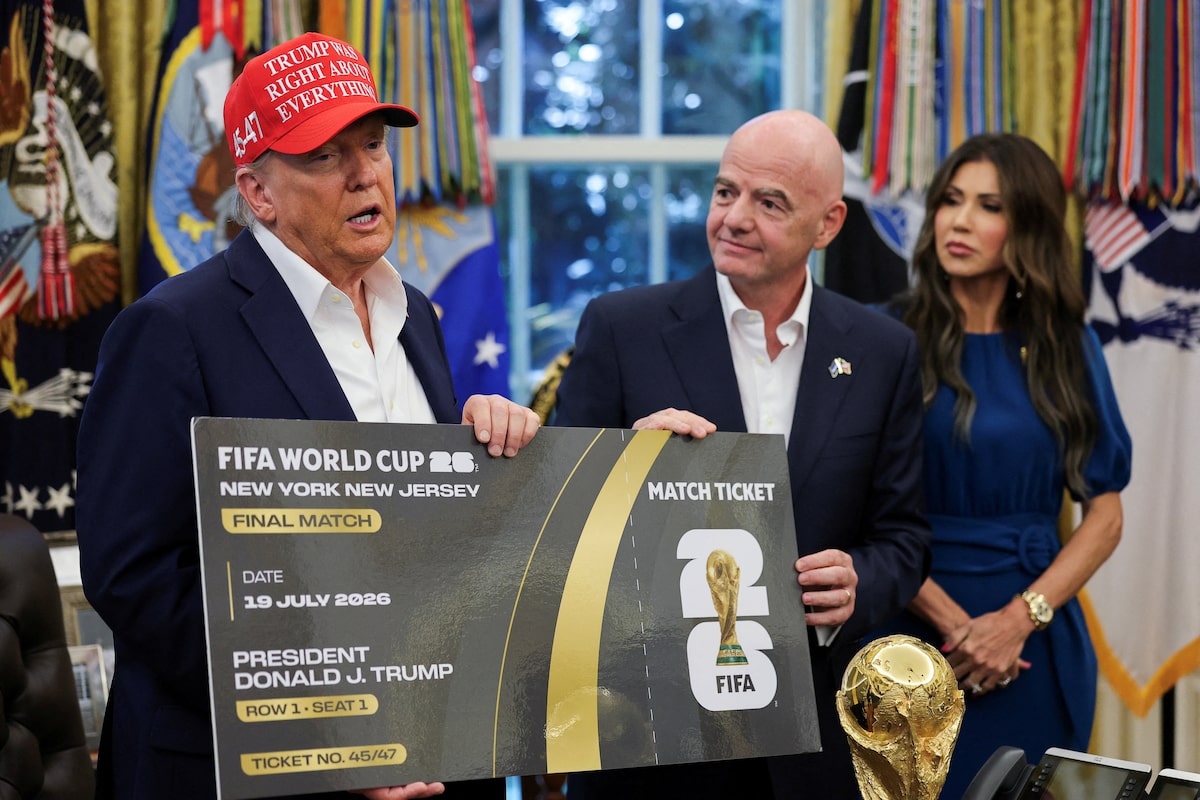
Mr. Trump has recognized that an association with FIFA is good for self-promotion and boosting his own brand.Jonathan Ernst/Reuters
That Mr. Trump has so tightly associated himself with the World Cup has only galvanized public opposition to the tournament. Recognizing from the very start its potential for advancing his own interests, the President threw his full support behind the bid to host the tournament in his first term; he has since regularly welcomed FIFA president Gianni Infantino to the White House for well-publicized exercises in self-promotion, and has even threatened to move games away from cities governed by Democrats. The narcissistic insouciance with which Mr. Trump broke with protocol by lingering on the victory podium after Chelsea won the Club World Cup to award a replica trophy (the President has said that he had already purloined the original) underscores that, as far as he is concerned, the World Cup is nothing more than a global stage on which to proselytize his peculiar cult of personality. As his disgraced consigliere Rudy Giuliani put it, Mr. Trump’s aim is to make this the “MAGA FIFA World Cup.”
World Cup draw in Washington is one more play in Trump and FIFA’s long game of politics
But Mr. Trump is by no means the first authoritarian-minded leader to make use of the World Cup to advance their own ends. Qatar organized the previous tournament as part of a broader sportswashing strategy, funnelling its nearly bottomless well of natural-gas profits into football in pursuit of soft power. Russian President Vladimir Putin used the 2018 World Cup as a shiny Potemkin village to conceal the ugly realities of his thuggish, oil-fuelled kleptocracy. Argentina’s military dictatorship seized upon the 1978 World Cup in a clumsy effort to drape a veil of legitimacy over the junta’s brutal regime. And in 1934, Benito Mussolini turned the second World Cup into a muscular showcase for fascism. Rather than resist authoritarian instrumentalization of the tournament, FIFA has instead regularly embraced its possibilities.
It was not always thus. The World Cup’s founder was Jules Rimet, a Frenchman who led FIFA from 1921 to 1954 and who, drawing inspiration from social Catholicism and Christian democracy, saw in football an emancipatory instrument for social cohesion and international peace. But Rimet could only look on uncomfortably as Mussolini hijacked the 1934 tournament, saying later that “during this World Cup, the real president of the international football federation was Mussolini.”
The Mephistophelian architect of football’s sporting pact with the devil of autocracy was João Havelange, the Brazilian who served as the organization’s president between 1974 and 1998 and piloted FIFA’s transformation from a tradition-minded federation dominated by Europe into a powerful, corporate-sponsorship-driven, graft-greased, and truly global sports organization. Mr. Havelange breezily partnered with Argentina’s colonels to put on the 1978 World Cup, and years later even testified on behalf of his old friend Carlos Alberto Lacoste, a naval officer with close ties to the leaders of the junta’s Dirty War who chaired the tournament’s organizing committee, and who found himself on trial for embezzling World Cup funds. Mr. Havelange’s hand-picked successor Sepp Blatter took up the torch of moral compromise and systemic corruption when he infamously engineered the awarding of the 2018 and 2022 tournaments to Russia and Qatar, before he was forced out in 2015 amidst a myriad of malfeasance investigations.
While Mr. Infantino succeeded Mr. Blatter on the promise to clean out FIFA’s Augean Stables, not only does the institution remain as profitably opaque as ever, but it is now even closer to autocratic regimes. After working hard to cultivate close relationships with Mr. Putin and Qatar’s rulers, he has taken sycophancy to new shame-free lows as he assiduously performs deep-tissue ego massage on Mr. Trump. He was on hand at Mar-a-Lago to celebrate Mr. Trump’s election victory in November, 2024, and an honoured guest at the inauguration (where Mr. Infantino promised that “together, we will make not only America great again, but also the entire world”); he opened a FIFA office inside Trump Tower last summer and gifted the President a gold copy of the World Cup; and most grotesquely of all, he awarded him a purpose-invented FIFA Peace Prize. Even as Mr. Trump was browbeating Europe for its commitment to defend Greenland and Danish sovereignty at Davos in January, Mr. Infantino was right there to announce that the President would have the honour of handing the trophy to the winning team in July.
Gianni Infantino presents Mr. Trump with the FIFA Peace Prize during the draw for the 2026 FIFA Football World Cup. The president of FIFA has cultivated a close relationship with the U.S. President.STEPHANIE SCARBROUGH/AFP/Getty Images
Peace prize for Trump triggers complaints about Infantino to FIFA ethics investigators
The heretofore fantastical geopolitical scenarios suddenly made thinkable by Mr. Trump’s foreign-policy folly might yet force the tournament’s disruption or even cancellation. Would Canada or Mexico, already uncomfortable in their roles as marginalized partners, wish to co-host if the White House ramped up threats to make Canada the 51st state or unilaterally deployed combat troops to Mexico to fight drug cartels? Would European federations send their national teams if Mr. Trump ordered military action against Greenland? Lest we forget, the 1942 and 1946 World Cups were among the Second World War’s collateral victims.
Barring an international crisis, however, it remains unlikely that FIFA or national federations would change their plans. Football’s organizing bodies, broadcasters, athletic apparel companies, corporate sponsors, and players all have too much financial, industrial and social capital invested to pull the plug. This is a high-stakes political and financial show – it is expected to generate an estimated US$10-billion in revenue and be watched by more people around the world than any other sporting competition – and so its stakeholders believe it must, and in all likelihood will, go on. As soon as everyone hears the whistle kicking off the opening match, many fans may simply turn a blind eye to America’s fascist turn, just as they did with Mr. Putin’s annexation of Crimea, and with the appalling conditions under which labourers built Qatar’s stadiums.
Though there has never been a politically motivated boycott by multiple qualified World Cup teams, the idea is not without precedent. Ukraine called for the world to stay away from Russia’s 2018 tournament, though they were politely ignored. A range of voices called for boycotting Argentina’s World Cup in 1978, and Amnesty International organized a campaign to draw attention to the regime’s human-rights abuses under the banner “Yes to Football, No to Torture!” And in a case of the Brezhnevian pot calling the Pinochetian kettle black, the Soviet Union refused to send its national team to Chile for a World Cup qualifying playoff to be played just weeks after the coup that overthrew Salvador Allende in 1973 in the Estadio Nacional, where the new regime had detained, tortured and put to death numerous political prisoners.
Sports boycotts can be clumsy instruments, premised on a moral clarity belied by geopolitical shadow and ambiguity. The United States discovered this itself in 1984, after its ill-considered boycott of the 1980 Moscow Olympics. As the West German footballer Paul Breitner put it shortly before the 1978 World Cup: “Those who demand a boycott would have to ask to stop the whole international sport movement because I cannot see any difference between the military regime in Argentina and human-rights violations in the Eastern Bloc or anywhere else.” But Mr. Breitner – a self-described member of the West German 68er movement and Maoist, and the only player to refuse his country’s call to play in Argentina in 1978 on political grounds – added: “This shouldn’t mean that sportsmen should be politically passive. They could refuse to be used as a kind of puppet in a political game.”
It was in this spirit that French striker Dominique Rocheteau tried unsuccessfully to convince his teammates to wear black armbands for France’s match against Argentina. And on his off days, the Dutch defender Wim Rijsbergen visited Buenos Aires’s Plaza de Mayo, where the mothers of the disappeared gathered in protest. More recently, Germany’s national team posed for an on-field photograph with their hands covering their mouths to protest FIFA’s ban on wearing the rainbow-flag “One Love” captain’s armbands for LGBTQ rights in Qatar, where same-sex relationships are outlawed.
Performers representing Qatar, left, and world football’s governing body FIFA, right, stand in front of T-shirts inscribed with the words Slave Labour, Discrimination, Trade Union Ban, and Arbitrary Justice, during a skit organized by Amnesty International in front of Berlin’s Brandenburg Gate, ahead of the Qatar World Cup.JOHN MACDOUGALL/AFP/Getty Images
Political protest isn’t unique to football. But football’s unrivalled global reach and its lofty self-identification as “the beautiful game” – that is, as the only sport that is bold enough to invest itself with aesthetic, universalist and even ethical aspirations – gives unique significance to political action in the sport. Furthermore, it is the only sport whose supporters have claimed such a powerful voice: in song, spectacle and sometimes formidable forms of mobilization. In recent years, fans around the world have organized action to decry high ticket prices, club ownership by distant financial interests, and profit-driven governance – or to join anti-government protests in Turkey, Egypt’s Arab Spring and European opposition to Israel’s war in Gaza. And it is the game that boasts perhaps the most extraordinary example of athlete-led political protest in the history of sport: the São Paulo club Corinthians modelled radical democratic opposition to Brazil’s military dictatorship in the 1980s, which helped pave the way for the country’s return to democracy.
The stakes are high, the fault lines fiercely drawn, and the repertoires for possible player and fan action deep and varied. Whatever happens in North America next summer, the considerable lengths that Mr. Trump has gone to commandeer the World Cup all but guarantee that the tournament will represent an important and volatile battleground over America’s future – and that of the world.